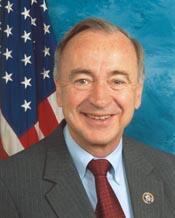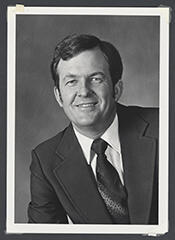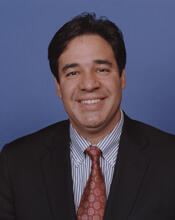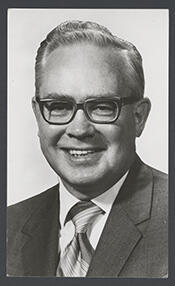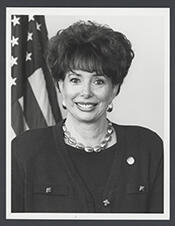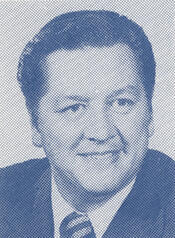
George Vernon Hansen (September 14, 1930 – August 14, 2014) was a Republican politician from the U.S. state of Idaho who served seven terms as a Representative from Idaho in the United States Congress. He represented Idaho’s 2nd congressional district for a total of 14 years, serving from January 3, 1965, to January 3, 1969, and again from January 3, 1975, to January 3, 1985. Over the course of his congressional career, he became known as one of the most conservative members of the House of Representatives and a particularly vocal critic of the Internal Revenue Service.
Hansen was born in Tetonia, Teton County, Idaho, on September 14, 1930. He grew up in rural eastern Idaho and later pursued higher education at Ricks College in Rexburg (now Brigham Young University–Idaho), from which he graduated in 1956. He subsequently undertook graduate work at Idaho State University in Pocatello. His early adult years were also marked by military service: he served in the United States Air Force from 1951 to 1954 during the post–World War II and Korean War era, and later held a commission as an officer in the United States Naval Reserve from 1964 to 1970.
After completing his initial education and active-duty military service, Hansen moved to Alameda, Idaho, a then-separate community adjacent to Pocatello. By 1958 he was established there as a life insurance salesman, a profession that helped launch his public profile in the region. His entry into elective office came at the local level. In 1961 he was elected mayor of Alameda, and he played a leading role in supporting and implementing the merger of Alameda with the neighboring city of Pocatello in 1962. Following the consolidation of the two municipalities, Hansen served as a Pocatello city commissioner from 1962 until 1965, gaining administrative and political experience that would underpin his subsequent bids for higher office.
Hansen first sought federal office in 1962, when he ran unsuccessfully in the Republican primary for the United States Senate from Idaho. Two years later, in 1964, he turned his attention to the U.S. House of Representatives and ran in Idaho’s 2nd congressional district. In a year otherwise dominated by President Lyndon B. Johnson’s 44‑state landslide victory for the Democrats, Hansen was one of the few Republican challengers in the nation to unseat a Democratic incumbent, defeating Representative Ralph Harding. He took office on January 3, 1965, beginning his first period of service in Congress. During this initial tenure, which lasted until January 3, 1969, he participated in the legislative process during a period of significant national change, representing the interests of his eastern Idaho constituents in debates over domestic policy and foreign affairs.
Ambitious for higher office, Hansen declined to seek reelection to the House in 1968 and instead ran for the U.S. Senate. He was the Republican nominee against two-term Democratic incumbent Senator Frank Church but lost by a wide margin in the general election. He made a second bid for the Senate in 1972, this time seeking the Republican nomination, but was defeated in the primary by Representative Jim McClure of Idaho’s 1st district, who went on to win the Senate seat. Meanwhile, Hansen’s former House seat in the 2nd district had been held by Republican Orval Hansen (no relation). In 1974, amid the political turmoil of the Watergate era, George Hansen mounted a comeback campaign for his old House seat. He defeated Orval Hansen in the Republican primary and then won the general election, returning to Congress on January 3, 1975. As in 1964, his victory came in a year that was otherwise disastrous for Republicans nationally.
During his second, decade-long stretch in the House from 1975 to 1985, Hansen was repeatedly reelected and became a prominent conservative voice. He was especially noted for his persistent criticism of the Internal Revenue Service and the federal tax system. In 1979, during the Iran hostage crisis, he traveled to Tehran in an attempt to negotiate with the hostage takers at the U.S. Embassy, reportedly speaking with them through the embassy fence; no hostages were released as a result of his efforts. His opposition to what he viewed as government overreach and abuse of power by tax authorities was further expressed in his writings. In 1980 he published a book titled “To Harass Our People: The IRS and Government Abuse of Power,” and in 1981 he authored “How the IRS Seizes Your Dollars and How to Fight Back,” continuing his campaign against perceived IRS excesses. Throughout this period he remained a high-profile figure in conservative circles and a staunch advocate for limited government.
Hansen’s congressional career, however, was increasingly overshadowed by legal and ethical controversies. In 1974 he became the first member of Congress to be convicted under a 1971 campaign finance law requiring full disclosure of all financial contributions to a campaign. A federal judge found him guilty of failing to disclose all of his loans and profits, and he was sentenced to pay a fine. In October 1976, the Lewiston Morning Tribune revealed that Hansen had failed to file his federal income tax returns for several years. A prior instance had occurred in the spring of 1969, when, during consideration for a U.S. Department of Agriculture appointment, an FBI background check discovered that he had not filed returns for 1966, 1967, and 1968. The director of the IRS office in Boise was instructed by higher officials in the Treasury Department to open the office on a Saturday, May 3, 1969, so that Hansen could travel from Washington, D.C., to Boise to file the delinquent returns and pay what he owed. He was also late in filing for the tax years 1970, 1971, 1973, and 1975. Despite these revelations, Hansen won reelection in November 1976, though by the narrowest margin of his congressional career up to that point.
Further legal difficulties followed. In 1983 Hansen was indicted by a federal grand jury on four counts of filing false financial disclosure statements, accused of concealing more than $245,000 in loans and $87,000 in profits from silver speculation, much of it in his wife’s name. In 1984 he was convicted of violating the 1978 Ethics in Government Act for failing to disclose $334,000 in personal loans to his campaign. He was sentenced to six months in prison and fined $40,000. Hansen appealed his conviction through the federal courts, and the case ultimately reached the United States Supreme Court; his conviction was vacated and the fine was returned to him. Politically, 1984 marked the end of his congressional service. Despite President Ronald Reagan’s 49‑state landslide that year, Hansen lost his bid for another term in the House. His Democratic opponent from 1982, Richard Stallings, defeated him by fewer than 200 votes in the general election. Hansen attempted unsuccessfully to challenge the election result, and he left Congress on January 3, 1985, concluding seven terms in office.
In the years after his congressional career, Hansen again faced serious legal and financial problems. In 1992 he was convicted on charges of defrauding two Idaho banks and approximately 100 individuals in a $30 million investment scheme. For this offense he was sentenced to four years in federal prison. His later life was marked by declining health and continued controversy, and he remained a figure often cited in discussions of federal political scandals and criminal convictions of American public officials. George Vernon Hansen died on August 14, 2014, at a hospital in Pocatello, Idaho, at the age of 83.
Congressional Record