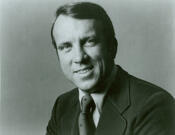
George William Grider (October 1, 1912 – March 20, 1991) was a United States Navy captain, attorney, and Democratic member of the United States House of Representatives from Tennessee, serving one term from 1965 to 1967. Over the course of his career he distinguished himself as a decorated World War II submarine officer, a legal practitioner, and a public official at both local and national levels.
Grider was born in Memphis, Tennessee, the son of John McGavock Grider, an aviator who was killed in action during World War I, and the brother of John McGavock Grider Jr. He attended the public schools of Memphis before receiving an appointment to the United States Naval Academy at Annapolis, Maryland. He graduated from the Naval Academy in 1936 and was commissioned as an ensign in the United States Navy. While at Annapolis he entered into a secret marriage in contravention of Naval Academy regulations, and the marriage was formally and officially recognized in 1938.
Following his commission, Grider was first assigned to the battleship USS Mississippi (BB-41), where he served as catapult officer, and subsequently to the destroyer USS Rathburne (DD-113). He later attended the Navy’s Submarine Warfare School, successfully completing the course and entering the submarine service. He was assigned to the USS Skipjack (SS-184), one of the more accomplished submarines of the World War II era. At the time of the Japanese attack on Pearl Harbor on December 7, 1941, Grider was serving as an instructor at the Fleet Sonar School in San Diego, California. In the tense period following the attack, when naval and civilian officials feared a possible Japanese invasion of the West Coast, he was assigned to a submarine deployed in the defense of San Diego.
As the war progressed, Grider held a series of increasingly responsible submarine billets. He served as engineering officer aboard the USS Wahoo (SS-238), operating under two of the U.S. Navy’s most noted submarine officers, Dudley W. Morton and Richard O’Kane. He then served as executive officer on the USS Pollack (SS-180) and the USS Hawkbill (SS-366). Subsequently he was given command of the USS Flasher (SS-249), one of the most successful American submarines of the war in terms of enemy shipping sunk, and later commanded the USS Cubera (SS-347). For his wartime service and leadership in submarine operations he was awarded the Navy Cross. After the war, Grider recounted his World War II experiences in the submarine service in the book War Fish, written with journalist Lydel Sims and published in 1958 by Little, Brown and Company.
Grider’s active naval career was cut short when he suffered a heart attack, forcing his retirement from active duty at the rank of captain in 1947. He then turned to the study of law, enrolling in the law school of the University of Virginia in Charlottesville, Virginia. He received his law degree in 1950 and, after admission to the Tennessee bar, returned to Memphis to begin the practice of law. His legal career in Memphis formed the foundation for his subsequent involvement in local government and politics.
In civic life, Grider first held appointed and then elected local offices. He served on the Memphis Planning Commission in 1956 and 1957, participating in the city’s efforts at postwar growth and urban planning. From 1959 to 1964 he was a member of the Shelby County Quarterly Court, a body that functioned as a legislative rather than a judicial institution and served as the predecessor to the modern Shelby County Commission. It was from this position that he launched a campaign for national office, seeking the Democratic nomination for the Memphis-based 9th Congressional District.
In the August 1964 Democratic primary, Grider successfully challenged and defeated 13-term incumbent Clifford Davis, a long-serving figure associated with the era of E. H. “Boss” Crump’s domination of Memphis politics. In the general election of November 1964 he faced a difficult political environment, as Republican influence in the Memphis area was rising, fueled in large part by a significant crossover of white voters from the Democratic Party to the Republican Party. Grider won the election by only about five percentage points, a margin that observers attributed in part to President Lyndon B. Johnson’s overwhelming national landslide that year. In that election he was one of two naval veterans elected to the House of Representatives from western Tennessee, the other being William Anderson. As a member of the House of Representatives from 1965 to 1967, Grider participated in the legislative process during a significant period in American history and represented the interests of his constituents in the 9th District. During his term he voted in favor of the Voting Rights Act of 1965, aligning himself with the major civil rights legislation of the era.
Grider’s congressional service lasted only one term. In the 1966 general election he was defeated for reelection by Republican Dan Kuykendall, a former co-chairman of the Shelby County Republican Party. The 1966 elections were notably favorable to Republicans in Tennessee and nationally; in Tennessee, Howard Baker was elected to the first of his three terms in the United States Senate, and Republican gains reduced the large Democratic majorities in Congress and in governorships across the country. Kuykendall entered the race with several advantages, having run strongly as the Republican nominee against Senator Albert Gore Sr. in 1964, and benefiting from the absence of a Republican gubernatorial nominee in 1966, which allowed Tennessee Republicans to concentrate their resources on key congressional contests. Kuykendall also capitalized on the continuing shift of many white Memphis-area Democrats to the Republican Party. Grider’s defeat marked a turning point in Memphis politics; he was the last white Democrat to represent a significant portion of Memphis in Congress until State Senator Steve Cohen was elected to the Ninth District seat in 2006.
After leaving Congress, Grider moved to Niagara Falls, New York, where he entered corporate practice. He served for eight years as vice president and general counsel of the Carborundum Company, an abrasives manufacturer with significant industrial operations. In 1975 he returned to Memphis and resumed the practice of law in his hometown. He continued to reside in Memphis until his death on March 20, 1991. George William Grider was interred at Memphis National Cemetery, reflecting both his lifelong connection to the city of his birth and his long record of military service to the United States.
Congressional Record