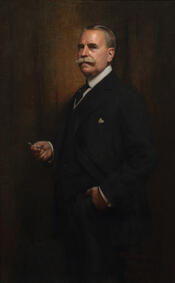
George Scott Graham (September 13, 1850 – July 4, 1931) was a Republican member of the U.S. House of Representatives from Pennsylvania who served ten consecutive terms in Congress from 1913 until his death in 1931. Over the course of a long public career, he was a prominent Philadelphia lawyer, a long‑serving district attorney, a law professor, and an influential Republican Party figure at both the local and national levels.
Graham was born in Philadelphia, Pennsylvania, on September 13, 1850. He was educated in the city and pursued legal studies at the University of Pennsylvania, graduating from the law department in 1870. Admitted to the bar shortly thereafter, he commenced the practice of law in Philadelphia, establishing himself in criminal practice at a relatively young age. His early professional work in the city’s courts laid the foundation for his later prominence as both a prosecutor and a legal educator.
Graham’s entry into public life came through municipal government. He served as a member of the select council of Philadelphia from 1877 to 1880, participating in the legislative affairs of the city during a period of rapid urban growth and political realignment. In 1877 he was an unsuccessful candidate for district attorney of Philadelphia, but he remained active in Republican politics and legal practice. His persistence was rewarded when he was elected district attorney in 1880, an office he would hold for nearly two decades, serving from 1880 until 1899.
As Philadelphia’s district attorney, Graham became widely known for his prosecution of several notable and often sensational criminal cases. In 1887 he prosecuted Hannah Mary Tabbs and George H. Wilson for the murder and dismemberment of Wakefield Gains, a case that drew attention for its reliance on forensic and “scientific” testimony. In his opening statement, Graham told the court, “We will show by scientific testimony that Wakefield Gains was dismembered while there was yet life in the body.” Wilson was initially convicted of first‑degree murder but was granted a new trial; he later pleaded guilty to second‑degree murder and was sentenced to twelve years in Eastern State Penitentiary. Tabbs, for her role in the crime, received a two‑year prison sentence. In 1895 Graham prosecuted Alphonso Cutaiar, stepson of notorious criminal Jimmy Logue, for the murder of Logue’s wife, Johanna, whose body was discovered beneath the kitchen floor of their former home. Although investigators first suspected Jimmy Logue, Graham’s office, working with Philadelphia Police Detective Frank Geyer, followed the evidence to Cutaiar, who ultimately confessed and was convicted of first‑degree murder.
Graham’s most famous case as district attorney involved Herman Webster Mudgett, better known as H. H. Holmes, often described as one of America’s first serial killers. Although Holmes confessed to numerous murders, Graham elected to try him in Philadelphia only for the killing of his business associate Benjamin Pitezel. Working closely with Detective Frank Geyer, Graham directed the search for Pitezel’s three missing children, whom Holmes had taken into his custody after Pitezel’s death. Geyer’s investigation led to the discovery of the children’s remains in Irvington, Indiana, and in Canada. Graham made clear that the Philadelphia prosecution would focus solely on the murder of Benjamin Pitezel, with the possibility of extradition to Indianapolis or Toronto for the children’s murders if necessary. Holmes was found guilty of the Pitezel murder and was hanged on May 7, 1896. These and other prosecutions cemented Graham’s reputation as a formidable and methodical prosecutor.
Alongside his work as district attorney, Graham contributed to legal education and remained active in party affairs. From 1887 to 1898 he served as a professor of criminal law and procedure at the University of Pennsylvania, where he drew on his extensive courtroom experience to train future lawyers in the practical and doctrinal aspects of criminal justice. He was a delegate to the Republican National Convention in 1892, reflecting his growing stature within the party. After leaving the district attorney’s office in 1899, he resumed the private practice of law, maintaining offices in both Philadelphia and New York City, and continued to be a recognized figure in legal and political circles. He later returned to the national party stage as a delegate to the Republican National Convention in 1924.
Graham entered national office with his election to the U.S. House of Representatives as a Republican in 1912. He took his seat in the Sixty‑third Congress on March 4, 1913, representing a Pennsylvania district during a period that spanned the Progressive Era, World War I, the 1920s, and the onset of the Great Depression. He was reelected nine times, serving ten terms in all, and remained in office continuously until his death in 1931. As a member of the House of Representatives, Graham participated in the legislative process and represented the interests of his Pennsylvania constituents, contributing to debates and legislation during a transformative era in American political and economic life. His long tenure reflected both his personal popularity and the strength of the Republican Party in his district during these decades.
George Scott Graham died in office on July 4, 1931, at his summer home in Islip, New York, while still serving in the U.S. Congress. His death brought to a close more than half a century of public service that had encompassed municipal government, a long and notable tenure as Philadelphia’s district attorney, a role in legal education, and nearly two decades in the national legislature. He was one of the members of the United States Congress who died in office in the first half of the twentieth century, and he left a record closely associated with the development of modern criminal prosecution and with the legislative history of the early twentieth‑century United States.
Congressional Record