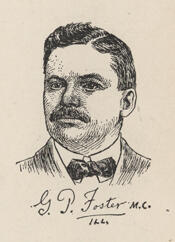
George Peter Foster (April 3, 1858 – November 11, 1928) was a Democratic U.S. Representative from Illinois who served three consecutive terms in the United States House of Representatives from 1899 to 1905. His congressional career spanned a period of significant national change at the turn of the twentieth century, during which he represented the interests of his Illinois constituents and participated in the federal legislative process.
Foster was born in Dover, Morris County, New Jersey, on April 3, 1858. In 1867, when he was still a child, he moved with his family to Chicago, Illinois, a rapidly growing industrial and commercial center in the post–Civil War era. He attended the public schools of Chicago, reflecting the city’s expanding system of urban education during the late nineteenth century. He later pursued higher education at the University of Chicago, continuing his preparation for a professional career in the law.
Foster completed his formal legal training at Union College of Law in Chicago, from which he was graduated in 1882. In the same year he was admitted to the bar and commenced the practice of law in Chicago. Entering practice in a city marked by swift population growth, industrialization, and complex municipal challenges, he built his professional reputation within Chicago’s legal community. His early legal work laid the foundation for his subsequent roles in local judicial and municipal offices.
Foster’s public career began in local judicial service. He served as justice of the peace for the town of South Chicago from 1891 to 1899, a position that placed him at the center of community-level disputes and minor civil and criminal matters in a heavily industrial district. Concurrently, from 1893 to 1899, he was acting police magistrate of the principal police court of the city of Chicago. In that capacity, he presided over cases arising from the city’s growing urban population, gaining practical experience in the administration of justice and municipal law enforcement issues. These roles enhanced his visibility in local affairs and prepared him for higher office.
Foster was elected as a Democrat to the Fifty-sixth, Fifty-seventh, and Fifty-eighth Congresses, serving in the U.S. House of Representatives from March 4, 1899, to March 3, 1905. As a member of the House of Representatives from Illinois, he took part in the legislative deliberations of a period marked by American expansion following the Spanish–American War, debates over economic policy, and the early stirrings of the Progressive Era. During his three terms in Congress, he contributed to the legislative process and represented the interests of his Illinois constituents, aligning with the Democratic Party in national policy debates. In 1904 he was an unsuccessful candidate for reelection to the Fifty-ninth Congress, bringing his formal congressional service to a close in March 1905.
After leaving Congress, Foster resumed the practice of law in Chicago, returning to the profession in which he had established himself before his election to national office. He continued his involvement in municipal legal affairs and, from 1912 to 1922, served as assistant corporation counsel of Chicago. In this capacity, he worked within the city’s law department during a decade of significant urban growth and reform, dealing with legal matters affecting municipal governance, public works, and city administration. His service as assistant corporation counsel extended his long association with Chicago’s public institutions and legal framework.
In 1928 Foster retired from active pursuits and moved to Wheaton, Illinois. Later that year, on November 11, 1928, he died in Wheaton. He was interred in Calvary Cemetery in Chicago, Illinois, returning in burial to the city where he had spent the greater part of his professional and public life.
Congressional Record