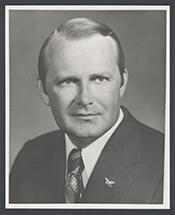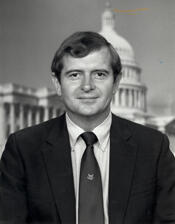
George Washington “Buddy” Darden III (born November 22, 1943) is an American politician and lawyer from Georgia who served as a Representative from Georgia in the United States Congress from 1983 to 1995. A lifelong Democrat, he served in the Georgia House of Representatives and then for more than five terms in the U.S. House of Representatives, where he contributed to the legislative process during six terms in office and represented the interests of his constituents during a significant period in American history.
Darden was born in Hancock County, Georgia, and grew up in Sparta, Georgia, where he attended the public schools. He graduated from Sparta High School in 1961. He went on to the University of Georgia in Athens, earning his Bachelor of Arts (A.B.) degree in 1965. He then attended the University of Georgia School of Law, receiving a Bachelor of Laws (LL.B.) in 1967, a degree that was later converted to a Juris Doctor (J.D.) in 1969. During his time at the University of Georgia, he was active in campus life and served as student body president, an early indication of his interest in public service and leadership.
Upon graduation from law school, Darden began his legal career in Cobb County, Georgia. He served as an assistant district attorney there from 1968 to 1972, gaining experience in criminal prosecution and local law enforcement. In 1972 he successfully ran for Cobb County district attorney and served in that office from 1973 to 1977. In these prosecutorial roles he established himself as a prominent legal figure in the county and built the local reputation that would later support his entry into elective office at the state and federal levels.
In 1980 Darden was elected as a Democrat to the Georgia House of Representatives, representing District 19-Post 3 in Cobb County. He took office in January 1981 and served in the state legislature until 1983. During his tenure in the Georgia General Assembly, he participated in the legislative process as a member of the Democratic Party and developed expertise in state policy issues. He resigned from the Georgia House in 1983 to campaign for an open congressional seat following the sudden death of U.S. Representative Larry McDonald, who was killed in the September 1, 1983, downing of Korean Air Lines Flight 007.
Darden won the special election to fill McDonald’s seat for the remainder of the Ninety-eighth Congress and entered the U.S. House of Representatives in 1983. He was subsequently reelected to five more terms, serving continuously until January 3, 1995. As a member of the House of Representatives, Darden participated in the democratic process during a period marked by the late Cold War, the end of the Soviet Union, and shifting domestic priorities. He served on the Committee on Armed Services and the Committee on Interior and Insular Affairs, and in 1991 he was elected to the House Committee on Standards of Official Conduct (Ethics). Over the course of his congressional career he sponsored 61 bills, including H.R. 2044, legislation authorizing and directing the National Park Service to assist the State of Georgia in relocating a highway affecting the Chickamauga and Chattanooga National Military Park in Georgia. He also shepherded numerous measures through Congress, including legislation benefiting Lockheed Aeronautical Corporation, reflecting his influence on defense and aerospace issues as part of the Armed Services Committee. Darden emphasized that effective legislators did not need to introduce many bills bearing their own names to make a difference.
Ideologically, Darden was a moderate-to-conservative Democrat, particularly on social issues and national security. He opposed federal funding for Medicaid abortions except in cases of rape, incest, or threat to the life of the mother, and he supported the death penalty. In foreign and defense policy, he advocated maintaining a strong national defense even as East–West relations improved at the end of the Cold War, arguing that any savings from a “peace dividend” should be directed toward deficit reduction rather than new domestic spending. His voting record reflected a centrist profile: in 1992, the Americans for Democratic Action gave his 1991 voting record a score of 40 out of 100, while the American Conservative Union rated him at 35 out of 100. Darden was defeated for reelection in 1994 by Republican Bob Barr amid the national Republican gains of that year. He later sought the Democratic nomination for his old seat, by then renumbered as Georgia’s 11th District, in 2002, but lost the primary to Roger Kahn, who was subsequently defeated in the general election. Darden was the last white Democrat to represent the Atlanta suburbs in Congress until Carolyn Bourdeaux was elected from a nearby district in 2020.
After leaving Congress in 1995, Darden remained active in law, politics, and public service. That year he was named a partner in the Atlanta law firm then known as Long, Aldridge & Norman, which later became McKenna, Long & Aldridge and ultimately Dentons. He practiced there for more than two decades before leaving Dentons in 2018 to join the Atlanta law firm Pope McGlamry as senior counsel. In state government, he served as chairman of the Judicial Nominating Commission under Georgia Governor Roy Barnes from 1999 to 2003, playing a key role in recommending candidates for judicial appointments. Nationally, he was a delegate to the Democratic National Conventions in 1996, 2000, and 2004. In 2000 President Bill Clinton announced Darden’s recess appointment to the Board of Directors of the Overseas Private Investment Corporation (OPIC), where he contributed to U.S. efforts to support private investment in emerging markets. He later became a member of the ReFormers Caucus of Issue One, a bipartisan group of former elected officials focused on political and campaign finance reform.
Darden has also been active in higher education and civic affairs. In 1992 he joined the Board of Trustees of LaGrange College in LaGrange, Georgia. He was named chairman of the Board of Trustees in 2002 and served in that role for five years, retiring as chair in 2007. In recognition of his service to the college, LaGrange College conferred upon him an honorary Doctor of Laws degree on May 19, 2007, at a commencement ceremony at which he delivered the graduation address. His ongoing engagement in educational and civic institutions complemented his long career in public office and the law.
On the personal side, Darden married Lillian Budd (born May 15, 1945) on February 18, 1968. The couple had two children: Lillian Christine Darden and George Washington Darden IV. Darden has long been associated with Cobb County and the Atlanta metropolitan area and currently resides in Marietta, Georgia. Throughout his career as a legislator and attorney, he has remained identified with the Democratic Party and with the political and civic life of Georgia.
Congressional Record