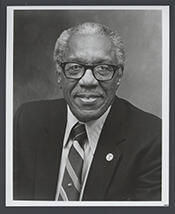
George William Crockett Jr. (August 10, 1909 – September 7, 1997) was an African-American attorney, jurist, civil rights advocate, and Democratic member of the United States House of Representatives from Michigan. Serving six terms in Congress from November 4, 1980, to January 3, 1991, he represented Michigan’s 13th congressional district and became known nationally for his work on civil rights, labor law, and international human rights. He also served as a national vice-president of the National Lawyers Guild and co-founded what is widely regarded as the first racially integrated law firm in the United States.
Crockett was born in Jacksonville, Florida, to George William Crockett and Minnie Amelia Jenkins, and had two siblings, Alzeda Crockett and John Frazier Crockett. His father, a Baptist minister, pastored Harmony Baptist Church in Jacksonville for more than thirty years and also worked as a railroad carpenter for the Atlantic Coast Line Railroad, mastering the carpentry trade. George Jr. learned carpentry from his father and continued to build room additions and practice carpentry for pleasure throughout his life. His mother, a gentle woman, Sunday School teacher, and poet, articulated a philosophy that her children should “climb a step higher and make a contribution to the family and to society,” a principle that deeply influenced Crockett’s life and career. He was educated in Jacksonville’s segregated public schools and graduated from Stanton High School.
In 1931, Crockett received a Bachelor of Arts degree from Morehouse College in Atlanta, Georgia, a historically Black institution that had become a leading center of African-American higher education. While at Morehouse, he pledged Kappa Alpha Psi fraternity and was later inducted into Phi Beta Kappa. Morehouse College awarded him an honorary LL.D. in 1972, and he served for many years as a trustee of the college. Crockett went on to earn a Bachelor of Laws degree from the University of Michigan Law School in 1934, at a time when very few African Americans attended major northern law schools. After graduation he returned to Jacksonville to practice law, becoming one of the very few African-American attorneys in the state of Florida in the mid-1930s.
Crockett’s early legal career quickly took on a national dimension. In 1937 he participated in the founding convention of the National Lawyers Guild (NLG), the nation’s first racially integrated bar association, and later served as a national vice-president of the organization. From 1939 to 1943 he served as the first African-American lawyer in the U.S. Department of Labor, working as a senior attorney on employment cases brought under the National Labor Relations Act, a key element of President Franklin D. Roosevelt’s New Deal. In 1943 he served as a hearing officer for the federal Fair Employment Practices Commission, which was charged with combating employment discrimination in war industries. That same year, the United Auto Workers (UAW) retained him to run the union’s Fair Practices Committee, where he worked to oppose racially motivated “hate strikes” by white workers protesting the migration of Black workers to northern industrial jobs.
In 1946, Crockett moved to Detroit, Michigan, and with Ernest Goodman, Morton Eden, and Dean A. Robb co-founded the law firm of Goodman, Crockett, Eden, and Robb, believed to be the first racially integrated law firm in the United States. The firm, later known as Goodman, Eden, Millender and Bedrosian, became prominent in civil rights, labor, and civil liberties litigation and continued in operation until 1998. In 1948, Crockett joined the defense team in the Foley Square trial in New York, representing 11 leaders of the Communist Party USA accused under the Smith Act of conspiring to teach the overthrow of the federal government. Among the defendants were Gil Green, Eugene Dennis, Henry Winston, John Gates, Gus Hall, Robert G. Thompson, and Benjamin J. Davis, a Morehouse alumnus and the first Black member of the New York City Council. During the highly charged proceedings, Judge Harold Medina cited Crockett and four other defense attorneys for contempt of court; in 1952 Crockett served four months in a federal prison in Ashland, Kentucky. A portion of his jury summation in the case was later published in “Freedom is Everybody’s Job! The Crime of the Government Against the Negro People.” His experience in the Smith Act trial deepened his criticism of McCarthyism and the House Un-American Activities Committee, and in 1952 he represented future Detroit mayor Coleman Young and the Rev. Charles A. Hill before that committee.
Crockett continued to link his legal practice to the civil rights movement. In 1964, as large numbers of student volunteers traveled to the South for Freedom Summer, he recruited lawyers from the National Lawyers Guild to support them and founded the NLG’s office in Jackson, Mississippi. From there he directed the Mississippi Project, a coalition of the NLG and other civil rights legal organizations that provided legal assistance to activists and local Black communities. During the crisis following the June 1964 disappearance of civil rights workers James Chaney, Andrew Goodman, and Michael Schwerner near Philadelphia, Mississippi, Crockett dispatched Guild lawyers to search for the missing men. He personally drove from Jackson to Meridian to investigate, narrowly avoiding an ambush after a sheriff loudly announced his route in the presence of white supremacists. Crockett later recounted his efforts and his frustration at the refusal of the Justice Department and the FBI to act on his report in the 1995 PBS documentary “Mississippi America,” narrated by Ossie Davis and Ruby Dee. The bodies of the three murdered civil rights workers were discovered days later, confirming the violent resistance to civil rights that Crockett had confronted.
Crockett’s prominence in Detroit politics grew alongside his legal and civil rights work. In 1965 he ran for the Detroit Common Council in a campaign managed by political strategist Bob Millender. Although he lost by a narrow margin, his former law partner Ernest Goodman later noted that Crockett had been “severely red-baited” during the election. In 1966, Crockett was elected Judge of Recorder’s Court in Wayne County, Michigan, a court with jurisdiction over criminal cases in Detroit. From the bench he became a controversial and influential figure, particularly after the events of March 29, 1969, when Detroit police officers, responding to the fatal shooting of an officer outside New Bethel Baptist Church—then rented by the secessionist Republic of New Afrika—fired into and stormed the church. More than 150 people, including juveniles, were arrested and taken to police headquarters. Summoned before dawn by the church’s pastor, Crockett opened a temporary court at police headquarters. Declaring the mass arrest a form of “collective punishment,” he refused to find probable cause to hold the vast majority of detainees and ordered the release of 130 people. His actions provoked intense backlash from segments of the white community and the police association, which organized pickets and popularized bumper stickers reading “Sock It to Crockett” and “Impeach Judge Crockett.” At the same time, he received strong support from Detroit’s Black community and interracial civic organizations. In 1974, Crockett was elected Chief Judge of Detroit’s Recorder’s Court, a position he held until his retirement from the bench in 1978.
Crockett entered Congress following the resignation of Representative Charles C. Diggs Jr. In a special election held in November 1980, he was elected as the Democratic candidate from Michigan’s 13th congressional district to the 96th Congress, in a campaign managed by Dennis W. Archer, who would later become mayor of Detroit. Simultaneously, he won election to a full term in the 97th Congress and was subsequently re-elected to the next four Congresses, serving continuously from November 4, 1980, to January 3, 1991. At age 71, he was sworn in as a member of the U.S. House of Representatives in the presence of his wife, his son, and his 96-year-old mother. During his tenure, Crockett was a member of the Congressional Black Caucus, the Democratic Study Group, the Congressional Caucus on Women’s Issues, and the Congressional Arts Caucus. He served on the House Judiciary Committee, the Select Committee on Aging, and the House Foreign Affairs Committee, where he became particularly active on issues involving Africa and the Western Hemisphere.
As a member, and later chair, of the Foreign Affairs Subcommittee on Western Hemisphere Affairs, Crockett played a prominent role in shaping congressional responses to human rights issues abroad. From 1987 until his retirement, he chaired that subcommittee. On the Africa Subcommittee, he authored the Mandela Freedom Resolution, H.R. 430, calling on the South African government to release Nelson Mandela and his wife Winnie Mandela from imprisonment and banning. The resolution was passed by both houses of Congress in 1984 and helped focus U.S. public and legislative attention on apartheid. Crockett continued to denounce apartheid and participated in protests against South African policies; he was jailed along with Detroit Mayor Coleman A. Young and others during demonstrations in Washington, D.C. He also challenged aspects of U.S. foreign policy in Latin America, filing suit against the Reagan administration in Crockett v. Reagan, 720 F.2d 1355 (D.C. Cir. 1983), alleging violation of the War Powers Resolution in the provision of military aid to El Salvador. His long-standing concern with civil liberties and the justice system informed his work on the Judiciary Committee, where, as he later noted, he held oversight jurisdiction over the same federal courts and prisons in which he had once been incarcerated for contempt during the Smith Act trial.
On March 28, 1990, Crockett announced his retirement from Congress on the House floor. Reflecting on the recent death of Judge Harold Medina, who had sentenced him and his colleagues to prison in 1949–1950, he reminded his colleagues that he was “the only living survivor of those five defense lawyers.” He remarked that during his four months in federal prison, it had never occurred to him that he would one day serve in Congress and sit on the committee overseeing federal judges and prisons. After “68 years of working, championing unpopular causes,” he declared his intention to retire at the conclusion of the 101st Congress, stating that serving the people of Michigan’s 13th District had been “a challenge and an honor” he would always cherish. When he concluded his remarks, Representative John Conyers of Detroit observed that all the members present stood and applauded, a measure of the respect Crockett had earned across the chamber.
Beyond his public offices, Crockett was an active writer and commentator on law and civil rights. His publications included “A Black Judge Speaks” (Judicature, 1970), which examined discrimination and racism in the courts; “Racism in the Law” (Science & Society, 1969), in which he identified Black self-awareness, the identification of Blacks and poor whites as a single class, and an establishment fearful enough to consider reform as hopeful signs of change; “Reflections of a Jurist on Civil Disobedience” (American Scholar, 1971); and “Michigan Blitzed: A Reagan Budget Case Study” (Freedomways, 1981). He also contributed to legal and political literature surrounding the Smith Act prosecutions, including materials related to United States v. Foster et al., the Foley Square case. These writings reflected his consistent commitment to using the law as an instrument for social justice and his belief that legal institutions must be held accountable to democratic and egalitarian principles.
Crockett’s family life and legacy were closely intertwined with public service and education. With his first wife, Dr. Ethelene Jones Crockett, a pioneering obstetrician-gynecologist and public health advocate in Detroit, he had three children: Elizabeth Crockett Hicks, George W. Crockett III, and Dr. Ethelene Crockett Jones. His son, George W. Crockett III, followed him onto the Recorder’s Court bench in Detroit. George Jr. had nine grandchildren—Wayne, Charles, Kyra, Iyisa, Kimberly, Kelly, LeBeau, and Enrique—and eight great-grandchildren. His extended family included his nephew Rear Admiral Benjamin Thurman Hacker (1935–2003), a U.S. Navy officer who became the first Naval Flight Officer to attain flag rank. After the death of Dr. Ethelene Crockett, he married Dr. Harriette Clark Chambliss, a pediatrician in Washington, D.C. In recognition of the contributions of both George and Ethelene Crockett, several educational institutions in Detroit bear their names, including the George Crockett Academy, a K–8 charter school opened in 1998; the George Crockett Consortium High School for grades 9–12; the George W. Crockett Jr. Community Law School, a public education program sponsored by the NAACP Detroit Branch; and the Ethelene Jones Crockett Technical High School.
George William Crockett Jr. died on September 7, 1997. He was buried in the New Zion United Methodist Church cemetery in Laurel, Delaware, alongside his parents and other generations of the Crockett family and within walking distance of Crockett Street, named in their honor. His life and career, spanning local ministry roots in Jacksonville, pioneering legal work in labor and civil rights, a controversial and influential judgeship in Detroit, and a decade of service in the U.S. Congress, placed him among the notable African-American United States representatives who helped reshape American law and politics in the twentieth century.
Congressional Record