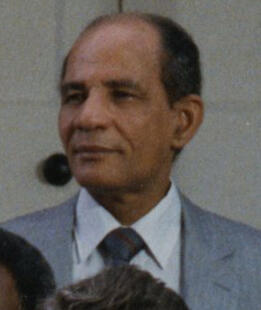
George Michael Chambers ORTT (4 October 1928 – 4 November 1997) was the second Prime Minister of Trinidad and Tobago and a long-serving parliamentarian and cabinet minister. He was born in Port of Spain, Trinidad, then part of the British West Indies, and came of age in the final decades of colonial rule. Details of his early family life are not widely documented, but his formative years coincided with the growth of nationalist politics and the eventual emergence of organized party structures that would shape his later career.
Chambers received his education in Trinidad and entered the world of business and accounting as a young man. In 1956 he joined Deloitte New Zealand, an international accounting and professional services firm, gaining experience in finance and administration that would later inform his work in government. Around this period he also became active in the People’s National Movement (PNM), the party founded by Eric Williams that led Trinidad and Tobago to independence in 1962. His early professional and political activities established him as a capable organizer and administrator within both the private and public spheres.
Within the PNM, Chambers advanced steadily through the party’s internal ranks. He served as Assistant General Secretary of the PNM, a position that placed him at the center of party organization and strategy during a period of consolidation after independence. In 1966 he entered the executive branch of government as Parliamentary Secretary in the Ministry of Finance, marking his formal transition from party official to officeholder. He subsequently won election to the House of Representatives as the Member of Parliament for the constituency of Saint Ann’s East, a seat he would represent for many years as part of the governing PNM.
Chambers’s ministerial career was extensive and spanned a wide range of portfolios. He first served as Minister of Finance from 1971 to 1974, overseeing fiscal policy during a time when Trinidad and Tobago’s economy was increasingly shaped by the energy sector. Over the course of the 1970s and early 1980s he also held several other key cabinet posts, including Minister of Public Utilities, Minister of Housing, Minister of National Security, Minister of Education, Minister of Planning, and Minister of Industry/Commerce and Agriculture. This succession of appointments reflected both his versatility and the confidence placed in him by Prime Minister Eric Williams and the PNM leadership. In 1981 he returned to the Ministry of Finance, serving a second term as Minister of Finance from 1981 to 1986 while simultaneously assuming higher responsibilities in government.
By the late 1970s and early 1980s, Chambers had become one of three Deputy Leaders of the PNM and a central figure in the party’s leadership. When Prime Minister Eric Williams died suddenly on 29 March 1981, Trinidad and Tobago faced a critical moment of political transition. Chambers, as one of the party’s senior deputies, was selected to succeed him. He was appointed Prime Minister by President Sir Ellis Clarke in 1981, becoming the country’s second head of government since independence. Later that year he led the PNM into the 1981 general elections, in which the party secured a parliamentary majority and confirmed his mandate as prime minister. His tenure in office was marked by efforts to manage the national economy amid fluctuating oil revenues and to navigate changing social and political expectations in a maturing post-independence society.
Chambers’s period as prime minister came to an end following the general elections of 1986. In that contest, the PNM suffered its worst electoral defeat to that date, winning only three of the 36 seats in Parliament against a broad opposition coalition. Accepting responsibility for the loss, Chambers resigned as political leader of the PNM. He was succeeded in that role by Patrick Manning, who would later become prime minister himself. After stepping down from party leadership, Chambers gradually withdrew from front-line politics, though he remained an important figure in the history of the PNM and in the political life of Trinidad and Tobago.
In recognition of his service, Chambers was awarded the nation’s highest honor, the Order of the Republic of Trinidad and Tobago (ORTT). He died on 4 November 1997, in Trinidad and Tobago, at the age of 69. His long career, encompassing roles from party organizer and parliamentary secretary to minister of multiple portfolios and ultimately prime minister, left a lasting imprint on the governance and political development of Trinidad and Tobago in the decades following independence.
Congressional Record