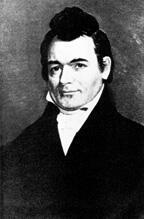
George Washington Campbell (February 9, 1769 – February 17, 1848) was an American statesman who served as a U.S. Representative, Senator, Tennessee Supreme Court Justice, U.S. Ambassador to Russia, and the fifth United States Secretary of the Treasury from February to October 1814. A member of the Republican Party, he played a prominent role in the legislative and executive branches during a formative period in the early republic and contributed to the democratic process while representing the interests of his constituents in Tennessee.
Campbell was born in the village of Tongue, Sutherland, on the north coast of Scotland. In 1772, when he was a young boy, he immigrated with his parents to the American colonies, settling in North Carolina. He was the youngest son of Dr. Archibald Campbell and Elizabeth Mackay Matheson Campbell, who established their home on Crooked Creek in Mecklenburg County, North Carolina. In his early adulthood, Campbell taught school before pursuing higher education. He entered the junior class at the College of New Jersey (now Princeton University) in 1792 and graduated in 1794. After completing his studies, he read law, was admitted to the bar in North Carolina, and in 1798 began practicing law in Knoxville, Tennessee. Like many Southern political figures of his era, he owned slaves.
Campbell’s public career began in national politics when he was elected as a Republican to the United States House of Representatives from Tennessee’s at-large congressional district in 1803. He served in the House from 1805 to 1809, sitting in the 8th, 9th, and 10th Congresses. During the 10th Congress he rose to a position of particular influence as chairman of the House Committee on Ways and Means, where he helped shape federal fiscal policy. He also played a significant role in the early development of congressional oversight of the judiciary. In 1804 he was appointed one of the House managers to prosecute the impeachment of John Pickering, judge of the United States District Court for the District of New Hampshire, and later that year he served as a House manager in the impeachment trial of Samuel Chase, associate justice of the Supreme Court of the United States.
Leaving the House of Representatives in 1809, Campbell returned to Tennessee and entered the judiciary. He became a judge of the Tennessee Supreme Court, serving from 1809 until 1811. Around this time he moved his residence from Knoxville to Nashville, Tennessee, which would remain his principal home for the rest of his life. In July 1812 he married Harriet Stoddert (1788–1848) in Prince George’s County, Maryland. She was the daughter of Benjamin Stoddert, the first Secretary of the United States Navy, and a member of a prominent Maryland family. The couple would have four children, three of whom died in April 1819 while Campbell was serving abroad.
Campbell’s service in the United States Senate occurred in two distinct periods and spanned some of the most consequential years of the early nineteenth century. He was first elected as a United States Senator from Tennessee to fill the vacancy caused by the resignation of Jenkin Whiteside, serving from October 8, 1811, to February 11, 1814. He resigned that seat to enter the Cabinet as Secretary of the Treasury. He returned to the Senate on October 10, 1815, and served until April 20, 1818. During this second tenure he became the first chairman of the Senate Finance Committee and of its immediate predecessor, holding that position from December 4, 1815, until his resignation in 1818. Across these terms, which together with his earlier House service placed him in Congress from 1803 to 1819, Campbell participated actively in the legislative process and represented Tennessee during a period marked by the War of 1812, postwar financial reorganization, and the nation’s westward expansion.
On February 9, 1814, his forty-fifth birthday, Campbell was appointed by President James Madison as the fifth Secretary of the Treasury. He assumed office at a time of severe national financial disorder brought on by the War of 1812. Congress had failed to recharter the First Bank of the United States when its charter expired in 1811, depriving the government of a central financial institution just as war expenditures mounted. With appropriations for the war difficult to secure and federal revenues disrupted, Campbell was forced to rely heavily on the sale of government bonds to finance military operations. To secure necessary funds, he often had to accept lenders’ terms and sell bonds at very high interest rates. The British occupation of Washington, D.C., in September 1814 further undermined public confidence and the government’s credit. Campbell’s efforts to stabilize federal finances and raise money through additional bond sales proved largely unsuccessful under these conditions, and, disillusioned and in poor health, he resigned in October 1814 after only about eight months in office.
After leaving the Treasury, Campbell resumed his Senate duties in October 1815 and continued to serve until 1818, when he again left Congress to undertake diplomatic service. In 1818 he was appointed United States Ambassador to Russia. He held this post from 1818 to 1821, representing American interests at the court of the Russian Empire during a period of expanding U.S. commercial and diplomatic engagement in Europe. While in Russia, Campbell suffered a devastating personal loss when three of his four young children died in April 1819. Deeply affected, he wrote to Secretary of State John Quincy Adams requesting to be recalled so that he could return home, though his recall was not granted until 1820. After concluding his mission, he returned to the United States and later continued to serve the federal government in a more limited capacity as a member of the French Spoliation Claims Commission in 1831, which was established to address long-standing claims arising from French depredations on American commerce.
In his later years, Campbell lived in Nashville, where he remained a respected elder statesman of Tennessee and national politics. His long public career, spanning legislative, judicial, executive, and diplomatic service, placed him among the notable early leaders of the state and of the nation. George Washington Campbell died on February 17, 1848, and was buried in the Nashville City Cemetery in Nashville, Tennessee.
Congressional Record