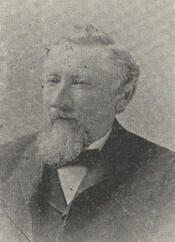
George H. Brickner (January 21, 1834 – August 12, 1904) was a German American immigrant, businessman, Democratic politician, and Wisconsin pioneer who served as a Representative from Wisconsin in the United States Congress from 1889 to 1895. A member of the Democratic Party, he represented Wisconsin’s 5th congressional district for three consecutive terms and contributed to the legislative process during a significant period in American political and economic history. Known in some records as G. H. Brickner, he became an important figure in the commercial development of Sheboygan Falls, Wisconsin, and played a notable role in the civic and religious life of his community.
Brickner was born on January 21, 1834, in the Grand Duchy of Hesse, in what is now Germany. He immigrated to the United States as a young man, part of the broader wave of German migration to the Midwest in the mid-nineteenth century. Settling in Wisconsin, he became identified with the state’s growing German American population and quickly established himself as an enterprising businessman. As he built his commercial interests, he also emerged as a local leader among fellow immigrants, helping to shape the social and religious institutions of his adopted community.
In Sheboygan Falls, Brickner developed extensive business interests, particularly in manufacturing. He became a major wool manufacturer, an occupation that would later give special significance to his positions on national tariff policy. His business success made him one of the important businessmen in the development of Sheboygan Falls, and he was instrumental in the establishment of the first Catholic church in the city, reflecting both his personal faith and his commitment to the religious and civic infrastructure of the community. His growing prominence in local affairs naturally led him into Democratic Party politics at the county, district, and state levels.
By the 1870s and 1880s, Brickner was a frequent delegate to Democratic state and district conventions in Wisconsin, where he gained a reputation as a steady party man rather than a flamboyant campaigner. His path to Congress emerged from intra-party dissatisfaction in 1888 within Wisconsin’s 5th congressional district, where Democrats sought to register disapproval of the incumbent U.S. Representative, Thomas R. Hudd. Party leaders devised a strategy in which delegates to the district nominating convention would initially vote for “favorite sons” from their own counties—Brickner for Sheboygan County, Frederick W. Horn for Ozaukee County, and Joseph Vilas for Manitowoc County. At the convention, Vilas persuaded his delegates to support Brickner and successfully recruited additional support from other counties, securing Brickner’s nomination. Brickner had not originally sought the nomination but consented to Vilas’s plan and accepted the candidacy.
The 1888 general election campaign centered heavily on tariff reform, particularly the question of “free wool.” Republicans argued that lowering tariffs would damage the American wool industry by exposing it to increased foreign competition, making it especially noteworthy that Brickner, himself a major wool manufacturer, publicly favored tariff reform and the “free wool” position. Despite being described as a poor politician—largely because of his thrifty management of campaign funds and reluctance to engage in customary political courtesies—Brickner benefited from the strong Democratic leanings of the 5th district. He won a comfortable victory with approximately 55 percent of the vote, defeating Green Bay city council member Gustav Küstermann. After his election, questions were raised about his citizenship status; Brickner insisted he was a citizen, though he implied that he might not have retained all the necessary documentation. The matter was resolved in his favor, and he was duly sworn in at the opening of the 51st Congress.
Brickner’s congressional service extended through the 51st, 52nd, and 53rd Congresses, from March 4, 1889, to March 3, 1895. In his first term he was generally regarded as a good representative, attentive to district interests, and he was renominated without opposition in 1890. The 1890 election in Wisconsin unfolded against the backdrop of intense public reaction to the Bennett Law of 1889, which mandated English-language instruction in schools and was deeply unpopular among immigrant communities that maintained schools in their native languages. Combined with national discontent over the McKinley Tariff, this backlash produced one of the most lopsided Democratic victories in Wisconsin since the founding of the Republican Party. In this favorable climate, Brickner was overwhelmingly reelected, receiving more than 67 percent of the vote and easily defeating three-time Sheboygan mayor Thomas M. Blackstock.
During the 52nd Congress, Brickner focused on securing tangible benefits for his district. He was responsible for obtaining an appropriation for a federal government building and for harbor improvements in Sheboygan, measures that supported both local commerce and maritime safety on Lake Michigan. Following the 1890 United States census, Wisconsin gained a ninth congressional district, prompting a redistricting act that substantially reshaped Brickner’s constituency. Brown, Kewaunee, Manitowoc, and Calumet counties were removed from the 5th district, while Washington, Waukesha, and the northern half of Milwaukee County were added, making the district more politically competitive. In this altered landscape, Brickner faced a serious renomination challenge from Waukesha lawyer Timothy E. Ryan. At a contentious district convention, Brickner secured four crucial delegates from Washington County, which, combined with ten Sheboygan delegates and five Ozaukee delegates, provided just enough support to win renomination.
The general election that followed was considerably more difficult than Brickner’s earlier campaigns. The reconfigured district diluted the solid Democratic base he had previously enjoyed, and he confronted a strong Republican opponent in Milwaukee state senator Julius Wechselberg. After a closely fought race, Brickner prevailed with approximately 51.7 percent of the vote, returning to Washington for a third term. In the 53rd Congress, he served as chairman of the subcommittee on lighthouses and life-saving services, a subcommittee of the House Committee on Interstate and Foreign Commerce, where he exercised influence over matters related to maritime navigation, coastal safety, and federal infrastructure along the nation’s waterways.
During his final term, Brickner’s voting record occasionally diverged from the dominant currents within his party. Notably, he voted against silver coinage, a position that placed him at odds with much of the Democratic Party, which was increasingly aligned with the free silver movement in the early 1890s. In August 1894, amid growing national debates over monetary policy and party direction, Brickner announced that he would not seek renomination for a fourth term. He left Congress at the conclusion of the 53rd Congress in March 1895 and was succeeded by Republican Samuel S. Barney. Despite stepping away from elective office, Brickner remained a respected figure in Wisconsin Democratic circles and was repeatedly mentioned as a potential congressional candidate in 1896, 1898, and 1900, though he declined to reenter the political arena.
In his later years, Brickner continued his business and civic activities in Wisconsin, maintaining his standing as a leading citizen of Sheboygan Falls and a prominent member of the state’s German American community. He lived to see the turn of the twentieth century and the continued growth of the region he had helped to develop both economically and institutionally. George H. Brickner died on August 12, 1904. His career as an immigrant entrepreneur, local benefactor, and three-term Democratic representative from Wisconsin’s 5th congressional district reflected the broader story of German American participation in the political and economic life of the Upper Midwest in the late nineteenth century.
Congressional Record