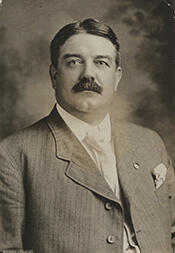
George Meade Bowers (September 13, 1863 – December 7, 1925) was an American politician and businessman who represented West Virginia in the United States House of Representatives from 1915 to 1923. A member of the Republican Party, he served four terms in Congress and contributed to the legislative process during a significant period in American history, including the First World War and the early postwar years.
Bowers was born near Gerrardstown, Berkeley County, West Virginia, where he spent his early years in a rural setting typical of the post–Civil War era in the Shenandoah Valley region. He attended the common schools of Berkeley County, receiving a basic formal education that prepared him for a career in business and public life. His upbringing in an agricultural community and his early exposure to local economic and civic affairs helped shape his later interest in public service and economic development.
Before entering national politics, Bowers established himself in business and banking in Martinsburg, West Virginia. He became active in Republican Party politics at the local and state level and served in the West Virginia House of Delegates from 1883 to 1887, gaining early legislative experience. He later held the position of president of the People’s Trust Company of Martinsburg, reflecting his prominence in local financial circles. His growing reputation as a capable administrator and party leader led to his selection as a delegate to the Republican National Conventions in 1896 and 1900, where he took part in shaping the party’s national platform during a transformative period in American economic and political life.
Bowers’s federal career began when he was appointed by President William McKinley as Commissioner of Fish and Fisheries in 1898, a post he held until 1913. In this capacity, he directed the United States Commission of Fish and Fisheries, overseeing federal efforts in fish culture, conservation, and the development of the nation’s fisheries. His long tenure in this role, spanning the administrations of several presidents, reflected both his administrative skill and the growing importance of scientific management of natural resources at the turn of the twentieth century. After the reorganization of federal fishery functions, he returned to West Virginia and resumed his business activities, remaining an influential figure in Martinsburg’s commercial and civic life.
Bowers was elected as a Republican to the United States House of Representatives, representing West Virginia from 1915 to 1923. His service in Congress is also recorded as running from 1916 to 1923, reflecting the period during which he actually sat in the House following his initial election. During his four terms in office, he participated in the democratic process and represented the interests of his constituents through the tumultuous years of World War I and the immediate postwar era. He served in the Sixty-fourth through the Sixty-seventh Congresses, taking part in debates and legislation related to wartime mobilization, veterans’ issues, economic adjustment after the war, and matters of national infrastructure and development that affected West Virginia’s industrial and agricultural economy.
After leaving Congress in 1923, Bowers returned to Martinsburg and again engaged in banking and business, continuing his long association with the People’s Trust Company and other local enterprises. He remained a respected public figure in Berkeley County, drawing on decades of experience in state government, federal administration, and national legislative service. George Meade Bowers died in Martinsburg, West Virginia, on December 7, 1925. His career reflected the trajectory of a late nineteenth- and early twentieth-century Republican from a growing Appalachian state, moving from local and state politics to federal administrative service and ultimately to a substantial tenure in the United States House of Representatives.
Congressional Record