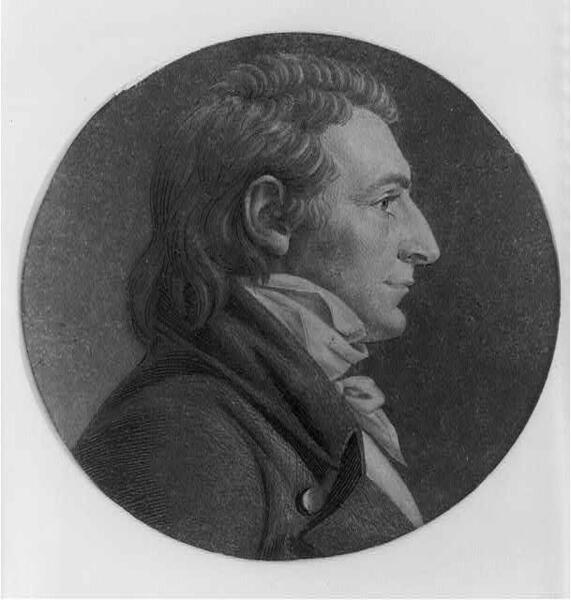
George Michael Bedinger (December 10, 1756 – December 7, 1843) was an American military officer, pioneer settler, and politician who came to oppose the expansion of slavery to Kentucky. He served in both houses of the Kentucky legislature and as a U.S. Representative from Kentucky, and later became known for his antislavery views in contrast to his nephew Henry Bedinger, who became a pro-slavery congressman from Virginia. As a member of the Republican (Democratic-Republican) Party representing Kentucky, Bedinger contributed to the legislative process during two terms in office, participating in the early national democratic experiment and representing the interests of his frontier constituents during a significant period in American history.
Bedinger was born on December 10, 1756, in Hanover, Pennsylvania, to Henry Bedinger (1729–1772) and Magdelena Schlegel (1734–1796), immigrants from Alsace. He attended an English school in his youth. Around 1762, the family moved from Pennsylvania to Virginia, where his elder brother Henry Bedinger (1753–1843) remained for most of his life. In 1779, amid the westward movement of colonial settlers, his father moved the rest of the family to Kentucky and settled at Boonesborough, one of the principal frontier stations of the trans-Appalachian West. This early exposure to the Kentucky frontier shaped George Bedinger’s later military and political career.
During the American Revolutionary War, Bedinger became involved in frontier and regular military service. In May 1779 he served as adjutant in Colonel John Bowman’s expedition against the Shawnee town of Chillicothe, a campaign that formed part of the broader struggle between settlers and Native American nations allied with the British. He later returned to Virginia and served at the siege of Yorktown in 1781, the decisive engagement that effectively ended major combat operations in the Revolution. His presence at Yorktown meant that he was absent from Kentucky during the Battle of Blue Licks in 1782, one of the last and bloodiest battles of the war on the western frontier, which he therefore missed.
In the post-Revolutionary period, Bedinger continued his military service during the Northwest Indian War, as the United States sought to assert control over the Northwest Territory. In 1791 he served as a major in Drake’s Regiment and as a major commanding the Winchester Battalion of Sharpshooters in the ill-fated St. Clair expedition, one of the most significant defeats suffered by U.S. forces against Native American confederated tribes. He subsequently held a regular commission as a major commanding the Third Sublegion of the United States Infantry from April 11, 1792, to February 28, 1793, during the reorganization of the U.S. Army under General Anthony Wayne. After his active military career, Bedinger engaged in agricultural pursuits in Kentucky, establishing himself as a farmer and landowner in the Blue Licks region.
Bedinger entered public life with the creation of Kentucky as a separate state. He won election to the State House of Representatives of the first legislature of Kentucky in 1792, participating in the formative period of the new state’s government. He later served in the Kentucky State Senate in 1800 and 1801. During these years he opposed Kentucky becoming a slave state and came to oppose the expansion of slavery into Kentucky, though he was unsuccessful in preventing its entrenchment in the state’s legal and social order. His stance placed him among a minority of early Kentucky leaders who expressed reservations about the growth of slavery in the trans-Appalachian West.
At the national level, Bedinger was elected as a Democratic-Republican to the Eighth and Ninth Congresses, serving as a U.S. Representative from Kentucky from March 4, 1803, to March 3, 1807. As a member of the Republican Party representing Kentucky, he contributed to the legislative process during two terms in office, participating in debates and votes during the administration of President Thomas Jefferson, a period marked by issues such as the Louisiana Purchase, westward expansion, and evolving federal-state relations. In Congress he represented the interests of his frontier constituents, bringing the perspective of a Revolutionary War veteran and Kentucky pioneer to national deliberations.
In his private life, Bedinger’s views on slavery were complex but increasingly antislavery in practice. Although he inherited several enslaved people from his brother, he freed those he owned personally when they reached the age of 30. He reportedly offered to pay for their passage to Liberia, reflecting early colonizationist ideas among some American opponents of slavery, though only one of the freed individuals is known to have accepted this offer. His personal opposition to the expansion of slavery and his manumission practices stood in notable contrast to the pro-slavery stance later taken by his nephew, Henry Bedinger of Virginia, who served in Congress as a defender of the institution.
George Michael Bedinger died at Blue Licks Springs, Kentucky, on December 7, 1843, just three days short of his eighty-seventh birthday. He was interred in the family cemetery on his farm near Lower Blue Licks Springs, Kentucky. His long life spanned from the colonial era through the early decades of the American republic, and his career as a soldier, legislator, and congressman reflected the experiences and contradictions of the early national frontier, including the expansion of settlement, the conflicts with Native peoples, and the contested growth of slavery in the new western states.
Congressional Record