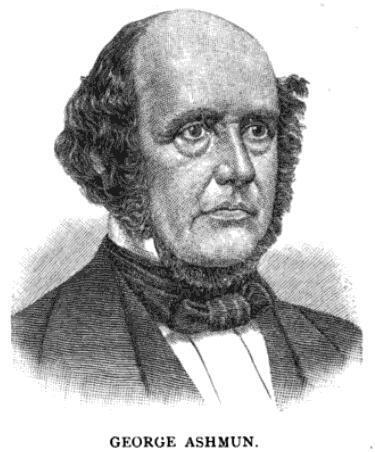
George Ashmun (December 25, 1804 – July 16, 1870) was a Whig member of the U.S. House of Representatives from Massachusetts and later an early leader in the Republican Party. He was born in Blandford, Massachusetts, to Eli P. Ashmun, a prominent lawyer and Federalist U.S. senator from Massachusetts, and Lucy Hooker Ashmun. Growing up in a politically engaged family, he was exposed early to public affairs and the law, influences that shaped his subsequent career in public service.
Ashmun pursued a classical education and graduated from Yale College in 1823. After completing his studies, he read law and was admitted to the bar, beginning a legal career in Massachusetts. In 1828 he married Martha E. Hall, establishing his household while simultaneously building his professional and political standing. His legal practice and family background helped him gain recognition within Massachusetts political circles during the Jacksonian era, when party alignments were in flux and the Whig Party was emerging as a principal opposition force.
Ashmun entered elective office in the Massachusetts House of Representatives, serving there from 1833 to 1837. During these years he became known as an able debater and a reliable Whig legislator. He then advanced to the Massachusetts Senate, where he served from 1838 to 1840, participating in state-level deliberations on economic development, infrastructure, and governance at a time when Massachusetts was rapidly industrializing. In 1841 he returned to the Massachusetts House of Representatives and was chosen Speaker, presiding over the 62nd Massachusetts General Court. His election as Speaker reflected his growing influence within the Whig Party and his reputation for parliamentary skill.
Building on his state legislative experience, Ashmun was elected to the U.S. House of Representatives from Massachusetts’s Sixth Congressional District in 1844. He took his seat in the Twenty-ninth Congress in 1845 and served continuously through the Thirty-first Congress, holding office from 1845 to 1851. In Congress he served on several important committees, including the Committee on the Judiciary, the Committee on Indian Affairs, and the Committee on Rules, positions that placed him at the center of debates over legal policy, federal relations with Native American nations, and the internal procedures of the House. During the Mexican–American War he emerged as a vocal opponent of the conflict, reflecting the views of many Northern Whigs who regarded the war as an instrument for the expansion of slavery. Throughout his congressional career he was a strong supporter of Daniel Webster, aligning himself with Webster’s brand of Unionist, commercially oriented Whiggery and his efforts to preserve the Union through compromise.
After leaving Congress in 1851, Ashmun moved to Springfield, Massachusetts, where he spent the remainder of his life. There he resumed and expanded his legal career, forming the law firm of Chapman & Ashmun with Reuben A. Chapman, who later became chief justice of the Massachusetts Supreme Judicial Court. Ashmun’s Springfield practice brought him into contact with leading figures in the city’s civic and intellectual life, including Samuel Bowles, the influential newspaper publisher of the Springfield Republican. Through these associations, Ashmun remained deeply engaged in public questions even while out of elective office.
As the Whig Party disintegrated in the 1850s under the strain of sectional conflict, Ashmun became one of the Massachusetts figures who helped organize the new Republican Party. Working with Samuel Bowles and other antislavery and anti–Kansas-Nebraska Act activists, he assisted in the formation of the Republican Party as a national coalition opposed to the extension of slavery into the territories. He joined the Republican Party immediately upon its organization and quickly assumed a leadership role within it. His standing as a former Whig congressman and ally of Daniel Webster lent weight to the new party’s efforts to attract former Whigs and moderate voters.
Ashmun’s prominence within Republican ranks culminated in his role at the 1860 Republican National Convention in Chicago. There he served as presiding officer of the convention that nominated Abraham Lincoln for President of the United States. In that capacity, he oversaw the proceedings that produced Lincoln’s nomination and helped to manage the often contentious deliberations among the party’s various factions. His position at the convention symbolized the transition of many former Whigs into the Republican coalition and underscored his national stature in the critical years leading up to the Civil War.
George Ashmun continued to reside in Springfield during and after the Civil War, maintaining his legal practice and remaining a respected elder statesman within Massachusetts Republican politics. He died in Springfield, Massachusetts, on July 16, 1870. Ashmun was buried in Springfield Cemetery, closing a career that spanned the Federalist, Whig, and early Republican eras and linked state politics in Massachusetts with the emergence of a new national party system.
Congressional Record