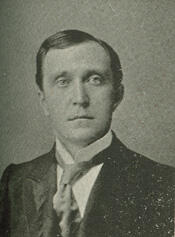
Gaston Ahi Robbins (September 26, 1858 – February 22, 1902) was a United States Representative from Alabama and a member of the Democratic Party who served three nonconsecutive terms in Congress during the late nineteenth century. He was born in Goldsboro, Wayne County, North Carolina, and in his youth moved with his family to Randolph County, North Carolina, a region then characterized by small farms and emerging educational institutions. His early years in North Carolina placed him within the post–Civil War South, a setting that would shape his later professional and political life.
Robbins pursued higher education at Trinity College in Durham, North Carolina, an institution that would later become Duke University. He continued his studies at the University of North Carolina at Chapel Hill, from which he was graduated in 1879. Following his collegiate education, he undertook the study of law, preparing for admission to the bar at a time when formal legal education was increasingly important for public service and professional advancement in the South.
In 1880 Robbins was admitted to the bar and soon thereafter moved to Alabama, where he commenced the practice of law in Selma, Dallas County. Selma was an important commercial and legal center in central Alabama, and Robbins established himself there as a practicing attorney. His legal career in Selma provided the foundation for his entry into Democratic Party politics in Alabama during the period of Reconstruction’s aftermath and the consolidation of Democratic control in the state.
Robbins was elected as a Democrat to the Fifty-third Congress and served from March 4, 1893, to March 3, 1895, representing Alabama in the U.S. House of Representatives. His service in Congress occurred during a significant period in American history marked by economic turmoil, debates over monetary policy, and the realignment of political forces in the South. As a member of the House of Representatives, Robbins participated in the legislative process and represented the interests of his Alabama constituents, contributing to the work of the Democratic majority in the House during President Grover Cleveland’s second administration.
In the closely contested political environment of the 1890s, Robbins’s subsequent elections were the subject of formal challenges. He presented his credentials as a Member-elect to the Fifty-fourth Congress and served from March 4, 1895, until March 13, 1896, when he was succeeded by Republican William F. Aldrich, who successfully contested his election. Robbins later returned to national politics and again presented his credentials as a Member-elect to the Fifty-sixth Congress, serving from March 4, 1899, to March 8, 1900. In that instance as well, his seat was contested, and he was again succeeded by William F. Aldrich after the House determined the contest in Aldrich’s favor. Across these three terms—1893 to 1895, 1895 to 1896, and 1899 to 1900—Robbins’s congressional career reflected both his electoral strength in Alabama and the intense partisan and procedural disputes of the era.
After his contested service in the Fifty-sixth Congress ended in 1900, Robbins did not again hold elective office. He resumed the practice of law, this time relocating to New York City, where he continued his legal career in the nation’s principal financial and commercial center. While he remained identified with Alabama through his prior service, his later professional life was spent in private practice rather than public office.
Gaston Ahi Robbins died in New York City on February 22, 1902. His remains were returned to his native state of North Carolina, and he was interred in Oakwood Cemetery in Statesville, Iredell County. His career, spanning legal practice in Alabama, three terms in the U.S. House of Representatives, and later work as an attorney in New York, placed him among the Southern Democratic figures who navigated the turbulent political and economic transformations of the late nineteenth century.
Congressional Record