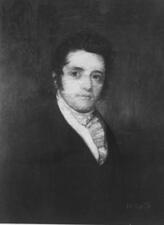
Gabriel Moore (1785 – August 6, 1844) was an American politician who rose from frontier legislator to governor of Alabama and United States senator during a formative period in the nation’s history. Born in Stokes County, North Carolina, in 1785, he was of English and some French descent. In 1810 he moved to Huntsville, in what would become the state of Alabama, joining a rapidly developing region on the southwestern frontier of the young republic. His relocation placed him at the center of Alabama’s territorial politics and early statehood, positioning him to play a significant role in the political life of the new state.
Details of Moore’s formal education are not extensively documented, but his subsequent legislative and executive responsibilities indicate that he acquired the legal and political knowledge necessary to participate effectively in public affairs. By the time Alabama was moving from territorial status toward statehood, Moore had established himself sufficiently to enter public service. His early involvement in territorial legislatures provided him with experience in lawmaking and governance at a time when institutional structures in the region were still being formed.
Moore’s political career began in the territorial period, when he served in the legislatures of the Alabama Territory. With the admission of Alabama to the Union, he advanced to national office. In 1821 he was elected to the United States Congress as a Democratic-Republican, becoming the second Representative of the state of Alabama and the first Representative of its First Congressional District. He initially served one term as representative of Alabama’s at-large district from 1821 to 1823, winning that 1821 contest as one of four candidates with 67.57% of the vote. After the creation of specific districts, he served as Alabama’s 1st district representative from 1823 to 1829. In the 1823 election he ran unopposed and received all 3,304 votes cast, and in the 1825 election he again secured re-election, defeating Clement Comer Clay with 71.12% of the vote. Over these years he was successively identified with the Democratic-Republican, Jacksonian, and later National Republican currents that characterized the shifting party alignments of the era.
In 1829 Moore left the House of Representatives to assume executive office as the fifth governor of Alabama. Elected unopposed and standing as a Jacksonian, he took office at a time when the state was experiencing rapid growth and political consolidation. His governorship was intended to last four years, but in 1831, two years into his term, he resigned the office to pursue a seat in the United States Senate. Upon his resignation, the presidency of the Alabama Senate passed the governorship to Samuel B. Moore (to whom he was not related), who succeeded him as governor. Gabriel Moore’s decision to leave the governorship reflected both his ambition and the importance of national legislative service in the emerging party system of the 1830s.
Moore’s bid for the Senate in 1831 was successful, and he entered the United States Senate as a Class 3 senator from Alabama, serving alongside William R. King. His service in Congress, which extended from his first election to the House in 1821 through the end of his Senate term in 1837, spanned five terms in national office and coincided with a significant period in American history marked by the rise of Jacksonian democracy, sectional tensions, and debates over federal authority. A member of the Jackson Party during part of this period, Moore contributed to the legislative process and participated in the democratic governance of the early republic, representing the interests of his Alabama constituents in both chambers of Congress. During his tenure in the Senate he was also associated with committee work; he is noted as having served as chairman of the House Committee on Revolutionary Claims, reflecting his involvement in the adjudication of claims arising from the Revolutionary era. In 1834, as party lines hardened, he was one of only two Anti-Jacksonian senators to vote against the censure of President Andrew Jackson, a stance that underscored the complexity of his political alignments and the fluid nature of party affiliation in this period. His Senate service ended in 1837, when he lost his seat to John McKinley, who had previously held the same Senate position before Moore’s election in 1831.
After his departure from the Senate, Moore gradually withdrew from the center of national politics. In 1843 he moved to the vicinity of Caddo Lake, in what was then the Republic of Texas and soon to become part of the State of Texas, continuing the pattern of frontier migration that had marked his earlier move from North Carolina to Alabama. He died near Caddo Lake on August 6, 1844, and was buried on the plantation of Peter Swanson. Gabriel Moore’s career, encompassing service in territorial legislatures, the U.S. House of Representatives, the governorship of Alabama, and the United States Senate, reflected the opportunities and shifting allegiances of American politics in the early nineteenth century, as well as the expanding reach of federal and state institutions across the southern frontier.
Congressional Record