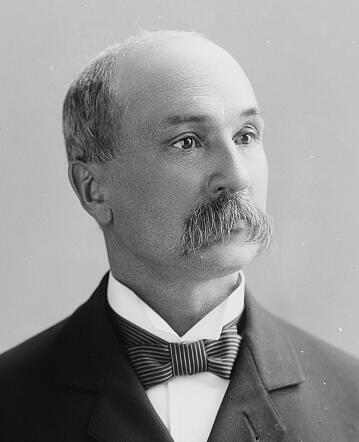
Freeman Tulley Knowles (October 10, 1846 – June 1, 1910) was an American Civil War veteran, lawyer, journalist, social activist, and Populist member of the United States House of Representatives from South Dakota. He served one term in Congress from 1897 to 1899, during a significant period in American political and economic history, and was later active in the Socialist movement in South Dakota.
Knowles was born in Harmony, Somerset County, Maine, on October 10, 1846. He was educated in the local schools of Harmony and later attended Bloomfield Academy in Skowhegan, Maine. His early life in rural New England, combined with a formal academy education, provided the foundation for his later pursuits in law, journalism, and politics.
In 1862, during the American Civil War, Knowles enlisted in the Union Army, joining the 16th Maine Volunteer Infantry Regiment. He served until the end of the war and took part in several major engagements, including the Battle of Gettysburg. Over the course of his service he attained the rank of corporal. His wartime experience, particularly in one of the conflict’s most decisive battles, shaped his later commitment to public service and reform-oriented politics.
After the war, Knowles moved west to Denison, Iowa, where he studied law. He was admitted to the bar and began practicing law in Denison in 1869. He continued in legal practice there until 1886, when he shifted his focus to journalism and publishing. That year he moved to Nebraska to become publisher of the Ceresco Times, marking the beginning of a long career in the newspaper business that he would use as a platform for his political and social views.
Knowles relocated to Tilford, South Dakota, in 1888 to begin publication of the Meade County Times. He later moved to Deadwood, South Dakota, where he published the Evening Independent. Through these newspapers he became an influential voice in the region, commenting on political, economic, and social issues of the day. His work as a journalist and editor brought him into close contact with the concerns of farmers, laborers, and small business owners, and helped propel him into active political life.
In addition to his activities in journalism, Knowles became active in the Populist Party, which was gaining strength in the Upper Midwest and Great Plains in the 1890s. He first sought federal office in 1894, running unsuccessfully for Seat A, one of South Dakota’s two at-large seats in the United States House of Representatives. In the election of 1896 he ran again, this time for Seat B, and was elected as a Populist to the Fifty-fifth Congress. He served from March 4, 1897, to March 3, 1899, representing South Dakota at large. During his single term in the House of Representatives, Knowles participated in the legislative process and represented the interests of his South Dakota constituents at a time of intense national debate over monetary policy, agricultural distress, and political reform. A member of the Populist Party throughout his congressional service, he contributed to the broader Populist effort to address the economic challenges facing farmers and working people. He was an unsuccessful candidate for reelection in 1898.
After leaving Congress, Knowles remained engaged in politics and social reform. He later became involved with the Socialist Party of America and emerged as one of the more prominent socialist figures in South Dakota. He ran unsuccessfully for Governor of South Dakota in 1904 and again in 1906 on a Socialist platform. In addition, he founded and edited a socialist newspaper, The Lantern, which he used to advocate for birth control, labor rights, labor unions, and other progressive causes. His outspoken editorials and stories, particularly those critical of mine owners and business leaders, drew hostility from powerful economic interests and led to increased scrutiny by law enforcement agencies and other government officials.
Knowles’s activism eventually brought legal consequences. In 1908 he was charged with sending obscene material through the mails, a charge that reflected both the strict federal standards of the era and the controversy surrounding his advocacy on sensitive social issues. He was convicted and sentenced to a year in prison, underscoring the risks faced by outspoken reformers and radicals in the early twentieth century.
Freeman Tulley Knowles died in Deadwood, South Dakota, on June 1, 1910. He was buried in Mount Moriah Cemetery in Deadwood. His life spanned the Civil War, the rise of Populism, and the early Socialist movement in the United States, and he left a legacy as a soldier, lawyer, editor, and reform-minded public figure who used both the press and elective office to advance the interests of his constituents and the causes in which he believed.
Congressional Record