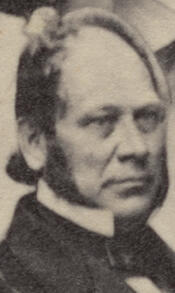
Freeman Clarke (March 22, 1809 – June 24, 1887) was a Republican U.S. Representative from New York who served three terms in the United States House of Representatives between 1863 and 1875, including during the American Civil War. Born in Troy, Rensselaer County, New York, he entered commercial life at an early age, going into business for himself at the age of fifteen. His early experience in trade and finance laid the foundation for a long career in banking and corporate management that would later support his entry into public life.
Clarke’s formal education is not extensively documented, but his rapid assumption of responsibility in the financial sector indicates that he acquired practical training and experience in business and banking as a young man. He began his financial career as cashier of the Bank of Orleans in Albion, New York, a position that placed him at the center of local credit, investment, and commercial transactions. In 1845 he moved to Rochester, New York, which was emerging as a major commercial and transportation hub in western New York, and there he expanded his activities in banking and corporate affairs.
In Rochester and New York City, Clarke became a prominent figure in finance and transportation. He served as director and president of several banks, railroads, and telegraph and trust companies, reflecting his role in the development of the region’s financial and communications infrastructure in the mid-nineteenth century. His business prominence naturally drew him into politics. Originally aligned with the Whig Party, he served as a delegate to the Whig National Convention held in Baltimore in 1852. With the collapse of the Whig Party and the rise of the Republican Party, Clarke became an early Republican leader in New York, serving as vice president of the first Republican State convention of New York in 1854, a formative moment in organizing the party in the state.
Clarke’s congressional service began during one of the most consequential periods in American history. He was elected as a Republican to the Thirty-eighth Congress and served from March 4, 1863, to March 3, 1865, representing a New York district in the House of Representatives during the height of the Civil War. As a member of the House, he participated in the legislative process at a time when Congress was addressing issues of war finance, the Union war effort, and the early contours of Reconstruction. Throughout his tenure he represented the interests of his New York constituents while supporting the broader Republican program of preserving the Union and reshaping the national economy.
At the close of his first term in Congress, Clarke was appointed Comptroller of the Currency, a key federal financial post created during the Civil War to oversee the newly established national banking system. He served as Comptroller of the Currency from March 9, 1865, to February 6, 1867. In this capacity, he was responsible for supervising national banks, regulating the issuance of national bank notes, and helping to stabilize and standardize the banking system under the National Banking Acts. His background as a banker and corporate executive informed his administration of the office during a critical period of postwar financial adjustment.
After leaving the Comptroller’s office, Clarke remained active in public affairs in New York. He served as a delegate to the New York State constitutional convention in 1867, participating in efforts to revise and modernize the state’s fundamental law in the aftermath of the Civil War. He returned to national legislative service when he was again elected as a Republican to the Forty-second and Forty-third Congresses, serving from March 4, 1871, to March 3, 1875. During these later terms, which fell in the Reconstruction era, he continued to contribute to the legislative process, aligning with Republican policies on economic development and national consolidation while representing the interests of his New York constituency.
In his later years, Clarke continued to be associated with the financial and corporate institutions that had defined much of his career, particularly in Rochester. He lived there until his death on June 24, 1887. Freeman Clarke died in Rochester, New York, and was interred at Mount Hope Cemetery in that city. His career combined substantial influence in banking and corporate enterprise with significant service in federal office, including three terms in Congress and a tenure as Comptroller of the Currency during and immediately after the Civil War.
Congressional Record