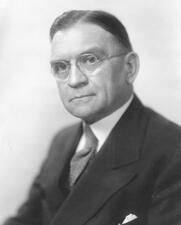
Frederick Van Nuys (April 16, 1874 – January 25, 1944) was a United States senator from Indiana and a prominent Democratic lawyer and public official in the first half of the twentieth century. Born in Falmouth, Fayette County, Indiana, he attended the local public schools before enrolling at Earlham College in Richmond, Indiana, from which he graduated in 1898. He then pursued legal studies at Indiana Law School in Indianapolis (now the Indiana University Robert H. McKinney School of Law), receiving his law degree in 1900. That same year he was admitted to the bar and began the practice of law in Shelbyville, Indiana, moving shortly afterward to Anderson, Indiana, where he established himself in private practice. According to an interview in The Literary Digest, he pronounced his last name “van-NIECE,” a point he occasionally clarified in public life.
Van Nuys’s early legal and political career developed rapidly in Madison County. From 1906 to 1910 he served as prosecuting attorney of Madison County, gaining a reputation as a capable trial lawyer and local Democratic leader. Building on this experience, he was elected to the Indiana Senate, serving from 1913 to 1916. During his tenure in the state legislature he rose to a position of influence, serving as president pro tempore of the Indiana Senate in 1915. In 1916 he moved to Indianapolis, where he continued the private practice of law and became increasingly active in statewide Democratic politics and federal legal affairs.
In 1920 Van Nuys was appointed United States Attorney for the U.S. District of Indiana, a post he held until 1922. In that capacity he represented the federal government in civil and criminal matters during the early years of Prohibition, further enhancing his profile as a lawyer and public servant. After leaving the U.S. Attorney’s office, he returned to private practice in Indianapolis, remaining engaged in party affairs and public issues, including the growing national debate over Prohibition and federal power, which would later shape his Senate career.
Van Nuys was elected as a Democrat to the United States Senate from Indiana in the 1932 election, riding the same electoral wave that brought Franklin D. Roosevelt to the presidency. He soundly defeated the longtime Republican incumbent and Senate Majority Leader James Eli Watson, contributing to the Democratic takeover of the Senate during the depths of the Great Depression. An opponent of the Eighteenth Amendment, Van Nuys had long called for changes to the Volstead Act, and his election coincided with the national movement toward repeal of Prohibition. In the Senate he aligned with efforts to modify and ultimately end Prohibition, reflecting both his earlier legal experience and the changing public mood.
During his Senate service, Van Nuys became particularly noted for his stance on civil rights and his complex relationship with the New Deal. In 1937 he joined Senator Robert F. Wagner of New York in introducing a federal anti-lynching bill in the Senate, part of a broader push by civil rights advocates to secure federal protection against mob violence. The House of Representatives passed a similar numbered bill (H.R. 1507) by a wide 277–120 margin, but in the Senate the measure encountered strong opposition. The Senate Judiciary Committee rewrote the bill in a manner that undermined its effectiveness, and in 1938 it failed to achieve even a simple majority on either of two cloture votes, effectively blocking its passage. Van Nuys’s committee work also reflected his growing seniority: he served as chairman of the Committee on Expenditures in Executive Departments in the 76th Congress and later as a member of the Committee on the Judiciary in the 77th and 78th Congresses.
Although elected as part of Roosevelt’s sweeping 1932 victory, Van Nuys was not always a reliable supporter of New Deal policies. He opposed President Roosevelt’s 1937 plan to enlarge the United States Supreme Court, viewing it as an overreach that threatened judicial independence. He also remained outside the Indiana Democratic Party’s dominant political machine, resisting pressure on patronage matters and often clashing with party leaders over appointments and intraparty control. His independence led some forces within the Democratic Party, including organized labor interests such as the AFL–CIO, to oppose his renomination in 1938. Loyalists to Indiana Governors Paul V. McNutt and M. Clifford Townsend sought to “eliminate” him from the Senate, a goal that was welcomed by elements of the Roosevelt administration frustrated by his dissent on key issues.
Despite these challenges, Van Nuys managed to secure the Democratic nomination for a second term after initially threatening to run as an independent. In the 1938 general election he faced Republican newspaper publisher Raymond E. Willis. The contest was extremely close, and Van Nuys ultimately prevailed by a margin of approximately 5,100 votes. Willis appealed to the Senate for a recount, alleging election irregularities, but the Senate denied the request on the grounds that the disputed votes would not have changed the outcome. Van Nuys returned to Washington as a weakened but still independent-minded Democrat, continuing to chart a course that often diverged from both the administration and his party’s state leadership.
By the early 1940s, Van Nuys’s record in foreign and domestic policy drew attention from observers abroad as well as at home. In 1943, Isaiah Berlin, then serving as an analyst for the British Foreign Office and attached to the Senate Foreign Relations Committee, prepared a confidential assessment of Van Nuys. Berlin described his voting record as “a very mixed one,” noting that in 1939 Van Nuys was among the committee members who voted to postpone consideration of the Neutrality Act in June, and that in October of that year he voted for a revision of the act but not for its full repeal. Berlin observed that Van Nuys was one of the senators whom the 1938 “purge” by Roosevelt’s supporters had failed to unseat, leaving his feelings toward the President “somewhat cool.” Van Nuys voted for the Lend-Lease Act, in common with most Democrats, but opposed reciprocal trade agreements and occasionally aligned with the Farm Bloc. Berlin characterized him as “a man of very uncertain views tinged with isolationism and liable, on the whole, to vote with the Conservatives,” underscoring the complexity of his position within the Democratic caucus during the tumultuous prewar and early wartime years.
Frederick Van Nuys died in office on January 25, 1944, at his home in Vienna, Virginia, after a short illness. His death placed him among the members of the United States Congress who died in office between 1900 and 1949. He was buried in East Maplewood Cemetery in Anderson, Indiana, the community where he had first established his legal career and political base. Following his death, Indiana Governor Henry F. Schricker appointed Samuel D. Jackson to succeed him in the United States Senate, bringing to a close Van Nuys’s long and often independent career in state and national public life.
Congressional Record