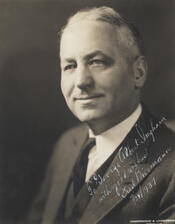
Frederick Elliott Biermann (March 20, 1884 – July 1, 1968) was an American politician and newspaper editor who served three terms as a Democratic U.S. Representative from Iowa’s 4th congressional district from 1933 to 1939. Elected as part of the 1932 Roosevelt landslide, he represented his largely rural northeastern Iowa constituency during the early New Deal era and contributed to the legislative process over three consecutive terms in the United States Congress. His congressional career ended when he was defeated for a fourth term by an opponent from his own small community of Decorah, Iowa.
Biermann was born in Rochester, Minnesota, on March 20, 1884. Following the death of his mother, he moved in 1888 to Decorah, Iowa, where he was raised by an aunt. He attended the public schools of Decorah and graduated from Decorah High School in 1901. After high school he enrolled at the University of Minnesota in Minneapolis, where he studied for three years before transferring to Columbia University in New York City. At Columbia he completed his undergraduate studies, graduating in 1905. His senior thesis, titled “Jefferson and Jackson as Leaders of the Democracy,” reflected an early and serious interest in American political history and the Democratic Party tradition that would later shape his public career.
After graduating from Columbia, Biermann returned to Decorah and taught at Valder’s Business College. Seeking broader experience, he then homesteaded in Morton County, North Dakota, before turning again to formal education. He attended Harvard Law School during the academic years 1906 and 1907, but did not complete a law degree. Instead, he returned to Decorah in 1908 and entered the newspaper business, becoming half-owner of the Decorah Journal. By 1911 he had acquired full ownership and assumed the role of editor and publisher. In 1913 he was appointed postmaster of Decorah, beginning a dual career as both a local federal official and influential small-town newspaper editor.
Biermann’s work as editor and postmaster was interrupted by the First World War. In April 1917 he volunteered for service in the United States Army and was commissioned a second lieutenant, later rising to first lieutenant in the 88th Infantry Division. He served from April 1917 until June 1919, including approximately ten months overseas. After his discharge he returned to Decorah, resumed his duties as postmaster (continuing in that role until 1923), and again took up active management of the Decorah Journal. Throughout the 1920s he remained a prominent voice in regional public affairs; his editorials and speeches were frequently reprinted, discussed, and critiqued on the editorial pages of other Iowa newspapers, including the Mason City Globe-Gazette and the Oelwein Daily Register. An X-ray accident around 1922 left him with serious burns that eventually crippled him, and when he sold the Decorah Journal in 1931 he cited those injuries as the reason for relinquishing the physically demanding work of newspaper publishing.
Parallel to his journalistic career, Biermann became increasingly active in Democratic Party politics during the 1920s. He served for eight years on the Central Committee of the Iowa Democratic Party, helping to build and organize a minority party in a predominantly Republican state. He was a delegate to the Democratic National Convention in 1928, participating in the national deliberations of his party at a time when Democrats were struggling to regain national power. In March 1932 he announced his candidacy for the U.S. House of Representatives from Iowa’s 4th congressional district, then represented by Gilbert N. Haugen, a Republican who was the longest-serving member of Congress at that time, with sixteen terms. Riding the national Democratic wave that accompanied Franklin D. Roosevelt’s election, Biermann defeated Haugen in November 1932 by more than 20,000 votes.
Biermann’s service in Congress began on March 4, 1933, and continued until January 3, 1939. As a member of the House of Representatives during a significant period in American history, he participated in the democratic process at the federal level and represented the interests of his northeastern Iowa constituents while the nation grappled with the Great Depression. He was reelected in 1934 and 1936, though by increasingly narrow margins. In 1936 his Republican opponent was Henry O. Talle, an economics professor at Luther College in Decorah; Biermann prevailed in that contest, but the rematch in 1938 occurred amid a strong Republican resurgence. In the 1938 election, part of a Republican sweep that captured all but two U.S. House seats in Iowa, Talle defeated Biermann by more than 4,000 votes, ending Biermann’s three-term tenure. During his time in Congress he also gained international parliamentary experience, serving as a delegate to the Interparliamentary Union Conference held in Paris in 1937.
After leaving Congress, Biermann continued in public service. In October 1940 he was appointed United States Marshal for the Northern District of Iowa, a federal law enforcement position he held until 1953. In that capacity he was responsible for the execution of federal court orders, the custody and transport of federal prisoners, and related duties across northern Iowa during the Second World War and the early Cold War period. He remained active in Democratic Party affairs and served as a delegate to the Democratic National Conventions in both 1940 and 1956, reflecting his continued influence and standing within the party long after his congressional service had ended.
Frederick Elliott Biermann died in La Crosse, Wisconsin, on July 1, 1968. He was interred in Phelps Cemetery in Decorah, Iowa, the community that had been his home for nearly all of his life and the base of his journalistic, political, and public service career. His papers, documenting his work as editor, soldier, party leader, congressman, and U.S. marshal, are preserved in the Frederick Elliott Biermann Papers at the University of Iowa Special Collections & University Archives.
Congressional Record