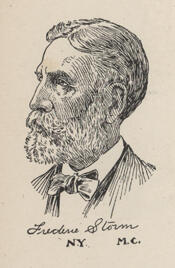
Frederic Storm (July 2, 1844 – June 9, 1935) was an American politician and businessman who served as a United States Representative from New York from 1901 to 1903. A member of the Republican Party, he represented his constituents in the House of Representatives for one term during a significant period in American history, contributing to the legislative process at the dawn of the twentieth century.
Storm was born in Alsace, then part of the Kingdom of France, on July 2, 1844. In 1846, when he was still a young child, he immigrated to the United States with his parents. The family settled in New York City, where he was raised. He attended the public schools of New York City, receiving the basic education that would support his later business and political career. Coming of age in a rapidly expanding urban and commercial environment, he entered the workforce in an era of industrial growth and increasing immigration.
After completing his schooling, Storm engaged in the cigar manufacturing business in New York. This work placed him within one of the city’s important trades of the nineteenth century and provided him with experience in commerce and industry. His involvement in business helped establish his standing in the community and laid the groundwork for his later leadership roles in both civic and political affairs.
Storm’s formal political career began in the 1890s within the Republican Party in Queens County, New York. He was a member of the Queens County Republican committee from 1894 to 1900 and served three times as its chairman, reflecting his influence in local party organization and strategy. In 1894, he was chosen as a delegate to the New York State Constitutional Convention, participating in the revision and modernization of the state’s fundamental law. He subsequently served as a member of the New York State Assembly, representing the 2nd District of Queens County in 1896, where he took part in state-level legislative deliberations.
In addition to his political activities, Storm was active in civic and institutional development in his community. He was the founder of Flushing Hospital, an important local medical institution that contributed to the health and welfare of residents in Queens. This endeavor demonstrated his interest in public welfare and community improvement beyond the strictly political sphere, and it further enhanced his prominence in the region.
Storm was elected as a Republican to the Fifty-seventh Congress and served as a United States Representative from New York from March 4, 1901, to March 3, 1903. During his single term in the House of Representatives, he participated in the democratic process at the federal level and represented the interests of his New York constituents during a time of national expansion and economic change. He sought reelection in 1902 to the Fifty-eighth Congress but was unsuccessful, bringing his brief period of congressional service to a close.
After leaving Congress, Storm returned to private enterprise and became active in banking in Bayside, Queens. In 1905 he founded the Bayside National Bank, reflecting both his entrepreneurial spirit and his continued engagement with local economic development. He served as the bank’s president from its founding until his resignation in 1920, overseeing its growth and operations for fifteen years and playing a significant role in the financial life of the community.
In his later years, Storm continued to reside in Bayside, New York, maintaining his ties to the area where he had built much of his business and political career. He lived there until his death in that city on June 9, 1935. He was interred in Flushing Cemetery in Flushing, New York, a resting place that reflected his long association with Queens and his contributions to its civic, political, and economic institutions.
Congressional Record