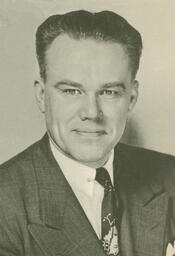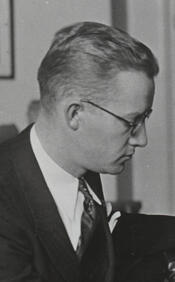
Frederick Allan Hartley Jr. (February 22, 1902 – May 11, 1969) was an American Republican politician from New Jersey who served ten consecutive terms in the United States House of Representatives from 1929 to 1949. Representing New Jersey’s 8th and later its 10th congressional districts, he became nationally prominent as the House sponsor of the Taft–Hartley Act of 1947, a landmark revision of federal labor law. Over two decades in Congress, Hartley contributed to the legislative process during a significant period in American history, spanning the Great Depression, World War II, and the early Cold War.
Hartley was born in Harrison, Hudson County, New Jersey, on February 22, 1902. He attended the public schools of Harrison and then Rutgers Preparatory School for his secondary education. He went on to attend Rutgers University, pursuing higher education that prepared him for public service and political life. After completing his studies in 1923, he quickly entered local public affairs, beginning a career that would move steadily from municipal responsibilities to national office.
Following his time at Rutgers, Hartley successfully ran in 1923 for the position of library commissioner in Kearny, New Jersey. He held that post for two years, gaining early administrative and public policy experience. He was then named police and fire commissioner for Kearny, a position he held until 1928. In these municipal roles, Hartley developed a reputation for diligence in local governance and public safety administration, which helped establish his standing within the Republican Party in northern New Jersey.
In 1928, Hartley was nominated as the Republican candidate for the United States House of Representatives from New Jersey’s 8th congressional district. In the general election held on November 6, 1928, he defeated the incumbent Democrat Paul J. Moore in a very close contest, receiving 64,915 votes to Moore’s 64,594, a margin of just 0.2 percent. Hartley was sworn into office on March 4, 1929, as the youngest member of the 71st United States Congress at age twenty-seven. He was again challenged by Moore in the 1930 election and was re-elected in another close race, winning 44,038 votes (50.4 percent) to Moore’s 43,195 votes (49.4 percent).
Hartley went on to represent New Jersey in the House of Representatives for ten terms, serving from March 4, 1929, until January 3, 1949. During this period, he represented both the 8th and, after redistricting and political realignments, the 10th congressional districts of New Jersey. He was one of a relatively small number of Republicans to hold their seats continuously through the political upheavals of the Great Depression and World War II. In 1932 he won election in New Jersey’s 10th congressional district by defeating William W. Harrison, and in 1934 he was re-elected over William Herda Smith. He survived another close contest in 1936, narrowly defeating Democratic challenger Lindsay H. Rudd by a 50.2 percent to 49.6 percent margin, and he soundly defeated Rudd again in 1938. Hartley continued to secure re-election in 1940 against William W. Holmwood, in 1942 against Frederic Bigelow, in 1944 against Luke A. Kiernan Jr., and in 1946 against Democrat Peter W. Rodino Jr., who would later succeed him in Congress.
As a member of the House of Representatives, Hartley participated actively in the democratic process and represented the interests of his New Jersey constituents during a transformative era in American political and economic life. He found the level of postwar labor unrest in the mid-1940s deeply troubling and believed it posed a threat to both economic and political stability. When the Republican Party regained control of both houses of Congress in the 1946 elections—the first such majority since the 1928 election in which Hartley had first won office—he assumed a central role in shaping labor legislation. In the 80th United States Congress he served as chairman of the House Committee on Education and Labor, placing him at the forefront of national debates over labor relations and industrial policy.
Working closely with Senator Robert A. Taft, chairman of the Senate Labor and Public Welfare Committee, Hartley in 1947 co-authored and sponsored legislation designed to curb what he and other supporters regarded as excesses in union power and labor tactics. The resulting measure, formally titled the Labor Management Relations Act of 1947 but widely known as the Taft–Hartley Act, constituted a major revision of the 1935 Wagner Act (the National Labor Relations Act) and was the first major New Deal statute to be significantly amended by the postwar Congress. The act restricted certain union practices, including secondary boycotts, and granted individual states the authority to enact right-to-work laws through its controversial Section 14(b). President Harry S. Truman vetoed the bill, but on June 23, 1947, Congress overrode the veto, with substantial support from both Republicans and a sizable minority of Democrats—20 of 45 Democratic senators and 107 of 188 Democratic representatives joined Republicans to enact the law. The Taft–Hartley Act has remained a central feature of American labor law and has long been opposed by major labor unions, which have repeatedly called for its repeal, particularly of Section 14(b). Despite periodic efforts, including a serious but ultimately unsuccessful attempt at repeal in the mid-1960s, the act has remained in force.
Hartley did not seek re-election to the House following the term in which the Taft–Hartley Act was passed, and his congressional service concluded on January 3, 1949. After leaving the House, he remained active in Republican politics and, in 1954, ran unsuccessfully for one of New Jersey’s two United States Senate seats. Following that defeat, he returned to New Jersey and spent the next fifteen years working as a business consultant, observing as the labor law that bore his name withstood its most serious political challenges and remained intact despite sustained opposition from organized labor and its allies.
Frederick Allan Hartley Jr. died in Linwood, New Jersey, on May 11, 1969. He was interred in Fairmount Cemetery in Newark, New Jersey. His family included his son, Al Hartley, who became a noted cartoonist best known for his work on Archie Comics. Hartley’s long tenure in Congress, his role as a Republican representative from New Jersey during a period of profound national change, and his central involvement in the passage of the Taft–Hartley Act secured his place as a significant figure in twentieth-century American legislative history.
Congressional Record