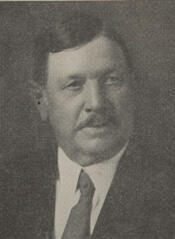
Franklin Menges (October 26, 1858 – May 12, 1956) was a Republican member of the U.S. House of Representatives from Pennsylvania who served three consecutive terms in Congress from 1925 to 1931. Over the course of his public career, he represented the interests of his constituents during a period of significant political and economic change in the United States and contributed to the legislative process as a member of the House of Representatives.
Menges was born on October 26, 1858, in Menges Mills, near Hanover, in York County, Pennsylvania. He grew up in rural south-central Pennsylvania at a time when the region was still heavily agricultural, an environment that would later shape his professional interests and public service. Details of his early family life are sparse in the historical record, but his upbringing in a small Pennsylvania community provided the foundation for his later engagement with education, science, and politics.
As a young man, Menges pursued higher education, reflecting the value he placed on learning and public instruction. He attended local schools in Pennsylvania and went on to study at institutions that prepared him for a career in teaching and scientific work. His education equipped him with a background in the sciences, particularly in fields related to agriculture and chemistry, which were of growing importance in the late nineteenth and early twentieth centuries as the United States modernized its agricultural practices and industrial base.
Before entering national politics, Menges built a career that combined education, scientific inquiry, and public engagement. He worked as an educator and lecturer, applying his academic training to practical and public purposes. His professional activities during these years helped establish his reputation as a knowledgeable and civic-minded figure in Pennsylvania, and they provided him with experience in explaining complex issues to lay audiences—an ability that would serve him well as a legislator. Through this work, he became increasingly involved in public affairs and aligned himself with the Republican Party, which was then dominant in much of Pennsylvania.
Menges’s congressional service began when he was elected as a Republican to the U.S. House of Representatives from Pennsylvania, taking office on March 4, 1925. He served three terms, remaining in Congress until March 3, 1931. During these years, which spanned the latter part of the Roaring Twenties and led up to the onset of the Great Depression, Franklin Menges contributed to the legislative process and participated in the democratic governance of the nation. As a member of the House of Representatives, he represented the interests of his Pennsylvania constituents, engaged in debates over national policy, and supported the Republican legislative agenda of the period. His tenure placed him in the midst of discussions over economic growth, agricultural conditions, and evolving federal responsibilities in an era of rapid change.
After leaving Congress in 1931, Menges returned to private life in Pennsylvania. Although no longer in federal office, he remained part of the civic fabric of his community, carrying with him the experience of three terms in the national legislature. His long life allowed him to witness profound transformations in American society, from the post–Civil War era of his youth through two world wars and the early years of the Cold War. Franklin Menges died on May 12, 1956, closing a life that had spanned nearly a century and included notable service as a Republican representative of Pennsylvania in the U.S. House of Representatives.
Congressional Record