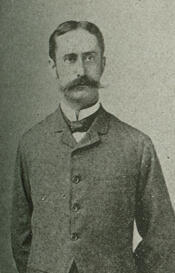
Franklin Bartlett (September 10, 1847 – April 23, 1909) was an American lawyer, soldier, and Democratic politician who served two terms as a U.S. Representative from New York from 1893 to 1897. He was born in Uxbridge, Worcester County, Massachusetts, the son of William Osborne Bartlett and Agnes Fredericka Herreshoff Willard Bartlett. He came from a family that would produce other prominent public figures, including his brother Willard Bartlett, who later became Chief Judge of the New York Court of Appeals.
Bartlett received a rigorous education that prepared him for a career in law and public service. He graduated from the Brooklyn Polytechnic Institute in New York, then attended Harvard University, where he completed his undergraduate studies and became a member of the Delta Kappa Epsilon fraternity. Pursuing legal training, he studied at Columbia Law School in New York City and was admitted to the bar, beginning the practice of law. He also broadened his education with study at Exeter College, Oxford University, in England, gaining exposure to British legal and political traditions that would inform his later work.
On June 4, 1872, Bartlett married Bertha King Post. The couple had one daughter, Bertha King Bartlett. While building his legal practice in New York, Bartlett became active in public affairs and Democratic Party politics. His legal expertise and growing reputation led to his selection as a member of the constitutional commission of the State of New York in 1890, where he participated in examining and proposing changes to the state’s fundamental law. His prominence within the party increased, and he served as a delegate to the Democratic National Convention in 1892, taking part in the national deliberations of his party during a pivotal presidential election year.
Bartlett’s congressional career began with his election as a Democrat to the Fifty-third Congress. He was subsequently reelected to the Fifty-fourth Congress, serving as a Representative from New York from March 4, 1893, to March 3, 1897. During these two terms in the United States House of Representatives, he participated in the legislative process at a time of significant economic and political change, including the aftermath of the Panic of 1893 and debates over monetary policy, tariffs, and industrial regulation. As a member of the House of Representatives, Franklin Bartlett represented the interests of his New York constituents and contributed to the democratic process through his work on legislation and committee assignments. A loyal member of the Democratic Party, he sought to advance its positions in Congress. He was an unsuccessful candidate for reelection in 1896 to the Fifty-fifth Congress, which ended his formal congressional service after four years.
After leaving Congress, Bartlett resumed his legal career and remained engaged in public life. When the United States went to war with Spain in 1898, he offered his services to the nation and was commissioned a colonel of volunteers during the war with Spain. His military role reflected both his patriotism and his standing as a former member of Congress and respected attorney. In addition to his professional and political activities, Bartlett was involved in hereditary and patriotic societies; he was a member of the Sons of the Revolution and the Society of Colonial Wars, organizations that emphasized the preservation of American history and recognition of ancestral service.
Franklin Bartlett died of a kidney disorder in Manhattan, New York County, New York, on April 23, 1909. He was interred at Green-Wood Cemetery in Brooklyn, New York, a resting place for many notable New Yorkers. His life encompassed service as a lawyer, constitutional commissioner, party delegate, congressman, and wartime colonel, and he remained closely connected to the civic and political life of New York and the nation until his death.
Congressional Record