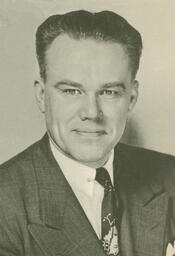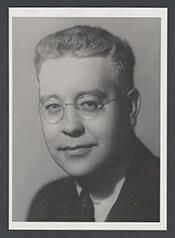
Frank William Towey Jr. (November 5, 1895 – September 4, 1979) was an American lawyer and Democratic politician who served as a United States Representative from New Jersey from 1937 to 1939. As a member of the Democratic Party, he represented New Jersey’s 12th congressional district for one term in the United States House of Representatives, contributing to the legislative process during a significant period in American history and participating in the democratic process on behalf of his constituents.
Towey was born and raised in Jersey City, New Jersey. He received his early education at Manresa Hall Grammar School and St. Peter’s Preparatory School, both in Jersey City. He then attended the College of the Holy Cross in Worcester, Massachusetts, from which he graduated in 1916. Pursuing a legal career, he enrolled at Fordham University School of Law in New York City and completed his law degree in 1919.
During World War I, Towey entered military service. He was commissioned as an infantry second lieutenant in the United States Army in September 1918. His period of active duty coincided with the final months of the war, and he served until he was honorably discharged in January 1919. Following his military service and completion of his legal studies, he was admitted to the bar in 1920 and commenced the practice of law in Newark, New Jersey, establishing himself in private practice and building the professional base that would later support his political career.
In 1936, Towey sought elective office as a Democrat, running for the U.S. House of Representatives from New Jersey’s 12th congressional district. He challenged eleven-term Republican incumbent Frederick R. Lehlbach in what became a closely contested race. In the general election, Towey narrowly defeated Lehlbach, receiving 54,688 votes to Lehlbach’s 54,363, a margin that translated into approximately 49.9 percent to 49.6 percent of the vote. His victory sent him to Washington as part of the Democratic majority during the New Deal era, and he served one term in the Seventy-fifth Congress from 1937 to 1939.
Towey’s congressional service took place during a transformative period in American political and economic life, as the federal government continued to respond to the effects of the Great Depression. As a member of the House of Representatives, he participated in the legislative process and represented the interests of his New Jersey constituents in national affairs. However, his tenure was limited to a single term. In the 1938 elections, he sought reelection and faced Republican challenger Robert W. Kean, a member of the prominent New Jersey Kean political family. In that contest, Towey was defeated by a margin of nearly 14 percent, bringing his congressional career to a close in January 1939.
After leaving Congress, Towey resumed the practice of law in Newark. He continued to serve in public roles at the state and federal levels while maintaining his legal career. From 1940 to 1947, he was a member of New Jersey’s Selective Appeal Board, participating in the administration and review of draft classifications during the period that spanned World War II and its immediate aftermath. In 1943, he was appointed assistant to the Attorney General of the United States, a position he held until 1955, contributing to the work of the Department of Justice over more than a decade.
Frank William Towey Jr. spent his later years in New Jersey. He died in Montclair, New Jersey, on September 4, 1979, at the age of 83. His ashes were interred in Acacia Memorial Park near Seattle, Washington, closing the life of a lawyer and public servant who had participated in both state and national service during a pivotal era in twentieth-century American history.
Congressional Record