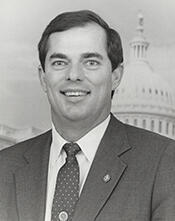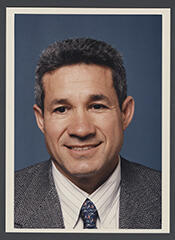
Frank Mariano Tejeda (October 2, 1945 – January 30, 1997) was an American Democratic politician from Texas who served as a Representative from Texas in the United States Congress from 1993 to 1997. A native of San Antonio, he became known as a conservative Democrat whose legislative work in Congress focused particularly on veterans’ issues. Over the course of three terms in the U.S. House of Representatives, he represented Texas’s 28th congressional district and participated actively in the legislative process during a significant period in American political history.
Tejeda was born in San Antonio, Texas, on October 2, 1945, and grew up in an impoverished household on the city’s South Side. He attended St. Leo’s Catholic School and Harlandale High School in the Harlandale Independent School District. His youth was marked by hardship; as a teenager he joined a gang and eventually dropped out of high school. Seeking a new direction, he enlisted in the United States Marine Corps, a decision he later credited with turning his life around. While in the Marines he resumed his education and passed the General Educational Development (GED) test, laying the groundwork for his later academic and professional achievements.
During the Vietnam War, Tejeda served in the United States Marine Corps from 1963 to 1967 and was wounded in action. His combat service earned him several decorations for valor, including the Silver Star, the Bronze Star, and the Purple Heart. After his active-duty service, he continued his military involvement in the Marine Corps Reserve, ultimately attaining the rank of major. His experiences in Vietnam and in the Marine Corps more broadly shaped his lifelong commitment to veterans and military affairs, which would later become central themes of his legislative agenda at both the state and federal levels.
Following his return to Texas, Tejeda pursued higher education with determination. He earned a bachelor’s degree from St. Mary’s University in San Antonio in 1970. He then attended the University of California, Berkeley, School of Law, where he received his J.D. in 1974. While serving later as a state legislator, he continued to advance his education: in 1980 he obtained a Master of Arts degree from Harvard University, and in 1989 he earned a Master of Laws (LL.M.) from Yale Law School. This combination of military experience and advanced legal and policy training helped shape his reputation as a serious, policy-focused lawmaker.
Inspired in part by the legacy of the Great Society and the expanding role of government in addressing social and economic issues, Tejeda entered public office in the Texas Legislature. He was elected to the Texas House of Representatives in 1976 and served there from 1976 to 1987. In the House, he built a record as a diligent representative of his San Antonio district, focusing on issues affecting working-class families, education, and veterans. In 1987 he moved to the upper chamber of the state legislature, serving in the Texas Senate from 1987 to 1993. His tenure in the Senate further enhanced his profile as a legislator attentive to both local concerns and broader statewide policy questions.
Tejeda was elected to the United States House of Representatives in 1992 with 87 percent of the vote, representing Texas’s newly created 28th Congressional District. A member of the Democratic Party, he took office on January 3, 1993, and served in Congress from 1993 until his death in 1997, completing two full terms and beginning a third. In the House of Representatives, he served on the Armed Services Committee and the Veterans’ Affairs Committee, assignments that reflected his military background and allowed him to champion veterans’ benefits, health care, and military readiness. As a conservative Democrat, he often emphasized fiscal responsibility and traditional values while maintaining a strong commitment to his largely Hispanic, working-class constituency in South Texas.
Frank Mariano Tejeda’s service in Congress occurred during a period of significant national debate over defense policy, federal spending, and health care. He contributed to the legislative process by representing the interests of his district and by advocating for those who had served in the armed forces, drawing on his own experience as a decorated Marine. His colleagues and constituents regarded him as a disciplined, low-profile legislator who focused more on substantive work than on publicity, and he became a respected voice on matters affecting veterans and military personnel.
On January 30, 1997, shortly after the beginning of his third term in Congress, Tejeda died in San Antonio from pneumonia at the age of 51, following a year-long battle with brain cancer. His death ended a two-decade career in elected office that had taken him from the Texas House of Representatives to the Texas Senate and finally to the U.S. House of Representatives. He was buried with full military honors at Fort Sam Houston National Cemetery in San Antonio, a final recognition of his distinguished service in the United States Marine Corps and his long public service.
In the years following his death, numerous public facilities and honors were dedicated in Tejeda’s memory, reflecting the esteem in which he was held in Texas and among veterans nationwide. On September 1, 1997, the Texas Legislature designated U.S. Highway 281 from Interstate 410 to the Atascosa–Bexar county line as the “Congressman Frank M. Tejeda Memorial Highway.” A charter high school in the Harlandale Independent School District, Frank Tejeda Academy, was named for him in the same district where he had grown up and attended school. The Frank M. Tejeda Post Office Building and the Department of Veterans Affairs outpatient clinic in San Antonio were also named in his honor, as were Frank Tejeda Estates, a housing development at Lackland Air Force Base, and Frank Tejeda Middle School in the North East Independent School District. Division Park in San Antonio was renamed Frank Tejeda Park in 1996, and the Texas State Veterans Home in Floresville, Texas, bears his name. In addition, the Marine Corps Reserve Association established the Major Frank M. Tejeda Leadership Award to recognize leaders committed to the Marine Corps, underscoring his enduring legacy as both a Marine officer and a public servant.
Congressional Record