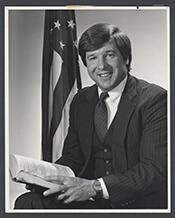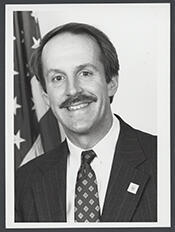
Frank Duncan Riggs (September 5, 1950 – December 20, 2023) was an American U.S. Army veteran, law enforcement officer, charter school executive, and Republican politician from the states of California and Arizona. Over the course of his public career, he served three terms as a Representative from California in the United States Congress from 1991 to 1999, contributing to the legislative process during a significant period in American history. As a member of the House of Representatives, he participated in the democratic process and represented the interests of his constituents while also becoming a prominent advocate for charter schools and education reform.
Riggs served in the U.S. Army early in his adult life, an experience that preceded and informed his later work in law enforcement and public service. Following his military service, he worked as a law enforcement officer, gaining experience in public safety and local government operations. His background in the Army and in policing helped shape his views on public policy, particularly in areas related to crime, community safety, and the role of government institutions. Before entering Congress, he also became involved in the charter school movement, eventually working as a charter school executive, which would later influence his legislative priorities in education.
Riggs was elected to the United States House of Representatives as a Republican in 1990 from California’s 1st Congressional District, a district stretching from Napa County to the northern Pacific coast. In that election he narrowly defeated four-term Democratic incumbent Doug Bosco. He took office on January 3, 1991, serving in the 102nd Congress. His initial term coincided with the end of the Cold War and the lead-up to the Gulf War, and he distinguished himself by voting against the Gulf War resolution. During this first term he also became a member of the “Gang of Seven,” a group of freshman Republican congressmen who pressed for public disclosure of the names of members of Congress who had made overdrafts at the House Bank, positioning himself as a reform-minded legislator focused on accountability and transparency.
Riggs’s early congressional career was marked by both defeat and comeback. In the 1992 election he lost his seat to Democrat Dan Hamburg. Two years later, in the 1994 midterm elections, he ran a rematch against Hamburg and regained the seat, returning to Congress for the 104th Congress. In 1996 he won re-election again, this time over Democrat Michela Alioto-Pier by about four percentage points, securing a third and final term in the House and serving through the 105th Congress, which ended on January 3, 1999. Across these three terms, he remained a member of the Republican Party and was an active participant in the legislative debates of the 1990s.
During his congressional service, Riggs held assignments on several influential committees. He served on the House Appropriations Committee, including its Agriculture Subcommittee and its Energy and Water Development Subcommittee, where he dealt with federal spending priorities affecting rural communities, agriculture, and infrastructure. He also served on the House Transportation and Public Works Committee and the House Banking and Financial Affairs Committee, giving him a role in shaping policy on transportation systems, public works projects, and financial regulation. In addition, he served on the House Education and Workforce Committee, where he focused on education and labor issues at the national level.
Riggs’s most prominent legislative work came in the field of education. In the 105th Congress he chaired the Subcommittee on Early Childhood, Youth and Families of the House Education and Workforce Committee. In that capacity, he authored the Charter School Expansion Act, a significant piece of federal legislation designed to support the growth of charter schools across the United States. The act, which provided federal start-up grants to newly formed charter schools to help defray their initial operating expenses, was signed into law by President Bill Clinton in October 1998. As a result of this legislation, most Arizona charter schools, among many others nationwide, received federal start-up grants, cementing Riggs’s legacy as a leading congressional advocate for charter school development and school choice.
After leaving Congress in 1999, Riggs continued his involvement in education and public policy, working as a charter school executive and remaining active in Republican politics, particularly after relocating to Arizona. In 2005, he explored a run for governor of Arizona at a time when many Arizona Republicans were reluctant to challenge the popular Democratic incumbent, Governor Janet Napolitano, in the 2006 election. His plans were curtailed when he discovered that Arizona law required a five-year residency to run for governor, a requirement he did not yet meet. He remained engaged in state politics and policy discussions, especially on education issues.
Riggs later sought elective office in Arizona on several occasions. In 2014, he ran for the Republican nomination for Governor of Arizona but was unsuccessful, finishing last in the Republican primary with less than five percent of the vote. In 2016, he formed an exploratory committee for a possible candidacy for the Arizona Corporation Commission, the state body that regulates utilities and certain business activities, but ultimately chose not to run for the position. In the 2018 Arizona Republican primary election, he sought the office of Superintendent of Public Instruction, running against college professor Bob Branch, incumbent Superintendent Diane Douglas, former Basis Charter Schools Director of Charter School Development Jonathan Gelbart, and former public school teacher Tracy Livingston. In a close primary contest in which he and Branch traded the lead several times, Riggs ultimately prevailed by a margin of only 249 votes. He advanced to the general election but was defeated on November 6, 2018, by Democrat Kathy Hoffman.
Frank D. Riggs died on December 20, 2023, at the age of 73. Over the course of his life, he combined military service, law enforcement work, and educational leadership with a political career that spanned two states and three terms in the U.S. House of Representatives. His congressional tenure from 1991 to 1999, his role in the “Gang of Seven,” and his authorship of the Charter School Expansion Act left a lasting imprint on federal education policy and on the development of charter schools, particularly in Arizona, where many schools benefited from the federal start-up grants made possible by his legislation.
Congressional Record