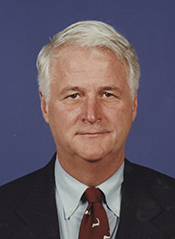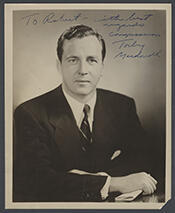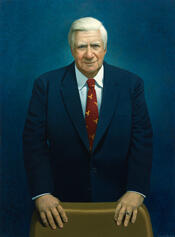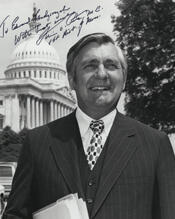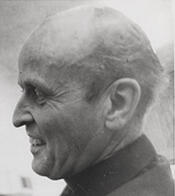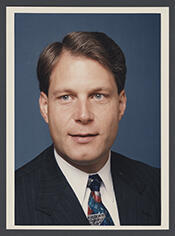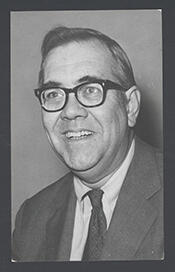
Frank Bradford Morse (August 7, 1921 – December 18, 1994) was an American lawyer, legislator, and international civil servant who served as a Republican member of the United States House of Representatives from Massachusetts from 1961 to 1973 and later held senior leadership positions at the United Nations. Over nearly twenty years in and around Congress, including twelve years as Congressman from Lowell, Massachusetts, and more than a decade in high-ranking posts at the United Nations, he played a significant role in domestic legislative affairs and international development. In 1972, he became Under-Secretary-General of the United Nations, and in 1976 he was appointed Administrator of the United Nations Development Programme. For his career as an international public servant, he received the Franklin D. Roosevelt Four Freedoms Award.
Morse was born in Lowell, Massachusetts, on August 7, 1921. He attended local schools before serving in the United States Army during World War II from 1942 to 1946, rising to the rank of second lieutenant before his discharge. After the war, he pursued higher education under the G.I. Bill, graduating from Boston University in 1948 and from Boston University School of Law in 1949. His early professional life reflected a broad engagement with the legal and academic communities: he entered private practice as a lawyer, worked as a business executive, served as a law clerk to the Chief Justice of the Supreme Judicial Court of Massachusetts, and taught as a professor at Boston University School of Law between 1949 and 1953.
Morse’s political and governmental career began at the local level when he was elected to the Lowell City Council in 1952, serving until 1953. That year he moved to the federal level as a staff member for the United States Senate Armed Services Committee, a position he held until 1955. From 1955 to 1958 he served as executive secretary and chief assistant to United States Senator Leverett Saltonstall of Massachusetts, gaining extensive experience in legislative affairs and constituent service. He then joined the executive branch as a deputy administrator of the Veterans Administration, serving from 1958 to 1960, where he helped oversee programs for former servicemembers in the postwar era.
Following the death of long-serving Representative Edith Nourse Rogers in September 1960, Morse was selected by the Republican Party to take her place on the ballot for Massachusetts’s 5th Congressional District. He was elected as a Republican to the Eighty-seventh Congress in November 1960 and took office on January 3, 1961. He was subsequently re-elected to the five succeeding Congresses, serving continuously until his resignation on May 1, 1972. During his six terms in the House of Representatives, Morse represented the interests of his Lowell-area constituents while participating in the broader legislative process during a period marked by the civil rights movement, the Great Society, and the Vietnam War. His congressional service formed the core of nearly twenty years of work in and around Congress.
As a legislator, Morse supported major civil rights and social welfare measures that reshaped American public policy in the 1960s. He voted in favor of the 24th Amendment to the U.S. Constitution, which abolished the poll tax in federal elections, and supported the Civil Rights Act of 1964 and the Voting Rights Act of 1965, landmark statutes aimed at ending segregation and protecting African American voting rights. He backed the creation of the Medicare program to provide health insurance for the elderly and supported the Civil Rights Act of 1968, which included fair housing provisions. Reflecting an interest in broader health coverage, he joined fellow House Republicans Seymour Halpern, Charles Adams Mosher, and Ogden Reid in co-sponsoring the Health Security Act, a bipartisan proposal for a government-run health insurance program intended to cover every person in the United States. In 1966, he was among three Republican Senators and four other Republican Representatives who signed a telegram to Georgia Governor Carl E. Sanders protesting the Georgia legislature’s refusal to seat Julian Bond in the state House of Representatives. The telegram described the refusal as “a dangerous attack on representative government,” and, while stating that the signers strongly repudiated Bond’s views on the Vietnam War, affirmed that he was entitled to express those views unless a court of law determined otherwise.
Morse resigned from Congress in 1972 to accept an appointment at the United Nations, marking the beginning of the second major phase of his public career. That year he became Under-Secretary-General for Political and General Assembly Affairs, serving from 1972 to 1976. In this capacity, he was involved in managing the work of the General Assembly and addressing a range of political and diplomatic issues during a period of Cold War tensions and decolonization. In 1976, he was promoted to be the third Administrator of the United Nations Development Programme (UNDP), a position he held from 1976 to 1986. As head of UNDP, he oversaw international development assistance programs, working with member states and multilateral partners to support economic and social development in emerging and developing countries.
After leaving UNDP in 1986, Morse continued his engagement with international affairs and leadership development. From 1986 to 1991, he served as the seventh president of the Salzburg Global Seminar, a non-profit organization based in Salzburg, Austria, whose mission is to challenge current and future leaders to develop creative ideas for solving global problems. His work there extended his long-standing interest in international cooperation and policy innovation beyond formal governmental structures. In recognition of his decades of service in international public life, he received the Franklin D. Roosevelt Four Freedoms Award, honoring his contributions to the ideals of freedom of speech, freedom of worship, freedom from want, and freedom from fear.
Frank Bradford Morse died at his home in Naples, Florida, on December 18, 1994. He was cremated, and his remains were placed in Arlington National Cemetery in Arlington, Virginia, reflecting both his military service in World War II and his long career in national and international public service.
Congressional Record