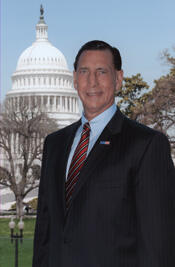
Frank Alo LoBiondo (born May 12, 1946) is an American businessman and politician who served as the U.S. Representative for New Jersey’s 2nd congressional district from January 3, 1995, to January 3, 2019. A member of the Republican Party, he represented all of Atlantic, Cape May, Cumberland, and Salem Counties and parts of Camden, Gloucester, Burlington, and Ocean Counties during his twelve terms in Congress. His service in the House of Representatives occurred during a significant period in modern American political history, and he participated actively in the legislative process while representing the interests of his South Jersey constituents.
LoBiondo was born in Bridgeton, New Jersey, and was raised on a farm in the Rosenhayn section of Deerfield Township in Cumberland County. Growing up in an agricultural setting, he was exposed early to the concerns of rural communities and small businesses. He attended Georgetown Preparatory School in North Bethesda, Maryland, a Jesuit college-preparatory institution, before pursuing higher education in business. He went on to receive a Bachelor of Arts degree in Business Administration from Saint Joseph’s University in Philadelphia, Pennsylvania, grounding himself in the principles of management and finance that would later inform both his private-sector work and his public service.
Following his graduation, LoBiondo entered the private sector, working for twenty-six years in a family-owned trucking company. This long tenure in the transportation industry gave him firsthand experience with the regulatory, infrastructure, and labor issues facing small and mid-sized businesses, particularly in logistics and freight. His business background and familiarity with regional economic concerns would later shape his legislative priorities, especially in the areas of transportation, infrastructure, and job creation.
LoBiondo’s formal political career began at the county level. He served on the Cumberland County Board of Chosen Freeholders from 1985 to 1987, where he gained experience in local governance, budgeting, and constituent services. Building on this foundation, he successfully ran for the New Jersey General Assembly from the 1st Legislative District in 1987. He served in the lower chamber of the New Jersey Legislature from 1988 to 1994, winning re-election in 1989, 1991, and 1993. During these years in state office, he developed a reputation as a pragmatic Republican attentive to the needs of his coastal and rural district.
In 1992, LoBiondo made his first bid for the U.S. House of Representatives, challenging incumbent Democrat William J. Hughes in New Jersey’s 2nd congressional district. He was defeated by a wide margin, but the race established him as a serious regional figure. When Hughes declined to seek re-election in 1994, LoBiondo ran again and was elected to the House in the Republican wave of the 1994 midterm elections. As a member of the large Republican freshman class aligned with Speaker Newt Gingrich’s “Contract with America,” he entered Congress at a time of significant partisan realignment. From that point forward, he won every re-election bid with at least 59 percent of the vote, even though the district was considered marginally Democratic-leaning on paper. The 2nd district gave President Barack Obama 54 percent of the vote in 2012, and in 2016 it gave President Donald J. Trump a five-point victory over Democrat Hillary Clinton, underscoring the district’s competitive and shifting political character.
During his congressional tenure, LoBiondo held a number of influential committee assignments that reflected both his regional interests and his policy expertise. He served on the House Committee on Armed Services, including the Subcommittee on Tactical Air and Land Forces and the Subcommittee on Readiness, where he worked on issues affecting national defense, military readiness, and the defense industrial base. He was also a long-serving member of the House Committee on Transportation and Infrastructure, where he sat on the Subcommittee on Coast Guard and Maritime Transportation, the Subcommittee on Highways and Transit, and the Subcommittee on Aviation, chairing the Aviation Subcommittee. In that role he was involved in oversight of the Federal Aviation Administration and aviation safety, as well as policy affecting airports and air traffic control. In addition, he served on the House Permanent Select Committee on Intelligence, participating in oversight of the intelligence community during an era marked by concerns over terrorism, cybersecurity, and global security threats.
LoBiondo’s political profile was that of a moderate Republican, and he was a member of the Republican Main Street Partnership, a group of centrist GOP lawmakers. His voting record on several issues, particularly environmental protection and labor union matters, often placed him to the left of many in his party. In 2005, National Journal ranked him as the most liberal Republican representative in New Jersey and more liberal than most of New York’s Republican congressional delegation. That same year, Americans for Democratic Action placed him in a higher liberal quotient than most Republican representatives in both states. His willingness to work across party lines was reflected in his ranking as the 13th most bipartisan member of the U.S. House of Representatives during the 114th Congress, and the most bipartisan member of the House from New Jersey, according to the Bipartisan Index created by The Lugar Center and the McCourt School of Public Policy, which measures cross-party co-sponsorship of legislation.
On social and regulatory issues, LoBiondo generally adhered to mainstream Republican positions while occasionally breaking with party leadership. He opposed taxpayer-funded abortion except in cases of incest, rape, or threat to the life of the mother, and he consistently voted against federal funding for abortion whenever it came to a vote. On drug policy, he received a “B” grade from the National Organization for the Reform of Marijuana Laws (NORML) for his voting record on cannabis-related matters. He supported the Veterans Equal Access Amendment, which sought to allow Department of Veterans Affairs physicians to provide veterans with information on accessing medical marijuana in accordance with state law. In presidential politics, he endorsed New Jersey Governor Chris Christie in the 2016 Republican primary. In the general election he supported the Republican ticket but rescinded his public support for nominee Donald Trump in October 2016 after the release of the “Access Hollywood” recording featuring Trump and Billy Bush; he ultimately stated that he ended up voting for Trump.
LoBiondo’s long congressional career was not without controversy in his political orbit. On March 4, 2011, Andrew J. McCrosson Jr., who had served as treasurer of LoBiondo’s congressional campaign committee from 1995 until August 2010, pleaded guilty in federal district court to charges of embezzling more than $458,000 from campaign accounts over a fifteen-year period. The charges included one count of wire fraud and one count of converting funds contributed to a federal candidate. LoBiondo’s campaign attorney characterized McCrosson’s actions as “an abuse of the trust placed in him by the campaign.” McCrosson was subsequently sentenced to 30 months in prison. There was no allegation that LoBiondo himself was involved in or aware of the misconduct.
LoBiondo continued to secure re-election throughout the 2000s and 2010s. In 2014, he ran again for the U.S. House, winning the Republican nomination in the June 3 primary. In the general election he faced Democrat William J. Hughes Jr., the son of his predecessor, and prevailed with the backing of a broad coalition that included endorsements from Governor Chris Christie, the Laborers’ International Union of North America, the U.S. Chamber of Commerce, the New Jersey State Building & Construction Trades Council, and the New Jersey State Fraternal Order of Police. He was re-elected again in 2016, running unopposed in the Republican primary and defeating Democrat David Cole in the general election. In November 2017, after more than two decades in Congress, LoBiondo announced that he would retire at the end of his term and would not seek re-election in 2018, concluding a twelve-term career in the U.S. House of Representatives.
Congressional Record