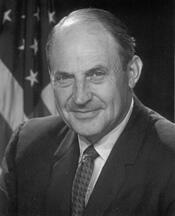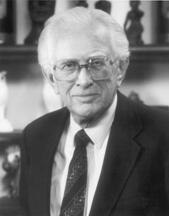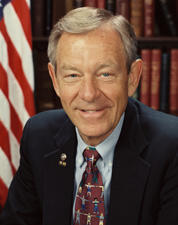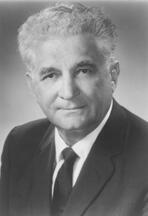
Frank John Lausche (November 14, 1895 – April 21, 1990) was an American Democratic politician from Ohio who rose from modest beginnings in Cleveland to become a prominent figure in mid‑twentieth‑century state and national politics. A member of the Democratic Party, he served as the 47th mayor of Cleveland, the 55th and 57th governor of Ohio, and represented Ohio in the United States Senate for two terms from 1957 to 1969. His service in Congress occurred during a significant period in American history, and as a United States Senator from Ohio he participated in the legislative process and represented the interests of his constituents during two full terms in office.
Lausche was born in Cleveland, Ohio, on November 14, 1895, the son of Slovenian immigrants Louis Lausche and Frances (née Milavec) Lausche. He grew up in the St. Clair–Superior neighborhood on Cleveland’s East Side, in a close‑knit ethnic community centered around St. Vitus Church. He attended St. Vitus Grade School for grades one through four, St. Francis Grade School in grade five, and Madison Grammar School for grades six through eight, after which he enrolled at Central Institute Preparatory School. In 1911, following the death of his older brother, he left school to help support his family. As a young man he was an avid baseball player, and his athletic talent became a formative part of his early life.
While working to support his family, Lausche played baseball locally and was recruited as a third baseman for the amateur White Motor team, which won a national championship. His performance attracted professional scouts, and in the spring of 1916 he reported to the Duluth White Sox of the Class D Northern League in Duluth, Minnesota. He began the season batting .422 but struggled with curve balls and was released after 31 games. He then signed with a semi‑professional team in Virginia, Minnesota, but performed poorly and soon returned to Cleveland and amateur baseball. In the spring of 1917 he joined the Class B Lawrence Barristers of Lawrence, Massachusetts, in the Eastern League, again starting well but being released after 27 games. That summer he enlisted in the United States Army and reported to Camp Gordon near Atlanta, Georgia, where his baseball skills led to his placement on the camp team. He was promoted to second lieutenant after eight months and assigned to officers’ training school, and his high batting average was later credited with sparing him a posting to the front lines in World War I. The camp team’s manager, Charles Frank—owner and manager of the Atlanta Crackers of the Class AA Southern Association—offered him a professional contract after the war, but by then Lausche had completed high school while in the Army and was contemplating a different career.
In early 1919, Lausche entered the Cleveland‑Marshall School of Law (then the John Marshall School of Law) and chose to continue his legal studies rather than report to spring training with the Atlanta Crackers, despite the offer of a six‑month contract at $225 per month. He graduated in 1921, ranking second in his class, and quickly established himself as one of Cleveland’s better trial lawyers. His reputation at the bar led to judicial office: he served as a judge of the Cleveland Municipal Court from 1932 to 1937 and as a judge of the Cuyahoga County Common Pleas Court from 1937 to 1941. These judicial posts provided him with broad exposure to urban legal and social issues and helped build the public profile that would carry him into elective executive office.
Lausche was elected mayor of Cleveland in 1941 and took office as the city’s 47th mayor, serving until 1944. His tenure coincided with the World War II years, when Cleveland was a major industrial center, and he developed a reputation as a plain‑spoken, pragmatic big‑city leader. In 1944 he successfully ran for governor of Ohio, becoming the state’s first Roman Catholic governor. He served his first term as the 55th governor from 1945 to 1947, but narrowly lost his bid for reelection to Republican Thomas J. Herbert. In a 1948 rematch, Lausche defeated Herbert and returned to the governorship, serving four consecutive two‑year terms from 1949 to 1957 as the 57th governor. He was reelected in 1950 over state treasurer Don H. Ebright, in 1952 over Cincinnati mayor Charles Phelps Taft II, and in 1954 over state auditor Jim Rhodes, who would later become governor himself. Lausche’s electoral strength rested heavily on his ability to build and maintain a coalition of ethnic and urban voters in Cleveland and across the state, a group sometimes referred to as the “cosmopolitan Democrats.”
In November 1956, Lausche was elected to the United States Senate, unseating incumbent Republican George H. Bender. He resigned the governorship in early 1957 to take his Senate seat, beginning a congressional career that would last until 1969. During his first term, when party control of the Senate was closely divided, he briefly alarmed Senate Democratic leader Lyndon B. Johnson by hinting that he might support Republican William F. Knowland for Senate Majority Leader, though he ultimately did not do so. Lausche was known throughout his career for his bipartisan and independent approach to politics, often described as a “Democrat with a small ‘d’.” This independence, which sometimes put him at odds with organized labor and elements of his own party, also earned him the derisive nickname “Frank the Fence” among some critics. Nevertheless, he remained popular with many voters and was easily reelected to the Senate in 1962. In 1968, however, his increasingly strained relationship with labor unions and party activists contributed to his defeat in the Democratic primary by former Congressman John J. Gilligan, who prevailed by a margin of 55 percent to 45 percent. In the general election that followed, Lausche declined to support Gilligan, who went on to lose to Republican state attorney general William B. Saxbe.
After leaving the Senate in 1969, Lausche retired from elective office but remained a respected figure in Ohio politics. His style of ethnic, urban Democratic politics influenced a generation of Cleveland leaders, including Ralph S. Locher, who became mayor of Cleveland and later an associate justice of the Ohio Supreme Court, and Bronis Klementowicz, a leader of the Cleveland City Council and later law director under Locher. Lausche’s popularity and reputation for independence were such that there is evidence Republican presidential candidate Dwight D. Eisenhower considered him as a possible running mate in 1952, and he was said to have been discussed again in Republican circles during the 1956 campaign by party chairman Leonard W. Hall in a presidential meeting. In recognition of his service and standing in the Catholic community, he was named a Knight of St. John of Malta by Pope John Paul II, described as the highest civilian honor that can be bestowed by the Catholic Church.
In retirement, Lausche and his wife, Jane, made their home in Bethesda, Maryland. Jane Lausche, who converted to the Roman Catholic faith, died on November 24, 1981, and was buried at Calvary Cemetery in southeast Cleveland. Frank Lausche continued to reside in Bethesda until January 1990, when he contracted pneumonia. He was flown back to Cleveland and admitted to the Slovenian Home for the Aged on February 20, 1990, where he died of congestive heart failure on April 21, 1990, at the age of ninety‑four. His funeral Mass was celebrated at St. Vitus Church, the parish of his youth, with Bishop Anthony Edward Pevec delivering the homily, and he was interred at Calvary Cemetery. His tombstone was mistakenly inscribed with a birth year of 1898 rather than 1895.
Lausche’s legacy has been commemorated in numerous ways in Ohio and within the Slovenian‑American community. The State of Ohio’s office building in downtown Cleveland bears his name, as does the Lausche Building at the Ohio Expo Center, site of the Ohio State Fair in Columbus. In Cleveland’s St. Clair–Superior neighborhood, Glass Avenue, running between East 60th and East 64th Streets adjacent to St. Vitus Church, was renamed Lausche Avenue in honor of his family’s long residence and parish membership. A bust of Lausche is displayed at St. Mary of the Assumption Church in Cleveland’s Collinwood neighborhood, and an exhibit of his papers and artifacts is maintained at Cleveland’s Slovenian Museum and Archives. His career has been the subject of scholarly attention, notably James E. Odenkirk’s 2005 biography, “Frank J. Lausche: Ohio’s Great Political Maverick,” which examines in depth the life and career of one of Ohio’s most distinctive political figures.
Congressional Record