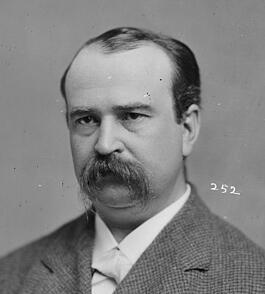
Frank Hunt Hurd (December 25, 1840 – July 10, 1896) was an American lawyer and Democratic politician who served as a U.S. Representative from Ohio for three nonconsecutive terms between 1875 and 1885. Over the course of his congressional career he represented Ohio in the Forty-fourth, Forty-sixth, and Forty-eighth Congresses, participating in the legislative process during a significant period in American history and representing the interests of his constituents in the House of Representatives.
Hurd was born on December 25, 1840, in Mount Vernon, Knox County, Ohio. He was the son of Rollin C. Hurd, a local judge of some prominence, and Mary B. Hurd, who was the sister of Daniel S. Norton, later a United States senator from Minnesota. Raised in a family closely connected to the law and public affairs, Hurd received his early education in Ohio and then attended Kenyon College in nearby Gambier. He graduated from Kenyon in 1858 and was a member of the Delta Kappa Epsilon fraternity, an affiliation that placed him among the rising professional and political class of the state.
After completing his collegiate studies, Hurd read law under the guidance of his father in Mount Vernon. He was admitted to the Ohio bar in 1861 and commenced the practice of law in his hometown. His legal abilities and family connections quickly led him into public service. In 1863 he was elected prosecuting attorney of Knox County, Ohio, a position in which he gained practical experience in criminal law and courtroom advocacy during the Civil War era.
Hurd’s state-level political career advanced rapidly. In 1866 he was elected a member of the Ohio State Senate, where he served during a period of post–Civil War reconstruction and legal reform. In 1868 he was appointed to participate in the codification of the criminal laws of Ohio. In this capacity he was credited with inserting a significant provision into the code that permitted the accused to testify in their own defense, a reform that reflected evolving views of criminal procedure and the rights of defendants.
In 1869 Hurd moved from Mount Vernon to Toledo, Ohio, a growing commercial city on Lake Erie, and there he reentered active politics while continuing his legal practice. He served as city solicitor of Toledo from 1871 to 1873, acting as the municipality’s chief legal officer. In 1872 he was the Democratic nominee for election to the Forty-third Congress, but he was unsuccessful in that first bid for national office. Nonetheless, his prominence within the Democratic Party in Ohio continued to grow, and he remained an influential figure in local and state politics.
Hurd was elected as a Democrat to the Forty-fourth Congress, serving from March 4, 1875, to March 4, 1877, thus beginning the first of his three nonconsecutive terms in the U.S. House of Representatives. He was an unsuccessful candidate for reelection in 1876 to the Forty-fifth Congress. He returned to the House after winning election to the Forty-sixth Congress, serving from March 4, 1879, to March 4, 1881, but again failed in his bid for reelection in 1880 to the Forty-seventh Congress. Hurd secured a third term when he was elected to the Forty-eighth Congress, serving from March 4, 1883, to March 4, 1885. He unsuccessfully contested the election of Jacob Romeis to the Forty-ninth Congress and later was an unsuccessful Democratic candidate for election in 1886 to the Fiftieth Congress. Across these years, from 1875 to 1885, he contributed to the legislative process during three terms in office, taking part in debates on economic and legal issues central to the late nineteenth century.
Within Congress, Hurd became particularly noted for his oratorical skill and his advocacy of free trade. His speech on free trade, delivered in the House of Representatives on February 18, 1881, was widely regarded as a classic statement of that position and was later compared to Henry Clay’s famous 1832 Senate speech on “The American System.” Hurd’s address opened with the memorable phrase “The tariff is a tax,” a formulation that gained broader currency when used years later by President Grover Cleveland. Journalist and future Toledo mayor Brand Whitlock, in his autobiography “Forty Years of It,” credited Hurd’s eloquence and Democratic principles with influencing his own decision to join the Democratic Party, recalling Hurd’s “beautiful voice” and the “majestic music of his rolling phrases” and describing him as a dedicated student of the art of oratory.
After his final term in Congress, Hurd returned to Toledo and resumed the full-time practice of law. He remained an active and respected member of the Ohio bar and a figure of influence in Democratic circles, though he did not again hold public office. He continued his legal work in Toledo until his death on July 10, 1896. Frank Hunt Hurd was interred in Mound View Cemetery in Mount Vernon, Ohio, returning in death to the community where his legal and political career had begun.
Congressional Record