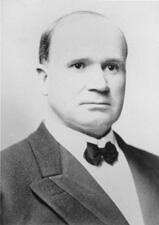
Frank Robert Gooding (September 16, 1859 – June 24, 1928) was a Republican United States senator and the seventh governor of Idaho. A dominant figure in Idaho politics in the early twentieth century, he served as a United States senator from Idaho from 1921 until his death in 1928 and as governor from 1905 to 1909. The city of Gooding and Gooding County, both in southern Idaho, are named in his honor, reflecting his prominence in the state’s political and economic life.
Gooding was born in Devon County, England, and emigrated to the United States with his family in 1867, settling on a farm near Paw Paw, Michigan. He attended the common schools there and worked on the family farm during his youth. In 1877 he moved west to Mount Shasta, California, where he engaged in farming and mining, part of the broader migration of young men seeking opportunity in the American West. Four years later, in 1881, he moved to the Idaho Territory, where he would build his fortune and political base.
Upon his arrival in Idaho Territory, Gooding became one of the largest sheep owners in the state, establishing himself as a leading figure in the region’s livestock industry. He initially settled in Ketchum, near what would later become the Sun Valley resort area, working as a mail carrier and then entering the firewood and charcoal business. In 1888 he moved south and settled near the site of the present-day city of Gooding. There he continued to expand his sheep and land interests and became a central figure in the development of the surrounding agricultural region. Although he had not yet become a U.S. citizen, he was already emerging as a local leader and organizer.
After Idaho achieved statehood in 1890, Gooding quickly rose within the Republican Party, aligning with and helping to lead its conservative faction. He was named chairman of the Lincoln County Republicans in 1896 and was elected to the Idaho Legislature in 1898. From 1900 to 1904 he served as state chairman of the Idaho Republican Party, consolidating his influence over party machinery and patronage. Known for an abrasive and often off-putting personal style, he frequently clashed with other Republicans, including progressive Senator William E. Borah. In 1904, before he had formally become a U.S. citizen, Gooding was elected governor of Idaho, underscoring both his political strength and the fluidity of citizenship and eligibility rules in the period.
Gooding served two consecutive two-year terms as governor from 1905 to 1909. His administration coincided with a period of institutional growth in Idaho, including the construction of the Idaho State Capitol building in Boise. He also played a significant role in the development of state educational institutions. The Idaho School for the Deaf and the Blind (ISDB) was first established in Boise in 1906, but its original facility burned down on December 8, 1908. The Idaho Legislature passed an act on March 16, 1909, establishing a permanent state school. Gooding donated land in his namesake community for the new campus, and the school was moved to Gooding, where it began accepting students in September 1910. The ISDB campus ultimately covered about 40 acres and included dormitories, a gymnasium, and park facilities, reflecting Gooding’s interest in anchoring state institutions in his region.
Gooding’s governorship brought him to national attention through his central role in the prosecution following the assassination of former Idaho Governor Frank Steunenberg. Steunenberg, who had suppressed a miners’ uprising in Coeur d’Alene in 1899, was killed by a bomb outside his Caldwell home in December 1905. Harry Orchard was arrested for the crime. Idaho’s Chief Justice J. F. Stockslager drafted a telegram inviting the Pinkerton National Detective Agency to investigate, and Governor Gooding approved the request. Pinkerton agent James McParland soon arrived and declared Orchard “the tool of others,” insisting that he be moved from the Caldwell jail to death row at the Boise penitentiary before trial. After initial resistance from the local sheriff and Judge Smith, Gooding arranged meetings among McParland, Chief Justice Stockslager, and Judge Smith that resulted in Orchard’s transfer. Under threat of immediate hanging, Orchard confessed and implicated Western Federation of Miners (WFM) leaders Bill Haywood, Charles Moyer, and George Pettibone, who were then arrested in Colorado on extradition papers falsely stating they had been present at the murder. The prosecution was financed in part through “deficiency certificates” that effectively funneled money from mine owners to the state, and additional funds were provided directly by mine operators to the prosecutors. When President Theodore Roosevelt learned of this arrangement, he issued a stern rebuke to Gooding, calling such financing the “grossest impropriety” and warning that Idaho’s government would “make a fatal mistake” if it aligned itself with mine operators against miners. Gooding’s written response to Roosevelt offered a distorted account of the financial arrangements, shifted blame to others, and promised to return private contributions, but he then continued to accept money from mine owners while publicly insisting that no private funds were involved. Haywood, Moyer, and Pettibone were ultimately acquitted of conspiracy, while Orchard was convicted and sentenced to death; his sentence was later commuted, and he remained in the state penitentiary until his death in 1954.
After leaving the governorship in 1909, Gooding remained a powerful force in Idaho Republican politics and in the state’s economic life. In 1918 he was the Republican nominee in a special election to complete the unexpired U.S. Senate term of James H. Brady, who had died earlier that year. Gooding narrowly lost that race to the appointed Democratic incumbent, John F. Nugent, by 970 votes. Undeterred, he ran again in 1920 and defeated Nugent for a full six-year term in the United States Senate. Nugent resigned in mid-January 1921 to accept a late-term appointment by President Woodrow Wilson to the Federal Trade Commission, allowing Gooding to take office about seven weeks early. As a senator from Idaho, Gooding served during a significant period in American history, including the immediate post–World War I years and the onset of the Roaring Twenties. A member of the Republican Party, he contributed to the legislative process over two terms in office, participating in the democratic process and representing the interests of his Idaho constituents in national debates.
Gooding was reelected to the Senate in 1926, again defeating John Nugent, and continued to serve until his death in office on June 24, 1928. His passing created a vacancy that was filled by his political protégé, John Thomas, who was appointed by Idaho Governor H. C. Baldridge. By the time of his death, Gooding had left a complex legacy as a forceful conservative leader, a builder of state institutions, and a central figure in some of the most contentious labor and political struggles in Idaho’s early statehood.
Congressional Record