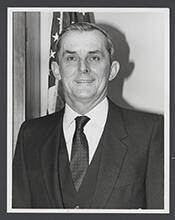
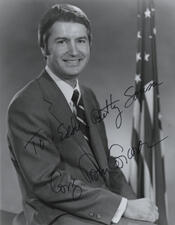
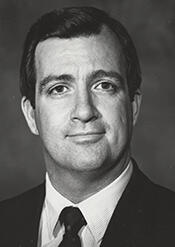
Frank Stoddard Dickson (October 6, 1876 – February 24, 1953) was a United States Representative from Illinois, a longtime officer in the Illinois National Guard, and later a federal and private-sector official in Washington, D.C., and Chicago. He was born in Hillsboro, Montgomery County, Illinois, where he attended the local public schools before moving on to secondary education in another part of the state.
Dickson completed his formal schooling at the high school in Decatur, Illinois, from which he was graduated in 1896. Soon after finishing high school, he entered the teaching profession and taught school at Ramsey, Illinois, a small community in Fayette County. His early work as a schoolteacher reflected the limited but practical educational opportunities available in rural Illinois at the turn of the twentieth century and provided him with experience in public service at the local level.
During the Spanish–American War, Dickson enlisted for military service and served as a private in the Fourth Regiment, Illinois Infantry. His regiment formed part of the volunteer forces raised by the state to support the national war effort in 1898. Following his period of active duty, he returned to civilian life and resumed his career in education, again engaging in teaching at Ramsey, Illinois. This combination of teaching and military experience helped establish his standing in the community and laid the groundwork for his entry into politics.
Dickson was elected as a Republican to the Fifty-ninth Congress and served a single term in the U.S. House of Representatives from March 4, 1905, to March 3, 1907, representing an Illinois district during the administration of President Theodore Roosevelt. In Congress he aligned with the Republican majority of the era, although his brief tenure limited his opportunity to attain senior committee positions. He was an unsuccessful candidate for reelection in 1906 to the Sixtieth Congress, after which he returned to state-level responsibilities and military administration in Illinois.
Following his congressional service, Dickson embarked on a long career in the Illinois military establishment. He served as assistant adjutant general of Illinois from 1908 to 1910 and then as adjutant general of Illinois from 1910 to 1922. In these roles he was the chief administrative officer of the state’s military forces, overseeing organization, training, and mobilization of the Illinois National Guard through a period that included the Mexican border service and World War I. His twelve-year tenure as adjutant general reflected the confidence of successive state administrations in his administrative ability and familiarity with military affairs.
After leaving the adjutant general’s office, Dickson moved into federal service connected with the nation’s maritime and wartime shipping programs. From 1922 to 1924 he served as assistant to the director of finance of the United States Shipping Board and the Emergency Fleet Corporation, agencies responsible for managing and disposing of the large merchant fleet built during World War I and for supervising financial matters related to commercial shipping. He subsequently became secretary to U.S. Senator Medill McCormick of Illinois from 1924 to 1926, working in Washington, D.C., and assisting with legislative and administrative duties in the senator’s office during a period of significant national debate over economic and foreign policy in the postwar years.
In his later career, Dickson was associated with the National Board of Fire Underwriters in Chicago, Illinois, an influential industry body concerned with fire prevention, insurance standards, and related regulatory issues. He advanced within the organization and was serving as its general counsel at the time of his death, indicating that he had acquired substantial expertise in legal and regulatory matters affecting the insurance and fire protection fields. His work there linked his earlier public service experience with the evolving needs of a modernizing urban and industrial society.
Frank Stoddard Dickson died in Washington, D.C., on February 24, 1953. He was temporarily interred in Oak Ridge Cemetery in Springfield, Illinois, a burial ground noted for being the resting place of Abraham Lincoln and many other prominent Illinois figures. His remains were later moved to nearby Camp Butler National Cemetery, also in the Springfield area, a national cemetery that reflects his long association with military service and the Illinois National Guard.
Congressional Record