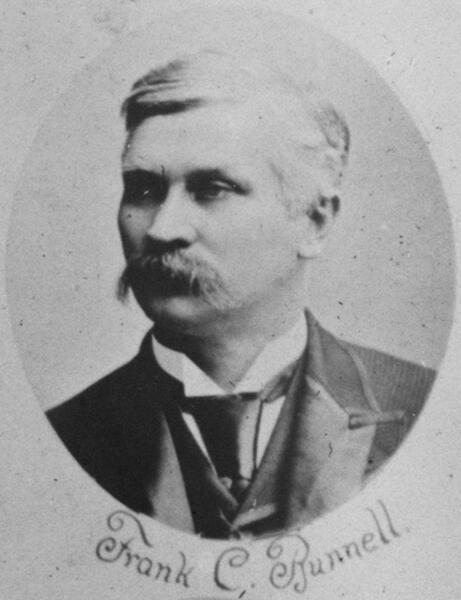
Frank Charles Bunnell (March 19, 1842 – September 11, 1911) was a Republican member of the United States House of Representatives from Pennsylvania who served three terms in Congress during the 1870s and 1880s. Born in Washington Township in Wyoming County, Pennsylvania, on March 14, 1842, with March 19 also cited as an alternate birth date, he was the son of James Bunnell (1814–1899) and Mary (Harding) Bunnell (1817–1898), both natives of Pennsylvania. He was raised with his sister, Savannah (1840–1864), and received his early education in the common schools of Dauphin County. He later attended the Wyoming Seminary in Kingston, Pennsylvania, where he continued his studies in preparation for a professional career.
At the outbreak of the American Civil War, Bunnell was among the early responders to President Abraham Lincoln’s call for volunteers to preserve the Union. He enrolled on September 20, 1861, at Mehoopany, Pennsylvania, at the age of nineteen, and was mustered into service on October 11, 1861, at Camp Curtin in Harrisburg as a private in Company B, 52nd Pennsylvania Infantry. Demonstrating ability and reliability, he was promoted to quartermaster sergeant of his regiment on March 1, 1862, during the Peninsula Campaign under Major General George B. McClellan. He saw active service in several engagements, including the Battle of Williamsburg on May 5, 1862, and the Battle of Seven Pines from May 31 to June 2, 1862. His military service was cut short when he was discharged on April 2, 1863, on a surgeon’s certificate of disability.
Following his honorable discharge, Bunnell returned to northeastern Pennsylvania and settled in Luzerne County. From 1864 to 1869 he worked as a merchant, establishing himself in local business circles. He subsequently moved to Tunkhannock, Pennsylvania, where he became active in both agricultural and banking pursuits. In Tunkhannock he began what would become a more than twenty-year tenure as president of the Wyoming County Agricultural Society, reflecting his sustained interest in regional agricultural development and community affairs.
Bunnell’s entry into national politics came as a member of the Republican Party during a significant period in American history marked by Reconstruction and its aftermath. An unsuccessful candidate for federal office in 1872, he was elected as a Republican to the Forty-second Congress to fill the vacancy caused by the resignation of Ulysses Mercur, thus beginning his service in the U.S. House of Representatives as a Representative from Pennsylvania. He went on to serve three terms in Congress between 1871 and 1889, contributing to the legislative process and representing the interests of his Pennsylvania constituents in the House of Representatives. After his initial service, he was later elected again to the Forty-ninth and Fiftieth Congresses. A loyal Republican throughout his career, he participated in the democratic process during a transformative era for the nation. He did not seek renomination in 1888, thereby concluding his congressional service.
In addition to his work in Congress, Bunnell remained active in local public life. In 1884 he was elected burgess and borough treasurer of Tunkhannock, positions that underscored his continuing engagement in municipal governance and fiscal oversight. His leadership roles in both local government and the Wyoming County Agricultural Society complemented his national legislative service and reflected the breadth of his public commitments.
On October 1, 1898, Bunnell married Martha A. Smith of Stroudsburg, Pennsylvania, in a ceremony held in Tunkhannock. By 1890, according to the special census of Union veterans and widows of the Civil War, he was still residing in Tunkhannock and was documented as suffering from rheumatism and deafness, lingering effects that likely stemmed in part from his wartime service. At the turn of the twentieth century he was recorded as living alone in Tunkhannock, and he later relocated to Philadelphia sometime during or before 1911, marking the final geographic transition of his life.
In his last years, Bunnell’s health declined further. He suffered from Bright’s disease and aortic regurgitation and died at his home at 2320 North 19th Street in Philadelphia on September 11, 1911. His body was returned to Tunkhannock, where funeral services were held on September 15 at the Methodist Episcopal Church. Later that same day he was interred at Gravel Hill Cemetery in Tunkhannock, Pennsylvania, closing the life of a Civil War veteran, businessman, local official, and three-term Republican Representative from Pennsylvania.
Congressional Record