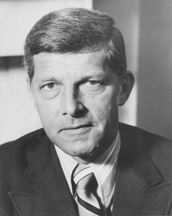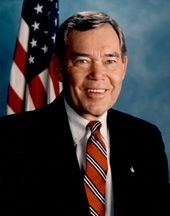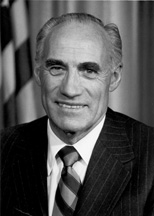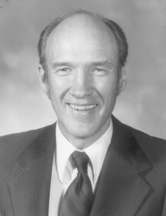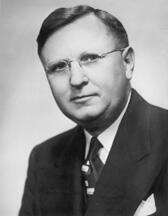
Frank Aloysius Barrett (November 10, 1892 – May 30, 1962) was an American soldier, lawyer, and Republican politician who served as a member of the United States House of Representatives, the United States Senate, and as the 21st Governor of Wyoming. A member of the Republican Party, he contributed to the legislative process during five terms in the United States Congress, and his service in Congress occurred during a significant period in American history, when he participated in the democratic process and represented the interests of his constituents.
Barrett was born in Omaha, Nebraska, to Patrick J. Barrett and Elizabeth A. Curran Barrett, in a family of eight children. His mother and his paternal grandparents emigrated to the United States from Ireland, giving him a strong Irish-American background. He attended Creighton University in Omaha, where he studied both law and science while supporting himself by working as a postal employee. During World War I, he enlisted in the United States Army and served for two years in the Balloon Corps, gaining military experience that would later complement his public service career.
On May 21, 1919, Barrett married Alice Catherine Donoghue. Shortly after their marriage, the couple moved to Lusk, Wyoming, where Barrett began the legal and political career that would define his public life. In Lusk, he put his law degree to use in private practice and quickly became involved in local public affairs. He was elected county attorney for Niobrara County, serving from 1922 until 1934, a twelve-year period in which he established himself as a prominent legal figure in the region.
Barrett’s political career advanced to the state level when he was elected to the Wyoming Senate, where he served from 1933 until 1935. In addition to his legislative duties, he served on the Board of Trustees of the University of Wyoming, reflecting his interest in higher education and public institutions in the state. He first sought federal office in 1936, running for a seat in the United States House of Representatives, but was defeated by incumbent Democrat Paul Greever. Undeterred, he remained active in Republican politics and continued to build support across Wyoming.
Barrett successfully ran for Congress in 1942 and was elected as a Republican to the United States House of Representatives from Wyoming. He took office in 1943 and served in the House until 1950, during a period that spanned World War II and the early years of the Cold War. Over the course of his House service, which formed part of his five terms in Congress, he participated in national legislative debates and represented Wyoming’s interests on issues affecting agriculture, natural resources, and postwar development.
In 1950, Barrett turned his attention to statewide executive office and was elected Governor of Wyoming. He was sworn in as the 21st Governor in 1951. His tenure as governor focused on the development of the state’s natural resources, improvements in infrastructure, and the promotion of economic growth in a largely rural state. His time in the governor’s office, however, was relatively brief. In 1952, he ran for the United States Senate and defeated three-term Democratic incumbent Joseph C. O’Mahoney. After winning the Senate seat, Barrett resigned as governor in 1953 to assume his new duties in Washington.
As a United States Senator from Wyoming, Barrett served from 1953 to 1959. His Senate service coincided with the Eisenhower administration and a critical phase of the Cold War, as well as the early stirrings of the modern civil rights movement. During his term, he took part in major legislative deliberations of the era and voted in favor of the Civil Rights Act of 1957, a landmark though limited measure that marked the first federal civil rights legislation since Reconstruction. Despite his active role, Barrett was defeated for reelection after a single Senate term by Democrat Gale McGee, a former aide to Joseph C. O’Mahoney.
After leaving the Senate in 1959, Barrett returned to private life, maintaining his ties to Wyoming and to the legal profession. His long career in public service—spanning local office, the state legislature, the governorship, and both houses of Congress—left a lasting imprint on Wyoming’s political history. Frank Aloysius Barrett died on May 30, 1962, closing a life marked by military service, legal practice, and more than three decades of involvement in public affairs at the local, state, and national levels.
Congressional Record