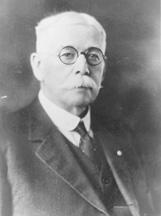
Francis Emroy Warren (June 20, 1844 – November 24, 1929) was an American politician of the Republican Party best known for his long service in the United States Senate representing Wyoming and for being the first Governor of the State of Wyoming. A prominent figure in the political development of the American West, he served as a Senator from Wyoming from 1890 to 1929, contributing to the legislative process during seven terms in office. A veteran of the Union Army during the American Civil War, he was the last veteran of that conflict to serve in the U.S. Senate.
Warren was born on June 20, 1844, in Hinsdale, Berkshire County, Massachusetts, the son of Cynthia Estella (Abbott) and Joseph Spencer Warren. He attended local common schools and Hinsdale Academy, receiving the basic education typical of New England youth of his era. His early life in rural Massachusetts, shaped by small-town schooling and farm work, provided the foundation for his later pursuits in agriculture, business, and public service.
During the Civil War, Warren enlisted in the Union Army and served in the 49th Massachusetts Infantry as a noncommissioned officer. As a corporal in Company C, he distinguished himself at the siege of Port Hudson, Louisiana, on May 27, 1863. In that action, his entire platoon was destroyed by Confederate bombardment; Warren, suffering a serious scalp wound, continued forward under heavy fire and took part in disabling enemy artillery. For his battlefield gallantry, he received the Medal of Honor. His official citation, issued on September 30, 1893, records that he “volunteered in response to a call, and took part in the movement that was made upon the enemy’s works under a heavy fire therefrom in advance of the general assault.” He had entered service from his native Hinsdale, Massachusetts. After his service with the 49th Massachusetts, Warren later served as a captain in the Massachusetts Militia, further cementing his identity as a veteran and soldier.
Following the Civil War, Warren engaged in farming and stock-raising in Massachusetts before seeking new opportunities in the West. In 1868 he moved to what was then part of the Dakota Territory and soon to become the Wyoming Territory, settling in Cheyenne. There he entered real estate and the mercantile business, expanded into livestock raising, and helped establish Cheyenne’s first lighting system. These ventures made him one of the more prosperous and influential businessmen in the growing community. During this period he married Helen Smith, a fellow Massachusetts native. Although she came from New England, all of their married life until his first election to the United States Senate upon Wyoming’s statehood in 1890 was spent in Wyoming. They had two children, a daughter, Helen Frances, and a son, Frederick Emory. Helen Smith Warren became a prominent figure in Cheyenne society, serving as president of church, literary, and charitable organizations, vice-president of the Foundling Hospital, and as a member of the Daughters of the American Revolution.
Warren’s success in business led naturally to political involvement in the Wyoming Territory. He served in the Wyoming Territorial Senate from 1873 to 1874 and again from 1884 to 1885, acting as president of the senate. At the local level, he was a member of the Cheyenne City Council from 1873 to 1874 and was elected Mayor of Cheyenne in 1885. He also held several territorial financial offices, serving as treasurer of Wyoming in 1876, 1879, 1882, and 1884. His growing prominence brought him to national attention, and in February 1885 President Chester A. Arthur appointed him Governor of the Territory of Wyoming. His tenure was cut short in November 1886 when Democratic President Grover Cleveland removed him from office, but he was reappointed territorial governor by Republican President Benjamin Harrison in April 1889. Warren served in that capacity until 1890, when Wyoming was admitted to the Union. Upon statehood, he was elected the first Governor of Wyoming, serving from October 11, 1890, until November 24, 1890.
In November 1890, Warren resigned as governor after being elected to the United States Senate as a Republican, marking the beginning of his nearly four decades of congressional service. His first term ran from November 24, 1890, to March 4, 1893. After this initial service, he briefly returned to his business pursuits in Wyoming before being reelected to the Senate, where he served continuously from March 4, 1895, until his death on November 24, 1929. Over the course of these seven terms, his tenure spanned a significant period in American history, including the closing of the frontier, the Progressive Era, World War I, and the early years of the interwar period. As a member of the Senate, Francis Emroy Warren participated in the democratic process, represented the interests of his Wyoming constituents, and became one of the chamber’s most senior and influential Republicans. At the time of his death, he had served longer than any other U.S. senator.
During his long Senate career, Warren chaired numerous committees, reflecting his broad legislative influence. He served as chairman of the Committee on Irrigation and Reclamation of Arid Lands, the Committee on Claims, the Committee on Irrigation, the Committee on Military Affairs, the Committee on Public Buildings and Grounds, the Committee on Agriculture and Forestry, the Committee on Appropriations, and the Committee on Engrossed Bills. His work on irrigation and reclamation was especially important to the development of the American West, while his leadership on the Appropriations Committee during World War I made him instrumental in securing funding for the American war effort. He was also notable for being the first senator to hire a female staffer, an early step toward expanding women’s roles in the federal government. His family connections extended into national military leadership when his daughter Helen Frances Warren married then-Captain John J. Pershing in 1905. President Theodore Roosevelt later promoted Pershing from captain to brigadier general over hundreds of more senior officers, and Pershing would go on to command the American Expeditionary Forces in World War I. Personal tragedy struck when Pershing’s wife and three daughters—Warren’s daughter and granddaughters—were killed in a fire at the Presidio in San Francisco.
In his later years, Warren remained a central figure in Wyoming’s political and social life. After the death of his first wife, he married Clara LaBarron Morgan. In 1915, Warren and Clara purchased the Nagle Warren Mansion in Cheyenne, a residence that became a social and political hub. Their dining room hosted prominent guests, including Presidents Theodore Roosevelt and William Howard Taft, underscoring Warren’s national stature. The mansion was later listed on the National Register of Historic Places. Beyond his lifetime, his legacy was commemorated in several ways. F. E. Warren Air Force Base in Cheyenne, Wyoming, was named in his honor, reflecting both his military service and his importance to the state. In 1958, he was inducted into the Hall of Great Westerners of the National Cowboy & Western Heritage Museum, recognizing his role in the development of the American West.
Francis Emroy Warren died in office on November 24, 1929, in Washington, D.C. His funeral service was held in the chamber of the United States Senate, a mark of the esteem in which he was held by his colleagues. As the last Civil War veteran to serve in the Senate and, at the time of his death, the longest-serving senator in American history, he bridged the era from the Civil War through the dawn of modern America, leaving a lasting imprint on both Wyoming and the nation.
Congressional Record