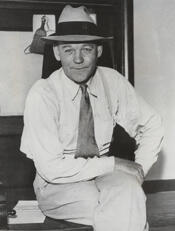
Francis Henry Shoemaker (April 25, 1889 – July 24, 1958) was a U.S. Representative from Minnesota and a prominent, if controversial, figure in the state’s Farmer-Labor movement. He was born on a farm in Flora Township, Renville County, Minnesota, where he grew up in a rural environment that shaped his later political identification with agricultural and labor interests. Largely self-educated, he studied with the assistance of his mother rather than through formal higher education, and from an early age engaged in agricultural pursuits. His experience as a farmer and his close association with working people led him to become active in numerous farm and labor organizations, laying the groundwork for his later role in third-party politics in Minnesota.
Shoemaker’s early political activity centered on agrarian and progressive causes in the Upper Midwest. By the 1910s and 1920s he was working as an organizer for the Nonpartisan League, a movement that sought to advance farmers’ economic interests through political action. During this period he became the subject of local controversy related to his military service in World War I. Shoemaker claimed that he had been drafted into the Army despite being physically unfit and having a dependent wife, and that he was the only married man in his area to be conscripted. He further asserted that he would not appeal the draft decision but would seek retribution after returning. These claims were publicly challenged by his pastor, Harry Milford, who stated that other married men had been drafted, that Shoemaker had been found physically fit, and that he had in fact filed an appeal with the draft board. The episode foreshadowed the contentious public reputation that would follow Shoemaker throughout his career.
In the early 1920s Shoemaker expanded his influence through journalism and party organization. From 1921 to 1927 he served as editor and publisher of the People’s Voice, the Green Bay Farmer, and the Progressive Farmer newspapers in Green Bay, Wisconsin, using these outlets to advocate for farmers, workers, and progressive reforms. In 1928 he became editor and publisher of the Organized Farmer newspaper in Red Wing, Minnesota, further solidifying his role as a voice for agrarian and labor interests in the Upper Midwest. A charter member and organizer of the Minnesota Farmer-Labor Party, he was instrumental in building the party’s base among rural and working-class voters. In 1924 he assisted in organizing the Federated Farmer-Labor Party at Chicago, a national effort to unite various farmer and labor groups. That same year he was nominated for Vice President of the United States on a third-party ticket, but he declined to run, choosing instead to continue his work as an organizer and publicist.
Shoemaker’s activism was accompanied by serious legal difficulties. In 1931 he was convicted in federal court on a charge of sending defamatory material through the mail and for violating the terms of his probation. As a result, he served nine months at the United States Penitentiary in Leavenworth, Kansas. Despite this criminal record, or perhaps partly because of the notoriety it brought him, Shoemaker remained a significant figure in Farmer-Labor politics. His reputation as a militant advocate for farmers and workers, combined with his skills as a polemicist, helped him secure a base of support among voters disenchanted with the major parties during the economic crisis of the Great Depression.
Riding the wave of Farmer-Labor strength in Minnesota during the early 1930s, Shoemaker was elected as a Farmer-Laborite to the 73rd Congress and served as a Representative from Minnesota in the United States Congress from March 4, 1933, to January 3, 1935. His single term in office coincided with the early years of the New Deal, a significant period in American history marked by widespread economic hardship and sweeping federal reforms. Because of his prior conviction, the House of Representatives held a vote to determine whether he should be seated. After debate, the House permitted him to retain his seat by a vote of 230 in favor to 75 against. As a member of the House of Representatives, Shoemaker participated in the legislative process and represented the interests of his Minnesota constituents, aligning with the Farmer-Labor Party’s advocacy for relief measures, labor rights, and support for farmers. During his tenure he filed an impeachment resolution against United States District Judge Joseph W. Molyneaux, although the effort came to little and did not advance to formal proceedings.
Shoemaker’s time in Congress was marked not only by his legislative activity but also by further controversy. While serving as a sitting member of the House, he was arrested outside his congressional office by two detectives executing a warrant for assaulting a taxi driver, an incident that reinforced his reputation as a combative and volatile public figure. In 1934, after twenty-two years of marriage, his wife, Lydgia Schneider, filed for divorce, citing his open adultery and threats against her. That same year he chose not to be a candidate for renomination to the 74th Congress. Instead, he sought the Farmer-Labor nomination for the United States Senate from Minnesota, but he was defeated in the primary by the incumbent Senator Henrik Shipstead. He then ran as an Independent candidate for election to the 74th Congress but was unsuccessful.
In the years following his congressional service, Shoemaker continued to seek public office while encountering additional legal and personal difficulties. In 1940 he was sentenced to ninety days in jail after assaulting a neighbor and was accused in the same period of throwing hot water into his former wife’s face, further damaging his public standing. He later entered the Farmer-Labor primary for Minnesota’s seventh congressional district, but finished last with approximately 11 percent of the vote. In 1942 he again attempted a political comeback as a candidate for the 78th Congress, but this campaign was also unsuccessful. These repeated defeats reflected both the decline of his personal influence and the changing political landscape in Minnesota, where the Farmer-Labor Party would soon merge with the state Democratic Party.
After his final electoral efforts failed, Shoemaker withdrew from active political life and returned to the occupation with which he had begun: farming. He resumed agricultural pursuits near North Redwood, Minnesota, maintaining his connection to the rural community that had shaped his early life and political outlook. Francis Henry Shoemaker died at the University of Minnesota Hospitals in Minneapolis on July 24, 1958. He was buried in Zion Cemetery in Flora Township, Renville County, Minnesota, close to his birthplace, closing a life that had moved from the farm to the halls of Congress and back again, marked throughout by intense engagement with the struggles of farmers and workers and by persistent personal and legal controversy.
Congressional Record