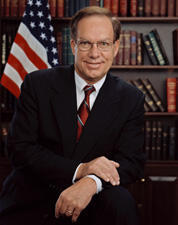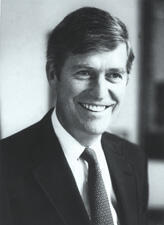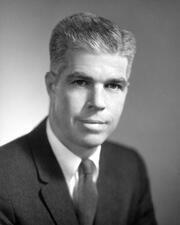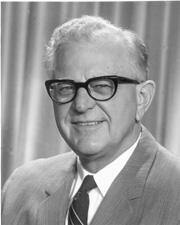
Floyd Kirk Haskell (February 7, 1916 – August 25, 1998) was an American lawyer and politician who represented Colorado in the United States Senate from 1973 to 1979. A member of the Democratic Party during his congressional service, he served one term in the Senate and contributed to the legislative process during a significant period in American history, representing the interests of his Colorado constituents on issues of tax policy, environmental protection, and energy.
Haskell was born in Morristown, New Jersey, to Edward Kirk Haskell, an investment banker, and Gladys (née Clarkson) Haskell. He attended Harvard College, receiving a Bachelor of Arts degree in 1937. While at Harvard he was athletically active, playing on the football, rugby, and soccer teams, later developing as a tennis player, and he served as president of the Rocky Mountain Club. He went on to Harvard Law School, where he earned his law degree in 1941. That same year he married Eileen Nicoll; the couple had three daughters, Ione, Evelyn, and Pamela, and remained married until their divorce in 1976.
With the onset of World War II, Haskell entered the U.S. Army in 1941 and served until 1945. He saw action in Asia, witnessed the immediate aftermath of the atomic bombing of Hiroshima, and rose to the rank of major. For his intelligence work during the war he was awarded the Bronze Star Medal. After his military service, he was admitted to the bar in 1946 and moved to Denver, Colorado, where he established himself as a tax lawyer. His legal practice in Denver provided the foundation for his later involvement in public affairs and state politics.
Haskell’s political career began at the state level. In 1964, he was elected as a Republican to the Colorado House of Representatives from Arapahoe County, serving until 1969. During his tenure in the state legislature he became assistant majority leader in 1967 and chaired the House Judiciary Committee. He also served on the House Education and Finance Committees, gaining experience in a broad range of policy areas. In 1970, in protest of President Richard Nixon’s invasion of Cambodia, Haskell left the Republican Party and became a Democrat, a change that would shape the rest of his political career.
In 1972, Haskell sought federal office, deciding to challenge three-term Republican incumbent Gordon L. Allott for a seat in the U.S. Senate from Colorado. Running as a Democrat, he first defeated state Senator Anthony Vollack in the Democratic primary. In the general election he faced Allott and candidates from the Raza Unida Party and the American Independent Party in a four-way race. Haskell narrowly prevailed, receiving about 49 percent of the vote and defeating Senator Allott by fewer than 10,000 votes, even as President Nixon carried Colorado by more than 267,000 votes. He was sworn into the Senate on January 3, 1973.
During his term in the United States Senate from 1973 to 1979, Haskell served on the Senate Finance Committee and the Senate Energy and Natural Resources Committee. He earned a reputation as a tax reformer and an environmentalist, focusing on issues that included tax policy, natural resource management, and energy development. He supported the historic Alaska Lands legislation, efforts to regulate automobile emissions, the Panama Canal treaties, and the development of alternative sources of energy. His service in Congress took place during a period marked by the end of the Vietnam War, the Watergate scandal, and shifting national energy priorities, and he participated actively in the democratic process as Colorado’s senator. In 1978, hampered by limited campaign funds and media exposure, he was defeated for re-election by Republican Congressman William L. Armstrong, who became the first candidate in Colorado to raise over one million dollars in a Senate race; Haskell lost by a margin of 59 percent to 40 percent.
After leaving the Senate in 1979, Haskell established his residence in Washington, D.C., where he resumed the practice of law. He later joined Common Cause and worked with a bipartisan group of retired lawmakers advocating campaign finance reform and measures to reduce congressional gridlock, continuing his interest in governmental integrity and institutional reform. In 1979 he married Nina Totenberg, the legal affairs correspondent for National Public Radio; they remained married until his death.
In his later years, Haskell experienced significant health challenges. In 1994 he suffered a cerebral hemorrhage after slipping on ice near his home in Washington, D.C. On August 25, 1998, at the age of 82, he died of pneumonia while returning from a vacation in Maine with his wife. His career left a record of service as a lawyer, state legislator, and U.S. senator who engaged with major issues of tax policy, environmental protection, and campaign reform in the mid- and late twentieth century.
Congressional Record