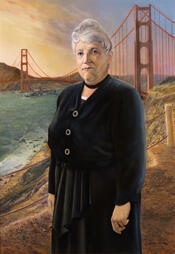
Florence Prag Kahn (née Prag; November 9, 1866 – November 16, 1948) was an American teacher and politician who became, in 1925, the first Jewish woman to serve in the United States Congress. A member of the Republican Party, she was only the fifth woman ever to sit in Congress and the second woman from California, following fellow San Franciscan Mae Nolan. Like Nolan, she entered the House of Representatives by winning election to the seat left vacant by the death of her husband, Representative Julius Kahn, and went on to serve six consecutive terms from 1925 to 1937.
Kahn was born on November 9, 1866, in Salt Lake City, Utah, to Conrad and Mary Prag, Jewish immigrants of Polish origin. Her parents had come to the American West during the era of the gold rush, selling supplies to miners and other settlers, and in Utah they became acquainted with Mormon leader Brigham Young. In 1869 the Prag family moved to San Francisco, California, where Florence was raised in a growing and diverse urban community that would remain her home for most of her life. The family’s background as Jewish immigrants and western pioneers helped shape her understanding of both minority experience and frontier opportunity in the United States.
Kahn received her early education in San Francisco’s public schools and graduated from San Francisco Girls’ High School in 1883. She then attended the University of California, Berkeley, one of the leading public universities in the country, and earned an A.B. degree in 1887. Her university education, relatively uncommon for women of her generation, provided a strong foundation in the liberal arts and prepared her for a professional career at a time when women were only beginning to enter such fields in significant numbers.
After completing her studies, Kahn became a teacher, joining the faculty of San Francisco’s Lowell High School, one of the city’s premier public secondary schools. There she taught English and history, subjects that reflected her academic training and her interest in literature, civic life, and public affairs. Her experience in the classroom honed her skills in communication, organization, and public speaking—abilities that would later prove valuable in political life. Teaching also placed her in daily contact with the city’s youth and families, deepening her ties to the community she would eventually represent in Congress.
On March 19, 1899, Florence Prag married Julius Kahn, a San Francisco Republican who was then emerging as a significant political figure. Julius Kahn was elected to the United States House of Representatives, where he served multiple terms and became an influential member, particularly on military and defense matters, until his death on December 18, 1924. Throughout his congressional career, Florence Kahn was closely involved in his work, serving as his aide and informal adviser. In parallel with her behind-the-scenes political activity, she wrote articles for the San Francisco Chronicle, further developing her skills as a writer and commentator on public issues and gaining insight into both politics and the press.
Following Julius Kahn’s death in 1924, Florence Prag Kahn sought to succeed him in Congress, as Mae Nolan had earlier succeeded her own late husband from another San Francisco district. Running as a Republican, Kahn won the special election to fill the vacancy and took her seat in the House of Representatives in 1925. Her election marked a milestone as she became the first Jewish woman ever to serve in the United States Congress. Representing a California district centered on San Francisco, she participated actively in the legislative process during a period of profound change in American history, spanning the later years of the Roaring Twenties, the onset of the Great Depression, and the early New Deal era.
Kahn served six terms in the House of Representatives, holding office from 1925 until 1937. During these twelve years, she contributed to the work of Congress as a loyal member of the Republican Party, engaging in debates over national policy and advocating for the interests of her constituents in California. Her tenure coincided with major developments in federal governance, economic policy, and social welfare, and she took part in the democratic process at a time when women were still a small minority in national office. As a pioneering Jewish woman in Congress, she helped broaden the representation of both women and religious minorities in the federal legislature and demonstrated that widows who entered politics through “widow’s succession” could build independent and substantive careers in their own right.
After leaving Congress in 1937, Kahn remained a respected public figure, associated with the generation of early women lawmakers who helped normalize women’s participation in national politics. She continued to be remembered for her trailblazing role as the first Jewish woman in Congress and for her long service representing San Francisco. Florence Prag Kahn died on November 16, 1948, closing a life that spanned from the immediate post–Civil War era through World War II and left a lasting imprint on the history of women and minorities in the United States Congress.
Congressional Record