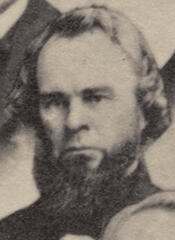
Fernando Cortez Beaman (June 28, 1814 – September 27, 1882) was an American teacher, lawyer, and Republican politician from Michigan who served five consecutive terms in the United States House of Representatives from 1861 to 1871, during and after the American Civil War. Over the course of his public career he also served as mayor of Adrian, Michigan, and as judge of probate for Lenawee County, contributing significantly to local and national public life in a period of profound national transformation.
Beaman was born in Chester, Vermont, the son of Joshua Beaman and Hannah (Olcott) Beaman. In 1819, when he was a small child, his family moved to a farm in Franklin County, New York. He was educated in the district schools and at Franklin Academy in Malone, New York. As a young man he taught school and, in 1836, moved to Rochester, New York, where he began the study of law, laying the foundation for a long legal and political career.
In 1838, Beaman moved west to Manchester, Michigan, and was admitted to the bar there, commencing the practice of law in 1839. Two years later, in 1841, he moved to Tecumseh to continue his legal practice, and subsequently relocated to Clinton. In 1843 he settled in Adrian, Michigan, having been appointed prosecuting attorney for Lenawee County. He served as prosecuting attorney until 1850, gaining prominence in the local legal community. In Adrian he formed a law partnership with Thomas M. Cooley, who would later become Chief Justice of the Michigan Supreme Court, further enhancing his professional standing. During these years he also served as city attorney of Adrian, reflecting his growing involvement in public affairs.
Beaman played an active role in the formation and early development of the Republican Party. He was a member of the convention that organized the party “under the oaks” at Jackson, Michigan, in 1854, an event widely regarded as a founding moment of the Republican Party in the state. He served as a delegate to the first Republican National Convention held in Philadelphia in 1856. That same year he was elected mayor of Adrian and also became judge of the probate court of Lenawee County, a position he held from 1856 to 1860. These local and party leadership roles positioned him for election to national office on the eve of the Civil War.
In 1860, Beaman was elected as a Republican from Michigan’s 2nd congressional district to the Thirty-seventh Congress and was subsequently re-elected to the four succeeding Congresses, serving in the United States House of Representatives from March 4, 1861, to March 3, 1871. Following redistricting after the 1860 census, he represented Michigan’s 1st congressional district beginning with the elections of 1862. His decade in Congress coincided with the Civil War and Reconstruction, a significant period in American history during which he participated in the legislative process and represented the interests of his Michigan constituents. During the Thirty-ninth Congress he served as chairman of the House Committee on Roads and Canals, reflecting his involvement in issues of internal improvements and infrastructure. A member of the Republican Party throughout his congressional service, he declined to be a candidate for renomination in 1870 and chose to return to private life.
After leaving Congress in 1871, Beaman returned to Adrian and resumed the practice of law. That same year he was again appointed judge of probate for Lenawee County. He was elected to the probate judgeship in 1872 and re-elected in 1876, continuing his long association with the county’s judicial affairs. His legal expertise and reputation led to consideration for several higher offices. However, due to ill health, he declined appointment as United States Senator to fill the vacancy caused by the death of Senator Zachariah Chandler in 1879. He also declined offers of appointment to the Michigan Supreme Court and to the post of United States Commissioner of Indian Affairs, turning down opportunities for further national service in his later years.
In his personal life, Beaman married Mary Goodrich on May 10, 1841, in Brockport, New York. The couple had three children: Mary A. Beaman, Edward C. Beaman, and Roscoe W. Beaman. He remained a resident of Adrian for the greater part of his adult life, deeply involved in the civic and legal life of the community he had helped to shape.
Fernando Cortez Beaman died in Adrian, Michigan, on September 27, 1882. He was interred in Oakwood Cemetery in Adrian, leaving a record of service that spanned local, state, and national office during one of the most consequential eras in United States history.
Congressional Record