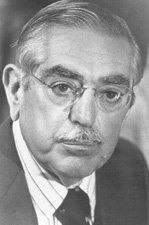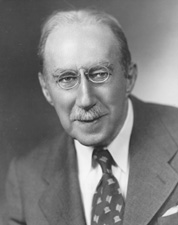
Felix Hebert (December 11, 1874 – December 14, 1969) was a United States senator from Rhode Island and the first person of French-Canadian ancestry to serve in the United States Senate. He was born in St. Guillaume, near Saint-Hyacinthe, Quebec, Canada, where his parents, Edouard and Catherine (née Vandale) Hebert, were visiting to tend to his father’s health. In 1880 the family returned to the United States and resumed their residence in Coventry, Rhode Island, a community with which the Heberts had longstanding ties. Hebert was one of fourteen children; among his siblings was Rev. Mathias A. Hebert, who on December 16, 1922, was appointed by Bishop William A. Hickey as the second pastor of St. Cecilia Parish in Pawtucket, Rhode Island. Raised in a Roman Catholic household, Hebert was a member of the parish of St. Jean Baptiste in Arctic Centre, Rhode Island, of which his father was one of the founders.
Hebert was educated in the public schools of Coventry before attending La Salle Academy in Providence, from which he graduated in 1893. On September 18, 1900, in Ware, Massachusetts, he married Virginia M. Provost (1875–1958), the daughter of Jean Octave Provost (1852–1929) and Virginie (née Deslauriers) Provost (d. 1878). Felix and Virginia Hebert had four children: Catherine Virginia, Adrien Warner, Marguerite Rosalie, and Edouard Felix. Active in civic and social life, Hebert belonged to various societies and clubs, including the Catholic Club and the Turk’s Head Club of Providence, reflecting his prominence within both the French-Canadian and broader Rhode Island communities.
Before entering public office, Hebert gained experience in business and government administration. From 1893 to 1896 he was employed as a railroad freight billing clerk, work that introduced him to commercial operations and regulatory concerns. From 1896 to 1898 he served as private secretary to General Charles R. Brayton, a leading figure in Rhode Island Republican politics, and then received an appointment as a clerk in the office of Rhode Island Treasurer Walter A. Read, where he worked for one year. Hebert was deputy insurance commissioner of Rhode Island from 1898 to 1906, a position that drew him into the developing field of insurance regulation. During this period he studied law, was admitted to the bar in 1907, and commenced the practice of law in Providence, laying the foundation for his later reputation as an authority on insurance law.
Hebert’s judicial and civic career in Rhode Island spanned two decades before his election to the Senate. From 1908 to 1928 he served as justice of the district court of the fourth judicial district of Rhode Island, presiding over local civil and criminal matters and gaining wide recognition for his legal acumen. He was a trustee of the Nathanael Greene Homestead Association of Rhode Island from 1924 to 1934, helping to preserve the historic home of the Revolutionary War general, and from 1925 to 1934 he was a member and secretary of the Providence County Courthouse Commission, which oversaw planning and administration related to courthouse facilities. These roles, combined with his legal practice, positioned him as a prominent Republican figure in the state.
A member of the Republican Party, Hebert was elected to the United States Senate from Rhode Island in 1928, unseating Democratic incumbent Peter G. Gerry by a narrow margin of 51 percent to 49 percent. He served a single term in Congress from March 4, 1929, to January 3, 1935, representing Rhode Island during a significant period in American history that encompassed the onset of the Great Depression. As a senator, Felix Hebert participated in the legislative process and represented the interests of his constituents, contributing to debates over economic and social policy at a time of national crisis. In 1931 he traveled to Europe to examine European unemployment compensation systems and, upon returning, advised President Herbert Hoover against the adoption of a federal unemployment compensation program in the United States. During his Senate service he was Republican whip from 1933 to 1935 and served as chairman of the Committee on Patents in the Seventy-second Congress, roles that placed him in the party leadership and at the center of legislative work on intellectual property.
Hebert’s tenure in the Senate ended after he was an unsuccessful candidate for reelection in 1934. In a rematch with Peter G. Gerry, he was defeated when Gerry won 57 percent of the vote, and Hebert left office at the expiration of his term on January 3, 1935. Following his congressional service, he resumed the practice of law in Providence and continued to be active in Republican politics. From 1944 to 1952 he served as a member of the Republican National Committee, contributing to the party’s national organization and strategy during and after World War II. In his legal career he became advisory counsel to the Associated Factory Mutual Fire Insurance Companies and was widely regarded as an “international authority on insurance law,” reflecting the depth of his expertise in that specialized field.
In his later years, Hebert remained a respected elder statesman within Rhode Island’s legal and political communities, known both for his pioneering role as the first senator of French-Canadian ancestry and for his long record of public service at the state and national levels. He died in Warwick, Rhode Island, on December 14, 1969, three days after his ninety-fifth birthday. He was interred in St. Joseph’s Cemetery in West Warwick, Rhode Island.
Congressional Record