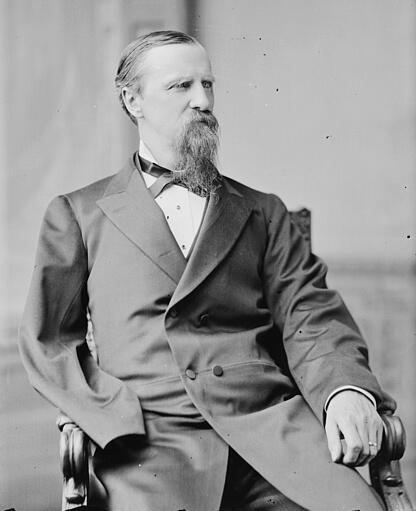
Evarts Worcester Farr (October 10, 1840 – November 30, 1880) was a Republican politician and lawyer who served as a U.S. Representative from New Hampshire from 1879 to 1881. His single term in the United States Congress took place during a significant period in American history, as the nation continued to adjust to the political, economic, and social changes that followed the Civil War and Reconstruction. As a member of the House of Representatives, he participated in the legislative process and represented the interests of his New Hampshire constituents.
Farr was born on October 10, 1840, in Littleton, Grafton County, New Hampshire. He grew up in northern New Hampshire at a time when the region was developing its commercial and civic institutions, and his early life in Littleton helped shape his later engagement in public affairs. Details of his early education are not extensively documented, but like many young men of his generation in New England, he would have been exposed to the common school system and local civic life that encouraged participation in public service.
Before entering national politics, Farr pursued a career in the law, establishing himself as an attorney in New Hampshire. His legal training and practice provided the foundation for his later public service, equipping him with knowledge of statutory interpretation, civil procedure, and the practical concerns of his clients and community. As a lawyer, he became familiar with the economic and social issues affecting residents of his region, experience that would inform his work when he later entered Congress.
A member of the Republican Party, Farr rose to prominence in New Hampshire politics during the post–Civil War era, when the Republican Party dominated political life in the state and across much of the North. His alignment with Republican principles of the period—support for the Union, economic development, and, in the aftermath of the war, the consolidation of national authority—reflected the prevailing political currents in New Hampshire. Through his legal work and party activity, he gained the confidence of local leaders and voters, positioning him for election to federal office.
Farr was elected as a Republican to the United States House of Representatives and served as a Representative from New Hampshire from 1879 to 1881. His service in Congress began with the Forty-sixth Congress, which convened on March 4, 1879, during the presidency of Rutherford B. Hayes. During his term, he contributed to the legislative process at a time when the federal government was addressing issues such as postwar economic policy, veterans’ concerns, and the continuing integration of the former Confederate states into national political life. As a member of the House, he participated in debates, committee work, and votes that shaped national policy, and he worked to represent the interests and priorities of his New Hampshire constituents in Washington.
Evarts Worcester Farr’s congressional career was cut short by his death while still in office. He died on November 30, 1880, before the completion of his term, bringing an early end to his service in the national legislature. His tenure, though limited to one term, placed him among the post–Civil War generation of New England Republicans who helped guide the country through the complex transition from wartime to peacetime governance.
Congressional Record