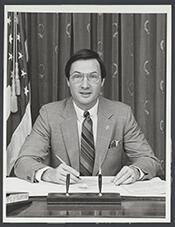
Eugene Daniel O’Sullivan (May 31, 1883 – February 7, 1968) was an American Democratic Party politician from Nebraska who served one term in the United States House of Representatives. He was born on a cattle ranch near Kent, Kansas, on May 31, 1883, to John E. O’Sullivan and Josephine Kluh O’Sullivan. Raised in a rural environment on the Kansas plains, he grew up in a family of Irish and German descent and was brought up in the Roman Catholic faith, which would remain an important aspect of his identity and later civic affiliations.
O’Sullivan received his early education in Kansas before pursuing higher studies in the Midwest. He attended Christian Brothers College in St. Joseph, Missouri, where he completed his undergraduate education. He then studied at St. Benedict’s College in Atchison, Kansas, in 1904 and 1905, furthering his liberal arts and preparatory training before turning to the law. In 1910 he graduated from Creighton University School of Law in Omaha, Nebraska, an institution closely associated with the Jesuit tradition, reflecting his Catholic background. That same year he was admitted to the bar and commenced the practice of law in Omaha, establishing himself professionally in what would become his lifelong home.
Settling in Omaha, O’Sullivan developed a substantial legal practice while becoming increasingly active in Democratic Party politics. He married Ellen Katherine Lovely, and the couple made their home in Omaha as he built his reputation as an attorney and party worker. Beyond his professional and political life, he was active in civic and fraternal organizations. A practicing Catholic, he was a member of the Benevolent and Protective Order of Elks, the Knights of Columbus, and the Fraternal Order of Eagles, affiliations that connected him to Omaha’s social, religious, and charitable networks and broadened his local influence.
By the 1920s O’Sullivan had become a recognized figure in Nebraska Democratic circles. He served as a delegate to the Democratic National Conventions in 1924, 1928, and 1932, participating in the nomination processes that shaped the party’s national leadership during the interwar period and the rise of Franklin D. Roosevelt. His continued prominence in party affairs was reflected in his later service as a delegate to the 1940 and 1944 Democratic National Conventions, underscoring his long-standing role in state and national Democratic politics over two decades.
O’Sullivan sought higher office during the New Deal era. In 1934 he ran for governor of Nebraska but was unsuccessful in securing the Democratic nomination, a setback that did not end his political ambitions. That same year he also mounted an unusual write-in candidacy for the United States Senate, which likewise proved unsuccessful. These efforts, however, demonstrated his determination to attain elective office and his standing within the party as a figure willing to contest major statewide positions during a period of Democratic ascendancy.
O’Sullivan achieved national office in the post–World War II period. Running as a Democrat in Nebraska’s 2nd Congressional District, he was elected to the Eighty-first United States Congress after defeating the incumbent Republican representative, Howard Buffett, the father of future investor Warren Buffett. He served in the House of Representatives from January 3, 1949, to January 3, 1951, during the administration of President Harry S. Truman, a period marked by early Cold War tensions and domestic debates over economic policy and postwar reconversion. In the 1950 election he sought reelection to the Eighty-second Congress but was defeated by Howard Buffett, who reclaimed his former seat, ending O’Sullivan’s brief tenure in Congress.
Following his congressional service, O’Sullivan returned to Omaha and resumed the practice of law, continuing the legal career he had begun four decades earlier. He remained a respected member of the local bar and of the civic and fraternal organizations with which he had long been associated. Eugene Daniel O’Sullivan died in Omaha, Nebraska, on February 7, 1968. He was interred in Calvary Cemetery in Omaha, reflecting both his deep roots in the city and his lifelong Catholic faith.
Congressional Record