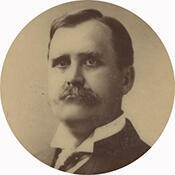
Eugene Noble Foss (September 24, 1858 – September 13, 1939) was an American politician, manufacturer, and three-term governor of Massachusetts who also served as a Representative from Massachusetts in the United States Congress from 1909 to 1911. He was born in West Berkshire, Vermont, a small town near the Canada–United States border, to George Edmund Foss, a politically active manager at the St. Albans Manufacturing Company, and Marcia (née Noble) Foss. When he was ten years old, the family moved to St. Albans, Vermont. Raised in a household where business and politics were closely intertwined, Foss was exposed early to industrial enterprise and public affairs, influences that would shape his later career in both manufacturing and government.
Foss was educated in the public schools of Vermont and then attended Franklin County Academy in St. Albans. He enrolled at the University of Vermont but left after two years, subsequently beginning the study of law. He again departed before completing formal training, deciding instead to pursue business opportunities. His early working life began as a traveling salesman for a lumber-drying device manufactured by the company his father managed. He later became a sales agent for the B. F. Sturtevant Company of Boston, selling mill-related equipment. His success in this role led Benjamin Franklin Sturtevant to bring him to Boston in 1882 to assume a management position in the firm, which was then expanding from mill equipment into industrial ventilation and extensive ironworks.
In Boston, Foss rose rapidly in the industrial sector. After the death of Benjamin Franklin Sturtevant in April 1890, Foss became president of the B. F. Sturtevant Company. Under his leadership, the company grew into a major manufacturer of industrial equipment, opening branches in Berlin, Johannesburg, Paris, and Saint Petersburg under the name Sturtevant Engineering Company. In 1901 he moved the company’s principal manufacturing plant to Hyde Park, Massachusetts, where a ten-acre facility produced blowers, economizers, engines, forges, motors, turbines, and other industrial machinery. In addition to serving as treasurer and manager of the Sturtevant Company, Foss held numerous other industrial and financial posts. He was president and director of the Becker Milling Machine Company in Hyde Park, which employed about 500 workers in 1910, and president of Mead-Morrison Manufacturing in Cambridge, Massachusetts, another 500-employee concern that produced coal conveying and hoisting machinery. He also served as president of the Maverick Cotton Mills in East Boston and the Burgess Mills in Pawtucket, Rhode Island, which together employed approximately 1,200 workers. Beyond manufacturing, he was president of the Bridgewater Water Company and a director of the Brooklyn Heights Railroad Company, Brooklyn Rapid Transit Company, Chicago Junction Railways, the Hyde Park National Bank, the Manhattan Elevated Railroad Company of New York, and the Union Stockyard Company. He was also a trustee and member of the executive committee of the Massachusetts Electric Company, reflecting his extensive involvement in transportation, utilities, and finance.
Foss’s prominence in business led naturally into political engagement. Initially a progressive Republican, he became active in Boston political and civic life, serving as chair of the Republican Party in ward 23 of Boston and as a leading member of the Home Market Club of Boston. In 1902 he ran for the United States House of Representatives as a progressive Republican on a tariff reform platform advocating “free wool, free coal, free iron, and free hides” and reciprocity with Canada. His campaign took place amid high coal prices that were hurting Massachusetts industry and consumers; while many voters blamed the protective tariff, President Theodore Roosevelt attributed the crisis to the 1902 anthracite coal strike. Foss narrowly secured the Republican nomination in a caucus on September 24, 1902, and attempted to reshape state Republican policy by submitting a revisionist tariff plank at the October state convention. His proposal was defeated after Senator Henry Cabot Lodge argued for party unity behind the protective tariff, and Foss lost the general election to Democrat John Andrew Sullivan. He was a delegate to the 1904 Republican National Convention and again sought a congressional seat that year, suffering an even more decisive defeat. In 1906 he failed in a bid for the Republican nomination for lieutenant governor. Growing divisions within the Massachusetts Republican Party, especially over tariff policy after the election of Governor Eben Sumner Draper in 1908, eventually led Foss to break with the party. In 1909 he secured the Democratic nomination for lieutenant governor, reportedly in part by financing his own place on the ticket, but narrowly lost the general election to the Republican candidate.
Foss entered Congress as a Democrat in 1910. On March 22, 1910, he won a special election to the United States House of Representatives from Massachusetts, filling the vacancy caused by the death of Representative William C. Lovering. A member of the Democratic Party by this time, he served from March 22, 1910, until January 4, 1911. His tenure coincided with a significant period in American political and economic history marked by debates over tariffs, industrial regulation, and labor relations. As a member of the House of Representatives, Foss participated in the legislative process and represented the interests of his Massachusetts constituents, bringing to Congress the perspective of a large-scale manufacturer and tariff reform advocate. He resigned his seat on January 4, 1911, in order to assume the governorship of Massachusetts, thus concluding his one term in the House.
Even before his brief congressional service ended, Foss had turned his attention to statewide office. In 1910 he sought the Democratic nomination for governor of Massachusetts. The party’s nominating convention was bitterly divided, with old-line labor Democrats opposing his candidacy. Critics within labor circles charged that Foss had opposed measures to reduce maximum working hours and had supported pro-business legislation, including a bill authorizing the merger of the Boston and Maine Railroad with the New York, New Haven and Hartford Railroad. The convention deadlocked on the second ballot between Foss and James H. Vahey, the previous year’s nominee, and descended into disorder, with fistfights and chairs thrown on the floor. A committee appointed to choose a nominee also deadlocked, this time between Foss and Charles Sumner Hamlin. Foss then declared that he would run regardless and demanded party ratification of his candidacy. A mail ballot of the committee resulted in his nomination by a single vote. In the general election of November 8, 1910, labor Democrats focused their attacks on Governor Draper’s anti-labor record, while Foss campaigned primarily against Senator Lodge’s pro-tariff stance. The Republicans enlisted former President Theodore Roosevelt to bolster Draper’s image, but Foss prevailed, winning the governorship by approximately 32,000 votes. He was reelected in 1911 and 1912, serving three consecutive one-year terms as governor.
As governor, Foss presided over a period of significant reform and labor unrest in Massachusetts. He signed legislation on employer liability and workmen’s compensation and approved an election reform measure that replaced party-dominated caucuses with direct primary elections. His administration also enacted a minimum wage law for women and children, instituted a pension plan for state employees, and enforced part-time schooling requirements for working children. At the same time, Foss vetoed bills granting tenure protections to schoolteachers and recognizing the right to picket, positions that contributed to his reputation as more pro-business than pro-labor. He also promoted and signed measures that benefited his own business interests. In 1911 he led an unsuccessful campaign to unseat Senator Henry Cabot Lodge; his efforts had the unintended effect of weakening both Democratic and progressive Republican chances to defeat Lodge. Foss’s tenure was marked by the 1912 textile strike in Lawrence, Massachusetts, organized by the Industrial Workers of the World (IWW). The strike, involving more than 20,000 workers from numerous immigrant communities, arose after the state reduced the maximum working hours for women and children, effectively cutting weekly pay. In response to violence and unrest, Foss called out the state militia and exerted pressure on mill owners, including threats to withdraw state support, to secure a settlement. During his governorship he also denied clemency to Clarence Richeson, a clergyman convicted of the widely publicized murder of Avis Linell. Despite evidence of Richeson’s mental instability and his decision to plead guilty without trial, Foss allowed the execution to proceed, a decision that fueled calls for reform in the treatment and legal handling of mental patients.
By 1913, Foss’s increasingly anti-labor positions and his perceived alignment with business interests had alienated much of the Democratic leadership in Massachusetts. Lieutenant Governor David I. Walsh announced that he would challenge Foss for the Democratic gubernatorial nomination. Foss received no meaningful support from party leaders and declined an offer to seek the Progressive (Bull Moose) Party nomination. He briefly attempted to reenter Republican politics by taking out papers for the Republican gubernatorial primary but failed to qualify for the ballot. Ultimately he ran for governor in the 1913 general election as an Independent. In a Democratic landslide year, Foss finished far behind the Democratic, Republican, and Progressive candidates and left office on January 4, 1914. He later made one more bid for federal office, running in 1925 for the U.S. House of Representatives from Massachusetts’s 5th Congressional District as a “Coolidge-Democrat,” aligning himself with the policies of President Calvin Coolidge. He was defeated by a wide margin and did not carry any districts.
After his political career waned, Foss returned to his manufacturing enterprises and to the management of his extensive real estate holdings in Boston. He continued to expand industrial production, including ventures into the manufacture of the American Napier automobile. In civic and religious life, he was a trustee of the Boston Young Men’s Christian Association (later the YMCA), Colby University, Hebron Academy, Newton Theological Seminary, and Vermont Academy. He was a member of the First Baptist Church in the Jamaica Plain neighborhood of Boston and belonged to several prominent social and professional clubs, including the Algonquin Club, the Boston Art Club, the Eliot Club, the Exchange Club, the Jamaica Club, and the Country Club. These affiliations reflected his status as a leading figure in Boston’s business, social, and philanthropic circles.
On June 12, 1884, Foss married Lilla Rollins Sturtevant (1860–1925), the daughter of his employer, Benjamin Franklin Sturtevant. The couple had four children: Benjamin Sturtevant Foss (1886–1961), who married Dorothy Emily Chapman, daughter of Wilfred Barrett Chapman, in 1911; they divorced in 1921. Their second son, Guy Noble Foss (born 1889), married Katherine Cobb, daughter of Frederick L. Cobb, in 1912. Their twin daughters, Esther Foss (1894–1954) and Helen Foss (born 1894), also made socially prominent marriages. Esther married polo player George Gordon Moore, from whom she divorced in 1933; she then married polo player Aiden Roark in 1934, divorcing him in 1937, and later married Sidney Webster Fish, son of financier and railroad executive Stuyvesant Fish. Helen married English polo player Henry Forrester in 1930. Through these family connections, Foss’s household was linked to influential business and social networks in both the United States and abroad.
Eugene Noble Foss died in the Jamaica Plain section of Boston on September 13, 1939. He was buried in Forest Hills Cemetery in Boston. His life encompassed a trajectory from rural Vermont to the leadership of major industrial enterprises and high public office in Massachusetts, including service as a member of the United States House of Representatives and as a three-term governor during a formative era of tariff debates, labor conflict, and progressive reform.
Congressional Record