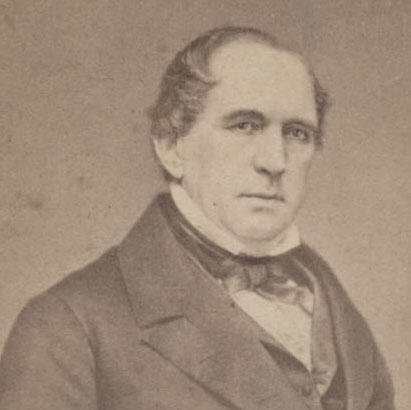
Erastus Corning (December 14, 1794 – April 9, 1872) was an American businessman, railroad executive, and Democratic politician from Albany, New York, who became a leading figure in the economic and political life of nineteenth-century New York. He was most notable for his service as mayor of Albany from 1834 to 1837, as a member of the New York State Senate from 1842 to 1845, and as a Representative from New York in the United States Congress, where he served three terms between 1857 and 1865, including two nonconsecutive terms from 1857 to 1859 and from 1861 to 1863. His congressional service coincided with the tumultuous years leading up to and during the American Civil War, during which he supported the Union while sharply criticizing what he regarded as the excesses of President Abraham Lincoln’s administration.
Corning was born in Norwich, Connecticut, the son of Bliss Corning and Lucinda (Smith) Corning. At the age of two he fell from his crib and injured a hip, a disability that left him unable to walk unaided for more than a few steps throughout his life. He relied on crutches in his youth, and later taught himself to walk with a cane so that he could depend less on them, though his physical limitation was rarely mentioned in the press. He attended local academies in Norwich and in Chatham, New York, receiving a practical education that prepared him for commercial life. At thirteen he moved to Troy, New York, to clerk in the hardware store of his uncle, Benjamin Smith, gaining early experience in the iron and hardware trade that would shape his later business career.
After six years in Troy, Corning moved to Albany, New York, where he joined the mercantile firm of James Spencer. Demonstrating considerable aptitude for business, he became a partner in the firm and, upon Spencer’s death in 1824, its senior partner. Combining the Spencer enterprise with holdings he inherited from his uncle, Corning organized Erastus Corning & Co., which became one of the leading iron and hardware houses in the region. The firm bought and sold a wide range of iron products, including tools, nails, stoves, farming implements, and eventually railroad track rails and railroad car parts. With a wharf and warehouse on the Hudson River in Albany, the company served not only local customers but hundreds of large buyers from western regions who came to Albany periodically to purchase supplies and examine new products. Corning expanded his interests into banking, insurance, land speculation, and land development, often in partnership with his relative by marriage, John V. L. Pruyn, whose wife, Harriet Corning Turner, was Corning’s niece.
Corning’s industrial ventures grew steadily. He purchased the Albany Rolling and Slitting Mill, renamed it the Albany Nail Factory, and used it to secure a dominant position in several lines of iron products sold through his store. The Albany Nail Factory later evolved into the Rensselaer Iron Works, which under Corning’s guidance installed the first Bessemer converter in the United States, marking a significant advance in American steel production. By the time he was forty, Corning had helped found the Albany City Bank and served as its president, a position he held until his death. He was appointed to the Board of Regents of the University of the State of New York, and he began extensive land speculation in western New York and farther west, including properties in what would become the town and city of Corning. In 1819 he married Harriet Weld (1794–1883); they were the parents of five children: Benjamin (1820–1821), John (1823–1833), Erastus Jr. (1827–1897), Joseph (1829–1830), and Edwin (1836–1871).
A Democrat, Corning entered public life in Albany municipal government. He served a term as an alderman beginning in 1828 and was elected mayor of Albany, serving from 1834 until 1837. At the same time, his business interests led him into the emerging railroad industry. As an iron dealer, he quickly recognized the potential of railroads as major consumers of iron and as vital arteries for trade. When the Utica and Schenectady Railroad was chartered in 1833, Corning became a major investor, president, and director. He was also a shareholder in and president of the Mohawk and Hudson Railroad, one of the earliest railroads in the state. In 1851 these lines were reorganized as the Mohawk Valley Railroad, with Corning continuing as president. His experience in state politics and railroad management convinced him that the patchwork of local and regional railroads in upstate New York was inefficient and could be made more profitable through consolidation.
Corning served in the New York State Senate from 1842 to 1845, sitting in the 65th, 66th, 67th, and 68th New York State Legislatures. During these years he advanced the idea of consolidating the state’s railroads into a single, integrated system. He was a delegate to the Democratic National Conventions of 1848 and 1852, reflecting his growing prominence in party affairs. In 1853 he successfully persuaded shareholders and executives of six operating railroads and two projected lines to agree to a consolidation plan. Acting as the principal lobbyist, he sought legislative approval for the merger and, though a Democrat, secured the cooperation of Thurlow Weed, the influential Whig leader who dominated New York’s state government. Their efforts resulted in passage of the Consolidation Act on April 2, 1853, creating the New York Central Railroad. As the largest shareholder, Corning became its first president and held that office for twelve years. Under his leadership the New York Central expanded and forged connections with other railways, securing access to a continuous route from New York City to Chicago and becoming one of the largest and most important corporations in the United States. Corning also invested heavily in western lands and in other transportation enterprises, including large holdings in the Chicago, Burlington and Quincy Railroad and the Michigan Central Railroad, and he served as president and largest shareholder of the St. Mary’s Falls Ship Canal Company, which constructed the canal and locks at Sault Ste. Marie, Michigan, linking Lake Superior and Lake Huron and receiving extensive federal land grants in return.
Corning’s prominence in business and state politics led to his election to the United States House of Representatives. In 1856 he was elected as a Democrat to the 35th Congress and served from March 4, 1857, to March 3, 1859. He was an unsuccessful candidate for reelection in 1858, but he returned to Congress after winning election in 1860. He served in the 37th Congress from March 4, 1861, until his resignation on October 5, 1863. His service in Congress thus spanned three terms between 1857 and 1865, a period of profound national crisis. As a Representative from New York, he participated in the legislative process during the secession crisis and the Civil War, representing the interests of his Albany-area constituents and of the broader Democratic Party. In 1860 he was a delegate to the Democratic National Convention, and in early 1861 he served as a delegate to the Peace Conference in Washington, D.C., an unsuccessful last effort to avert civil war.
Although a Democrat and a critic of Republican policies, once the Civil War began Corning supported the Union cause. He nonetheless opposed what he considered unconstitutional measures by the Lincoln administration, particularly the suspension of habeas corpus and the use of military arrests in place of civilian trials for those accused of desertion or resistance to conscription. In February 1863 he was the Democratic caucus nominee for United States Senator from New York, but the Republican-controlled state legislature elected Republican Edwin D. Morgan by a vote of 86 to 70, with one vote cast for John Adams Dix and one for Daniel S. Dickinson. In the spring of 1863 Corning organized a large public meeting in Albany to consider Lincoln’s conduct of the war. The meeting adopted resolutions affirming loyalty to the Union while criticizing several administration policies, including the arrest of antiwar Democrat Clement Vallandigham. Lincoln responded with a lengthy public letter defending his wartime powers and famously asking, “Must I shoot a simple-minded deserter, while I must not touch a hair of a wily agitator who induces him to desert?” Corning, whose health was declining and who remained at odds with Lincoln over the prosecution of the war, resigned his seat in Congress on October 5, 1863. Despite these disagreements, he fully supported the effort to maintain the Union, and his business associates John F. Winslow and John Augustus Griswold, with whom he was closely linked, manufactured ironclad components for the USS Monitor after contracting with designer John Ericsson in 1862.
In the mid-1860s Corning gradually reduced the scope of his business activities, though he continued as president of the Albany City Bank and its successor institution and remained active as vice chancellor of the Board of Regents of the University of the State of New York. He amassed a substantial fortune and maintained wide-ranging investments in railroads, banking, insurance, and western lands, including 100,000 acres of the 750,000 acres granted to the St. Mary’s Falls Ship Canal Company. After his death, his son Erastus Corning Jr. assumed management of the family’s business interests, though he did not handle them successfully. The next generation, notably his grandsons Edwin and Parker Corning, restored the family’s wealth and became influential Democratic leaders in Albany and Albany County. Edwin Corning served as lieutenant governor of New York from 1927 to 1928, and Parker Corning represented New York in the United States House of Representatives from 1923 to 1937. Corning’s great-grandsons, Erastus Corning 2nd and Edwin Jr., were also active in business and politics; Edwin Jr. served in the New York State Assembly from 1955 to 1959, and Erastus Corning 2nd was mayor of Albany for more than forty years, from 1941 to 1983, extending the family’s political legacy well into the twentieth century.
Erastus Corning died at his home in Albany on April 8, 1872, and was buried in Albany Rural Cemetery. His papers, documenting his extensive business, political, and personal activities, are preserved in the collections of the Albany Institute of History & Art.
Congressional Record