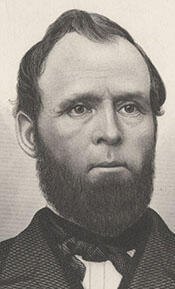
Ephraim Ralph Eckley (December 9, 1811 – March 27, 1908) was an American Civil War veteran, lawyer, state legislator, and three-term Republican U.S. Representative from Ohio, serving in Congress from 1863 to 1869. His congressional tenure spanned the critical years of the Civil War and early Reconstruction, during which he participated in the legislative process and represented the interests of his Ohio constituents in the House of Representatives.
Eckley was born near Mount Pleasant, Jefferson County, Ohio, on December 9, 1811. In 1816, when he was a small child, he moved with his parents to Hayesville, Ohio. He attended the common schools of the area and later pursued further education at the Vermillion Institute in Hayesville, from which he was graduated. This combination of local schooling and institute training provided the foundation for his later professional and political career.
In 1833, Eckley moved to Carrollton, Ohio, where he initially taught school. While in Carrollton he began the study of law under the guidance of William Johnston, a prominent Ohio lawyer. He was admitted to the bar in 1836 and commenced the practice of law in Carrollton. His legal career quickly intertwined with public service, and Carrollton remained his home base throughout his long life, both as an attorney and as a public official.
Eckley entered state politics as a member of the Ohio State Senate, in which he served from 1843 to 1846 and again in 1849 and 1850. He was an unsuccessful candidate for Lieutenant Governor of Ohio in 1851, reflecting his growing prominence within state political circles. He subsequently served in the Ohio House of Representatives from 1853 to 1855. During this period he also sought higher office at the federal level, running unsuccessfully in 1853 for election to the United States Senate. As the national political landscape realigned over the issue of slavery, Eckley became an early and active member of the emerging Republican Party. He served as a delegate to the first Republican National Convention held in Philadelphia in 1856, underscoring his role in the formative years of the party.
With the outbreak of the American Civil War, Eckley entered military service in the Union Army. He served as colonel of the 26th Ohio Infantry and later as colonel of the 80th Ohio Infantry. His Civil War service, combined with his established record in state government and his Republican affiliation, enhanced his stature as a public figure in wartime Ohio and helped position him for national office.
Eckley was elected as a Republican to the Thirty-eighth, Thirty-ninth, and Fortieth Congresses, serving in the U.S. House of Representatives from March 4, 1863, to March 3, 1869. As a Representative from Ohio during a significant period in American history, he contributed to the legislative process through three consecutive terms in office. His service in Congress coincided with the Union war effort, the abolition of slavery, and the initial phases of Reconstruction, and he participated in the democratic process at the national level on behalf of his district. He did not seek renomination in 1868 and thus concluded his congressional career at the end of his third term.
After leaving Congress, Eckley resumed the practice of law in Carrollton, Ohio, returning to the profession in which he had first made his name. He remained a respected figure in his community and within Ohio Republican circles. He married Martha L. Brown, and the couple had five children, including a son, Harvey J. Eckley. Harvey followed his father into public life, serving as an Ohio state senator and as a judge, thereby extending the family’s involvement in law and politics into a second generation.
Ephraim Ralph Eckley lived to an advanced age, witnessing the transformation of the United States from the antebellum era through the Civil War and into the twentieth century. He died in Carrollton, Ohio, on March 27, 1908. He was interred in Grand View Cemetery in Carrollton, closing a life that combined legal practice, military service, and a lengthy record of public office at both the state and national levels.
Congressional Record