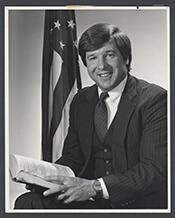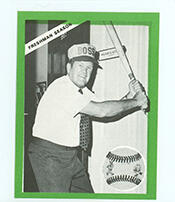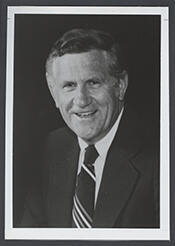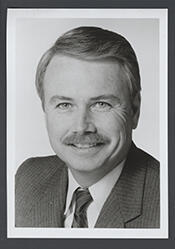
Elton William Gallegly (born March 7, 1944) is an American politician and former U.S. representative from California who served in the United States House of Representatives from January 3, 1987, to January 3, 2013. A member of the Republican Party, he represented California’s 21st, 23rd, and, following redistricting, 24th congressional districts over the course of 13 consecutive terms. His tenure made him the longest-serving congressional representative in Ventura County history, and he did not seek re-election in 2012.
Gallegly was born in Huntington Park, Los Angeles County, California, on March 7, 1944. He is of partial Swiss descent. He attended California State University, Los Angeles, but did not complete a degree. Before entering public office, he worked in the private sector as a real estate broker, experience that would later inform his understanding of land use, development, and economic issues affecting his region.
Gallegly’s political career began at the local level in Simi Valley, California. He was elected to the Simi Valley City Council and subsequently became a prominent figure in the city’s governance. In 1982, he became Simi Valley’s first elected mayor, a position that helped establish his reputation as a Republican leader in Ventura County and provided a platform for his eventual bid for Congress.
Gallegly entered national politics in 1986 when incumbent Republican Representative Bobbi Fiedler retired from the House to run for the U.S. Senate. That year, Gallegly ran for the open House seat and won the Republican primary with 50 percent of the vote, defeating Tony Hope, the son of entertainer Bob Hope. In the general election, he prevailed with 68 percent of the vote. He was re-elected in 1988 with 69 percent and in 1990 with 58 percent. In 1992, after redistricting, he defeated Democrat Anita Perez Ferguson by a margin of 54 percent to 41 percent. In subsequent elections he consistently secured re-election with at least 58 percent of the vote, with the exception of 2000, when he defeated Democrat Michael Case by a 54 percent to 41 percent margin. He continued to win comfortably in later cycles, including 2006, 2008, and 2010.
During his 13 terms in Congress, Gallegly served during a period of significant political and historical change and participated actively in the legislative process, representing the interests of his constituents in Ventura County and surrounding areas. He served on the House Committee on Foreign Affairs, where he rose to the position of vice chair, and sat on the Subcommittee on Europe and Eurasia and the Subcommittee on the Western Hemisphere. He was also a long-serving member of the House Committee on the Judiciary. Within Judiciary, he served on the Subcommittee on Courts, Commercial and Administrative Law and chaired the Subcommittee on Immigration Policy and Enforcement, giving him a central role in debates over immigration, judicial policy, and administrative law. In 2011, he voted in favor of the National Defense Authorization Act for Fiscal Year 2012.
Gallegly developed a particular legislative focus on animal welfare and education policy. His activism on animal rights led him to author a bill, enacted in 1999, that made it a federal crime to sell videos depicting dogfights and other forms of animal cruelty for profit. The law was intended to curb the commercial exploitation of animal violence. On April 20, 2010, however, the Supreme Court of the United States, in an 8–1 decision written by Chief Justice John Roberts, struck down the statute on First Amendment grounds, characterizing it as a “criminal prohibition of alarming breadth.” Gallegly defended his legislation, noting that it contained exceptions for religious, political, scientific, educational, journalistic, and artistic expression, and argued that the videos at issue promoted violence and therefore should not be protected by the Constitution. He also supported gifted and talented education, introducing the Gifted and Talented Students Act of 1998 to provide federal funding and support for programs serving high-achieving students.
Gallegly’s electoral career included several notable episodes. On March 10, 2006, he announced his intention to retire from the House at the end of that term, citing health concerns, even though he had already filed nomination papers for re-election. He attempted to have his name removed from the Republican primary ballot, but California election law permits withdrawal only in the case of a candidate’s death. When it became clear that his name would remain on the ballot and that no new challengers could enter the race, Gallegly reversed his decision and chose to seek what he described as a final term. He won re-election that year with 62 percent of the vote. He was re-elected again in 2008 with 58 percent and in 2010 with 60 percent. For the 2009–2010 campaign cycle, his top sources of campaign contributions included retirees ($39,484), the real estate industry ($35,578), lawyers and law firms ($29,374), pharmaceutical interests ($22,500), and crop production and processing interests ($20,179). In January 2012, it was reported that Gallegly had received so-called “VIP” or “Friends of Angelo” mortgage loans from Countrywide Financial at rates more favorable than those available to the general public. His name, along with those of other legislators, was referred to the House Committee on Oversight and Government Reform for investigation. Gallegly denied knowing that he was part of any special loan program.
After deciding not to seek re-election in 2012, Gallegly left Congress at the conclusion of his 13th term in January 2013. His long service was recognized in various ways in his home region and beyond. A gallery at the Ronald Reagan Presidential Library in Simi Valley has been named in his honor. In addition, the Elton and Janice Gallegly Center for Public Service and Civic Engagement was established at California Lutheran University as a non-partisan center bearing his and his wife’s names. The center was intended to house his congressional papers and mementos and to promote civic education and public service. In subsequent years, however, Gallegly sued the university for breach of contract, alleging that it had not fulfilled agreed-upon obligations regarding the archival treatment of his materials and the display of his donated office furnishings. The legal dispute continued over several years, centered on the interpretation of those contractual requirements. In September 2025, Gallegly and the university announced that they had reached a legal settlement, bringing the lawsuit to a close; the terms of the settlement were not publicly disclosed.
In his personal life, Gallegly is married to the former Janice Shrader, and the couple has four children. Throughout and after his congressional career, he remained closely associated with Ventura County and the broader Southern California region he represented, and his long tenure in the House made him a significant figure in the contemporary political history of that area.
Congressional Record