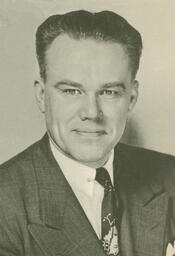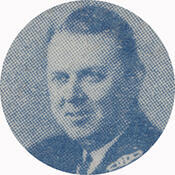
Elmer Hartpence Wene (May 1, 1892 – January 25, 1957) was an American Democratic Party politician who represented New Jersey’s 2nd congressional district in the United States House of Representatives from 1937 to 1939 and again from 1941 to 1945. He served three terms in Congress and twice ran unsuccessfully for the governorship of New Jersey, participating in state and national politics during a period of significant economic and political change in the United States.
Wene was born on a farm near Pittstown, Hunterdon County, New Jersey, on May 1, 1892, the son of Emanuel S. Wene and Mary J. Kiley. He was raised in a rural environment that would shape his lifelong interest in agriculture. He attended the public schools and later enrolled at Rutgers University in New Brunswick, New Jersey. Pursuing specialized training in agriculture, he studied at the New Jersey State Agricultural College, from which he graduated on March 4, 1914, with a degree in poultry husbandry. This formal education in agricultural science provided the foundation for his early professional pursuits and his later policy interests.
After completing his education, Wene engaged in agricultural pursuits, particularly poultry raising, near Vineland, New Jersey, beginning in 1918. He became a successful farmer and agricultural businessman, gaining prominence in New Jersey’s agricultural community. His expertise and reputation in this field led to his appointment to the New Jersey State Board of Agriculture, on which he served from 1925 to 1934. Through this role, he helped shape state agricultural policy during a period when farming interests were central to New Jersey’s economy, and he developed experience in public administration that would carry over into his political career.
Wene entered national politics as a Democrat and was elected to the Seventy-fifth Congress, serving from January 3, 1937, to January 3, 1939, as the representative of New Jersey’s 2nd congressional district. His first term in the House of Representatives coincided with the later years of the New Deal, and he contributed to the legislative process as the federal government responded to the lingering effects of the Great Depression. He was an unsuccessful candidate for reelection in 1938 to the Seventy-sixth Congress. Following this defeat, he continued his public service at the local level as a member of the Board of Chosen Freeholders of Cumberland County, New Jersey, from 1939 to 1941, where he participated in county governance and administration.
Wene returned to Congress when he was again elected as a Democrat to the Seventy-seventh and Seventy-eighth Congresses, serving from January 3, 1941, to January 3, 1945. During this second period of congressional service, which spanned the United States’ entry into and participation in World War II, he represented the interests of his South Jersey constituents while engaging with national issues of wartime mobilization, economic regulation, and postwar planning. He was not a candidate for renomination in 1944, instead seeking higher office. That same year, he ran unsuccessfully for election to the United States Senate, marking his first major statewide campaign beyond his House service.
After leaving Congress, Wene resumed his agricultural pursuits and poultry-raising operations, maintaining his longstanding ties to New Jersey’s farming community. He also expanded his business interests into communications, becoming president and owner of two radio stations in New Jersey, which reflected his engagement with emerging media and public outreach. In 1945, he returned to the federal sphere as an adviser to the Secretary of Agriculture, drawing on his combined experience as a farmer, agricultural policymaker, and legislator to influence national agricultural policy at the close of World War II.
Wene continued to play a prominent role in New Jersey politics in the postwar years. He was elected to the New Jersey Senate in 1946, further extending his legislative career at the state level. In 1947, he served as a delegate to the New Jersey State Constitutional Convention, which drafted the current New Jersey State Constitution, thereby contributing to the modern framework of state government. On June 26, 1948, President Harry S. Truman gave him a recess appointment as Undersecretary of Agriculture, placing him in a senior leadership position within the Department of Agriculture and underscoring his national stature in agricultural affairs. He sought to translate this prominence into executive office in New Jersey, but he was an unsuccessful Democratic candidate for Governor of New Jersey in 1949 and again failed in a bid for the gubernatorial nomination in 1953. In 1950, he also ran unsuccessfully for election to the Eighty-second Congress, attempting to return to the U.S. House of Representatives.
Elmer H. Wene never married and had no children. He remained active in public life and agricultural and business pursuits until his final illness. He died of cancer at the University of Pennsylvania Hospital in Philadelphia, Pennsylvania, on January 25, 1957. He was buried in Locust Grove Cemetery in Quakertown, New Jersey, closing a career that spanned local, state, and national service and reflected a consistent commitment to agriculture, public administration, and Democratic Party politics in New Jersey.
Congressional Record