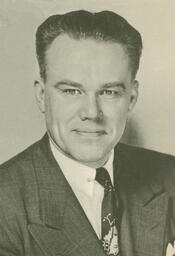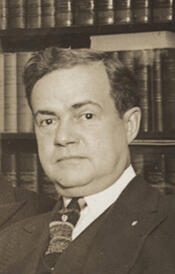
Elmer Hendrickson Geran (October 24, 1875 – January 12, 1954) was an American Democratic Party politician, attorney, and businessman who represented New Jersey’s 3rd congressional district in the United States House of Representatives from 1923 to 1925. Over the course of a varied public career, he served at multiple levels of government in New Jersey, including as a member of the New Jersey General Assembly, sheriff of Monmouth County, and United States Attorney for the District of New Jersey, and he played a notable role in early twentieth-century election reform in the state.
Geran was born in Matawan, New Jersey, on October 24, 1875. He attended the public schools of Matawan and the Glenwood Military Academy in his hometown. He continued his education at the Peddie Institute in Hightstown, New Jersey, from which he graduated in 1895. He then enrolled at Princeton University, receiving his degree in 1899, and pursued legal studies at New York Law School, graduating in 1901. That same year he was admitted to the New Jersey bar and commenced the practice of law in Jersey City, New Jersey, beginning a legal career that would intersect closely with his later political and business activities.
Alongside his early legal practice, Geran became involved in a series of business ventures in the first decade of the twentieth century. In January 1902 he was one of five principals in the incorporation of The Western Telephone and Telegraph Company, a holding company that became part of the American Telephone and Telegraph (AT&T) system from 1902 to 1911; AT&T ultimately absorbed Western Telephone and Telegraph in 1911 through a stock purchase of three shares of AT&T for four shares of Western stock plus $20. Also in January 1902 he was one of five principals in the incorporation of the Accidental Company, a telephone company organized under the laws of 1896 to conduct business outside the state of New Jersey. In 1905 he was one of twelve principals in establishing the Vandalia Coal Company, which owned and operated mines in the Midwest. He joined with three others in 1909 to incorporate Lind & Company, a real estate concern specializing in purchasing land and building mines. In 1910 he started the Bankers Organization and Asset Realization Company, a general real estate and investment business. During this period he also served as director of the Hudson County Water Company, which appropriated water in New Jersey and sold it on Staten Island; he resigned from this position in 1911, stating that continued service might be viewed as a conflict of interest in light of his political ambitions.
Geran’s public career developed in parallel with his legal and business activities. He served for a number of years as borough attorney for Matawan, New Jersey, and gained recognition for his speeches on banking, including a notable presentation on May 11, 1911, at the Annual Convention of the New Jersey Banking Association in Atlantic City. In 1911 he initially sought a seat in the New Jersey State Senate but withdrew from that race in August and instead ran successfully for the New Jersey General Assembly. He served in the Assembly in 1911 and 1912 and was appointed a member of the New Jersey State Water Supply Commission, serving from 1912 to 1915. Geran is credited with working under Governor Woodrow Wilson in 1911 to draft a series of election reform laws that transformed the conduct of elections in New Jersey. Viewed chiefly as anti-corruption measures, these reforms were a cornerstone of Wilson’s state program; among their provisions was the requirement that county clerks mail sample ballots to voters before an election.
Geran continued to hold a succession of public offices in Monmouth County and at the state level. From 1915 to 1917 he served as assistant prosecutor of the pleas of Monmouth County. He returned to the New Jersey General Assembly in 1916 and 1917, during which time he served as minority leader. He was elected sheriff of Monmouth County, serving from 1917 to 1920. An unusual episode during his tenure as sheriff occurred in 1920, when he was ordered by a New Jersey court to sell the effects of a bar to satisfy creditor demands. Because most of the bar’s assets consisted of intoxicating liquors and the sale took place during Prohibition, Geran obtained federal permission to conduct the sale legally. He was widely considered a prospective candidate for Governor of New Jersey in 1918 but ultimately chose not to enter the race.
In 1920 President Woodrow Wilson appointed Geran United States Attorney for the District of New Jersey. In that capacity he was associated with enforcement of federal law restricting dissemination of motion pictures of prizefights, including legal issues surrounding the filming and distribution of the Dempsey–Carpentier fight held in Jersey City in July 1921. On December 16, 1921, Attorney General Harry M. Daugherty requested Geran’s resignation, stating that he desired a Republican to hold the office. Geran resigned later in 1921 and resumed the practice of law in Asbury Park, New Jersey.
Geran was elected as a Democrat to the Sixty-eighth Congress, representing New Jersey’s 3rd congressional district from March 4, 1923, to March 3, 1925. His single term in the House of Representatives occurred during a significant period in American history marked by post–World War I adjustment and the early years of Prohibition. As a member of the House, he participated in the legislative process and represented the interests of his constituents in central New Jersey. During this period he also served as a delegate to the 1924 Democratic National Convention. He was an unsuccessful candidate for reelection in 1924 to the Sixty-ninth Congress, after which his formal congressional service concluded.
After leaving Congress, Geran resumed the practice of law until September 22, 1927, when he entered the sand and gravel industry as vice president of the New Jersey Gravel & Sand Company at Farmington. In 1931 he served on the board of directors of the Matawan Bank when it closed its doors after exhausting its cash funds. The following year he was president of the City Mortgage Company, which he placed into receivership after uncovering what he described as “unscrupulous trading of company stock” by the board of directors. He was also president of the Central Jersey Sand and Gravel Company of Asbury Park when that company went into receivership and became insolvent in 1932. In 1932 he continued his involvement in financial and real estate matters, and in 1933 he formed the New Jersey Sand and Gravel Producers Association, an industry group that advocated the use of New Jersey materials in state highway construction. By the time of the 1940 federal census, he was recorded as manager of a sand and gravel plant and residing on Hodgner Road in Marlboro, New Jersey.
Elmer Hendrickson Geran died at his home, Glen Geran Farm, in the Morganville section of Marlboro Township, New Jersey, on January 12, 1954. He was interred in Old Tennent Cemetery in Manalapan Township, New Jersey. Throughout his career he combined legal practice, public office, and business enterprise, and he left a particular imprint on New Jersey’s election laws and on the political life of Monmouth County and the state at large.
Congressional Record