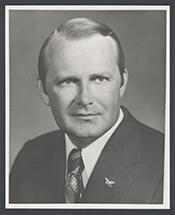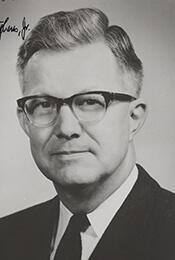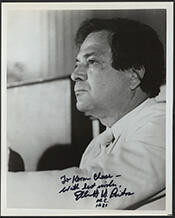
Elliott Harris Levitas (December 26, 1930 – December 16, 2022) was an American politician and lawyer from Georgia. A member of the Democratic Party, he served as a member of the United States House of Representatives for five consecutive terms from 1975 to 1985, representing Georgia’s 4th congressional district. He was the first Jewish congressman elected in Georgia and contributed to the legislative process during a significant period in American history, participating in the democratic process and representing the interests of his constituents.
Levitas was born in Atlanta, Georgia, and graduated in 1948 from Henry W. Grady High School in that city. He attended Emory University in Atlanta, where he became a member of the secret honor society D.V.S. He pursued legal studies at the Emory University School of Law, earning his Juris Doctor in 1956. Even before completing his law degree, he undertook additional study in law at the University of Michigan from 1954 to 1955, reflecting an early commitment to advanced legal training. He was admitted to the Georgia bar in 1955 and commenced the practice of law in Atlanta.
A Rhodes Scholar, Levitas continued his legal education in England, receiving a Master of Laws degree from the University of Oxford in 1958. His academic achievements and early professional work coincided with service in the United States Air Force, in which he served from 1955 to 1958. Alongside his legal and military careers, he was active in the local Jewish community in Atlanta and participated in the work of the Anti-Defamation League, reinforcing his emerging public profile as both a civic and community leader.
Levitas’s formal political career began within the Democratic Party in the 1960s. He served as a delegate to the 1964 Democratic National Convention in Atlantic City, New Jersey, which nominated the Lyndon B. Johnson/Hubert Humphrey ticket, the first Democratic slate to lose the electoral votes of Georgia since the Reconstruction era. In the same period, he won election to the Georgia House of Representatives in 1964 and served there from 1965 to 1974, completing five terms in the state legislature. Early in his first term, he gained notoriety for voting in support of civil rights activist Julian Bond in a contested effort to seat Bond following his election; Levitas was one of only five white legislators to vote in favor of seating him. During his second term, he was one of thirty Democrats who voted for Republican Bo Callaway rather than the Democratic nominee, Lester Maddox, a segregationist from Atlanta, in the disputed 1966 gubernatorial race. Although the legislature ultimately chose Maddox to resolve the deadlock, Levitas’s vote underscored his willingness to break with party lines on matters of principle.
In 1974, Levitas was elected as a Democrat to represent Georgia’s 4th congressional district in the 94th United States Congress and was reelected to the four succeeding Congresses, serving from January 3, 1975, to January 3, 1985. The district he represented was dominated by DeKalb County, northeast of Atlanta, and had been held for four terms by Republican Benjamin B. Blackburn prior to his election. Coming into office as part of the post-Watergate class of 1974, Levitas quickly established himself as a champion of environmental causes, eventually rising to chair the committee with oversight of environmental matters. During his ten years in the House of Representatives, he was a prominent Democratic voice from Georgia and the first Jewish congressman in the state’s history, reflecting both the demographic changes in metropolitan Atlanta and the broader political realignments of the era. He was an unsuccessful candidate for reelection to the 99th United States Congress in 1984, losing to Republican Pat Swindall amid President Ronald Reagan’s landslide victory, in which Reagan carried the district.
After leaving Congress, Levitas resumed the practice of law and became a partner with the Atlanta-based firm Kilpatrick Townsend & Stockton. In private practice, he was involved in complex litigation and public-interest matters. His most notable case, Cobell v. Norton, involved a landmark class-action lawsuit brought on behalf of Native American plaintiffs, including members of the Blackfeet tribe, against the United States government over mismanagement of trust lands and funds, including land that had been taken and used for various industrial purposes. The litigation resulted in a successful $3.4 billion settlement, which at the time was the largest class-action award ever obtained against the U.S. government, and it solidified Levitas’s reputation as an accomplished attorney in high-stakes public law cases.
Levitas remained connected to his alma mater and to civic life in Georgia in his later years. Emory University established an annual award in his honor, presented to the outstanding graduating senior majoring in political science, recognizing both academic excellence and a commitment to public service in the spirit of his career. He continued to be remembered in Georgia political and legal circles for his independent stands in the state legislature, his decade of service in Congress, and his advocacy in major litigation after leaving elective office.
Elliott Harris Levitas died on December 16, 2022, in Georgia, at the age of 91, ten days before his 92nd birthday. He was buried at Arlington Memorial Park near Atlanta. His life and career, spanning military service, state and national legislative office, and significant legal advocacy, left a lasting imprint on Georgia’s political history and on the broader record of Jewish participation in the United States Congress.
Congressional Record