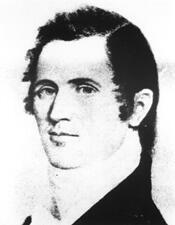
Elias Kent Kane (June 7, 1794 – December 12, 1835) was the first Illinois secretary of state and a United States senator from Illinois. He was born in New York City to merchant Capt. Elias Kent Kane and Deborah VanSchelluyne of Dutchess County, New York. Raised in the early national period, he attended public schools before enrolling at Yale College. He graduated from Yale in 1813, receiving a classical education that prepared him for a career in law and public affairs.
After completing his studies, Kane read law and was admitted to the bar. He commenced legal practice in Nashville, Tennessee, where he began to establish himself as a young attorney on the western frontier. In 1814 he moved to Kaskaskia, in the Illinois Territory, then the territorial capital and a center of political and legal activity. There he became allied with Jesse B. Thomas, a slaveholder who had secured appointment as a judge of the Territory of Illinois, and he entered into the political life of the territory as it moved toward statehood.
Kane emerged as a significant figure in the movement to frame a state constitution for Illinois. In 1818 he served as a delegate to the first Illinois state constitutional convention, where he aligned with the Thomas faction in an effort to include language permitting slavery in the new state, despite the prohibition on slavery in the Northwest Ordinance of 1787. This proslavery initiative was defeated by a coalition whose leaders included Baptist minister John Mason Peck, Methodist preacher Peter Cartwright, Quaker James Lemen, publisher Hooper Warren, and future governor Edward Coles. By 1820 Kane himself claimed ownership of five people as slaves, reflecting his continued identification with the proslavery interest in Illinois politics.
In 1820 Kane ran unsuccessfully for election to the Seventeenth Congress, a contest in which the issue of slavery figured prominently and was debated in numerous letters published in the Edwardsville Spectator. The election was won by anti-slavery candidate Daniel Pope Cook. Later that year, however, Kane was appointed the first secretary of state of Illinois, a position he held from 1820 to 1824. During this period he became one of the leading proslavery voices in the state. In 1824 he led proslavery forces in the Illinois House of Representatives in an effort to call another constitutional convention that might overturn the state’s free-soil provisions. This attempt was again defeated by a coalition led by Governor Edward Coles, Representative Cook, and religious leaders from various denominations who opposed the expansion of slavery.
Kane’s prominence in Illinois politics led to his selection for national office. A member of the Jackson Party, associated with the emerging Jacksonian Democratic movement, he was twice chosen by the Illinois legislature to serve in the United States Senate. He entered the Senate on March 4, 1825, and served continuously until his death in 1835, completing two terms in office. His decade of service in Congress coincided with a significant period in American history marked by the rise of Jacksonian democracy, intense debates over federal power, internal improvements, and the expansion of slavery. As a senator from Illinois, Elias Kent Kane participated in the legislative process, represented the interests of his constituents, and took part in the broader democratic deliberations of the era.
Kane died in office in Washington, D.C., on December 12, 1835, while still serving in the United States Senate. His body was returned to the family farm in Randolph County, Illinois, for burial. Over time, continued desecration of the family gravesite led to a campaign, spearheaded by local funeral director Michael McClure, to move the remains. In 1984 Kane was reinterred in Evergreen Cemetery in nearby Chester, Illinois, in a grave adjacent to that of his sometime political opponent and Illinois’ first governor, Shadrach Bond. On January 16, 1836, shortly after his death, the Illinois legislature created a new county named Kane County in his honor, commemorating his role in the early political history of the state.
Kane’s family remained prominent in Illinois and national affairs. The Kane family gravesite includes the remains of his wife, Frances Pelletier (1799–1851), two children who died young, and four sons. One son, Elias Kent Kane Jr. (1822–1853), served in the United States Army. One of his daughters married Illinois governor William H. Bissell, who became known as a vocal opponent of slavery, a stance that contrasted with Kane’s own proslavery record. Kane’s father, also named Elias Kent Kane, survived his son by five years and is buried in Congressional Cemetery in Washington, D.C.; he played a role in securing his namesake grandson’s admission to the United States Military Academy at West Point.
Congressional Record