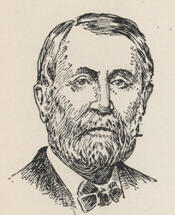
Elias Deemer (January 3, 1838 – March 29, 1918) was a Republican member of the United States House of Representatives from Pennsylvania who served three consecutive terms in Congress from 1901 to 1907. Over the course of his public career he combined business leadership in the lumber and banking industries with active participation in municipal government and national politics.
Deemer was born on January 3, 1838, near Durham, Bucks County, Pennsylvania. Details of his formal education are not extensively recorded, but as a young man he entered commercial life and, by 1860, was engaged in the mercantile business in Lycoming County, Pennsylvania, and in Philadelphia. This early experience in trade and commerce laid the foundation for his later prominence in business and civic affairs.
With the outbreak of the American Civil War, Deemer enlisted in the Union Army in July 1861 as a private in Company E of the 104th Regiment, Pennsylvania Volunteers. He served until the middle of May 1862, when he was discharged because of disabilities. Following his military service, he moved in 1862 to Milford, New Jersey, where he continued in business pursuits. In 1868 he returned to Pennsylvania, settling in Williamsport, Lycoming County, where he entered the lumber industry, a major economic force in the region at the time.
Deemer’s business interests in Williamsport expanded significantly in the late nineteenth century. He became a leading figure in the local lumber trade and was also involved in the publication of several newspapers in Williamsport, reflecting both his commercial acumen and his interest in public affairs. From 1888 to 1890 he served as president of the Williamsport common council, playing a prominent role in municipal governance. In 1893 he became president of the Williamsport National Bank, a position he held until his death in 1918, underscoring his long-standing influence in the city’s financial and commercial life. His growing stature in Republican politics was marked by his service as a delegate to the Republican National Convention in 1896.
Building on his local and party leadership, Deemer was elected as a Republican to the Fifty-seventh, Fifty-eighth, and Fifty-ninth Congresses, serving in the U.S. House of Representatives from March 4, 1901, to March 3, 1907. As a member of the House of Representatives during a significant period in American history at the turn of the twentieth century, he participated in the legislative process and represented the interests of his Pennsylvania constituents. His three terms in office coincided with the early Progressive Era, a time of growing national attention to economic regulation, industrial development, and political reform, and he contributed to the work of Congress within this broader context.
Deemer was an unsuccessful candidate for reelection in 1906 to the Sixtieth Congress and again failed to secure election in 1908. After leaving Congress, he resumed his lumber operations in Pennsylvania and expanded his activities to the South. He founded an unincorporated town in Neshoba County, Mississippi, which was named Deemer in his honor; this community, located just south of Philadelphia, Mississippi, reflected the geographic reach of his business enterprises beyond his home state.
Elias Deemer remained active in business and banking until his death. He died at his home in Williamsport, Pennsylvania, on March 29, 1918, while still serving as president of the Williamsport National Bank. He was interred in Wildwood Cemetery in Williamsport, closing a life that combined military service, entrepreneurial success, local civic leadership, and three terms of service in the United States Congress.
Congressional Record